

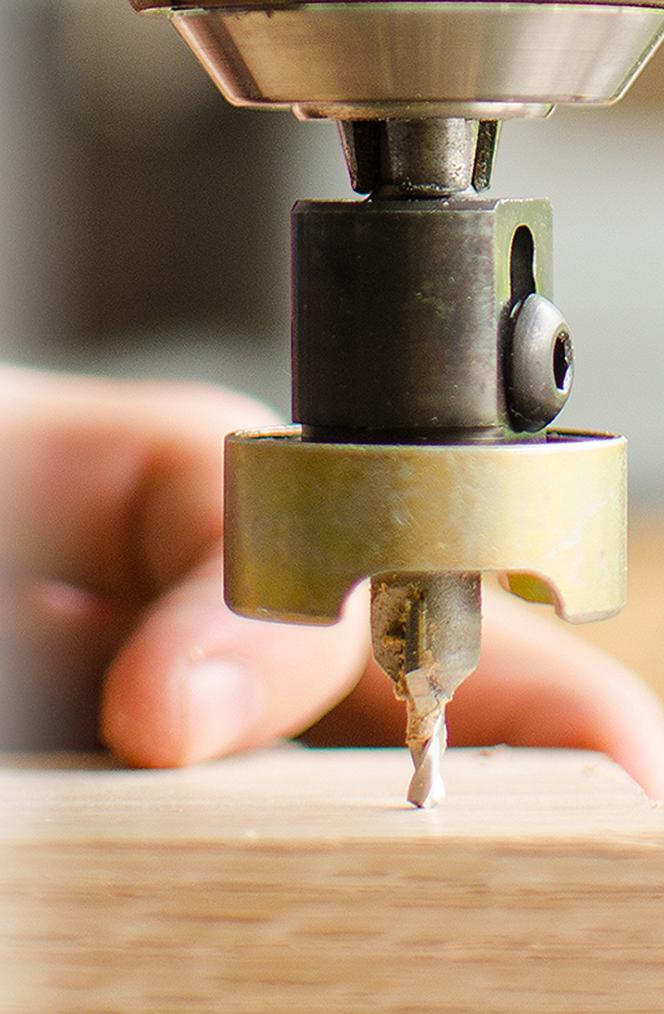
What is the most important part of the router bit?
The shank (shaft) of the router bit is most important. If the shank is not perfectly concentric, there will be excessive vibration, run-out, and imbalance, which can cause poor quality cutting. This is particularly important for large-diameter router bits, which can be dangerous if they are not properly manufactured. Equally important is the accuracy and condition of the router collet.
What is the proper way to install a router bit into the collet?
Insert the router bit in all the way until it bottoms out, then back off 1/16 inches. This will allow room for shank expansion and keep the router bit from freezing in the collet.
I’m getting a vibration when I’m routing. What could be causing it?
There are a few reasons. Check that the router shaft and collet are clean and in good condition. Also check the RPM’s. You may be running it faster than the maximum.
When should I use a single flute, two-flute and three-flute bit?
Single flute bits are primarily used for cutting to size when speed is more important than finish. Two- and three-flute bits are used when finish is more important than speed. The more flutes, the slower the feed rate.
Why would I use a compression bit over a straight bit when cutting double-sided melamine?
Compression bits are designed to compress the material to avoid chipping or tearing the material. The result is a much cleaner cut without chipping or tearing the melamine.
What are the benefits of using ‘insert’ tooling?
Although the initial cost is higher, there are several real advantages to insert tooling, or tooling that uses replaceable knives. The primary benefit is that no re-sharpening is necessary. Most insert tools have at least two cutting edges per knife, while some have four. When the knife becomes dull, you simply loosen the knife (or knives), rotate them, and re-tighten. This can often be done without removing the cutter from the machine or router, which saves valuable set-up time. Of course, it is important to unplug the machine before changing knives. Another key feature of insert tools is that there is no diameter loss as with re-sharpened tools. This is particularly beneficial if tight tolerances must be adhered to, or if the piece being cut must exactly match the previous piece.
What is the maximum RPM for horizontal raised panel and other large diameter router bits?
Generally, all large diameter router bits (approx. 2 inches and larger) should be run at a reduced RPM, usually about 14,000 max and 12,000 is ideal. This gives you more control over the cut and the feed rate. Also, bits of this type are normally used in a table-mounted router with a minimum of 2-1/2 horsepower. Adjustments to the RPM, feed-rate, and amount of material being removed must be made based upon the type of material, the horsepower, moisture content, and the like. With large diameter cutters, it is best to first remove as much material as possible (by means of chamfering or using a smaller radius, etc.). Save the large cutter for the final few light passes only. This method is not only safer but will give a better quality finish and longer tool-life. For more information, check with your router owner’s manual and specific instructions for the particular tools that you intend to use.
Source: Amana Tool. For information, call 800-445-0077, email [email protected], or visit AmanaTool.com.

Have something to say? Share your thoughts with us in the comments below.