

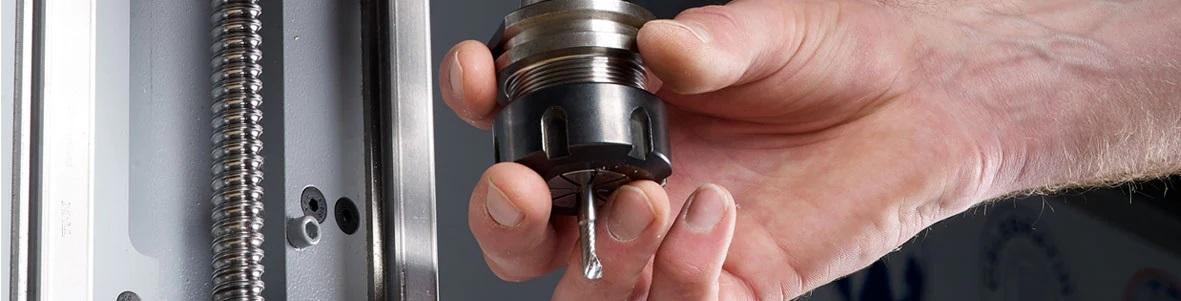
Collet maintenance is one of the most common causes of inadequate tool life or breakage. There are up to six links in the chain that comprise this critical tool-holding system, known as a collet. As a chain is only as strong as its weakest link, a router bit can only be as good as the system that holds it properly. The small amount of time spent regularly inspecting and cleaning the collet system will be more than offset by increased productivity and a reduction in overall costs.
The six critical components are as follows:
1. Internal collet clamping surfaces
The most important link in the tool holder chain is the inside of the collet. Resin migrates up through the slits in the collet and then deposits itself on the inside of the collet. This resin buildup, if not removed, causes the collet to grip inconsistently on the tool shank. By not applying equal pressure throughout the entire gripping range of the collet, the tool holder allows the tool to resonate inside, causing slippage inside the collet.
Slippage can cause “fretting,” a condition in which resins are deposited on the shank of the tool. Any resin buildup should always be removed from the inside of the collet.
2. Internal spindle & collet taper
The inside taper of the spindle and tool holder is a critical surface that accumulates resin buildup and should be cleaned at each tool change to maintain best concentricity. Felt brushes are available to fit most taper sizes and provide a quick means of removing short-term buildup.
3. External collet & tool holder taper
The outside taper of the collet and tool holder requires regular inspection and should be cleaned of all deposits each time the tool is changed. Brass brushes work well for this application, but felt cloths can also be used if the tapers are regularly maintained and the buildup is minor.
4. Clamping nut surfaces
The inside of the nut should be clean and free of burrs on the surface. Any surface burrs or contamination will not only skew a collet but can also permanently ruin a new collet. The clamping nut should be cleaned with a brass brush during every tool change. Special care should be taken to examine the clamping nut threads on a regular basis.
5. Thrust bearings
Some collet nuts have an integrated thrust bearing connected to the inside taper. This bearing serves to reduce friction wear between the collet and nut as the nut is tightened. The bearing’s seating surface is the most critical feature and must be kept clean. The bearings should also be kept in a smooth operating condition. If there is rough movement, it is a good indication of contamination or abuse. Either instance is indicative of runout and poor operation.
6. Tool holders
Tool holders such as the ISO 30 have additional matching and mating tolerances beyond those of the older tapers. Because of their unique design, these tool-holding systems can be more prone to runout caused by resin buildup. “Fretting” or “Bronzing” will cause inconsistent gripping in the taper and/or the flat mating surface and reduce the consistency of tool life. If ignored, these conditions can eventually produce premature spindle failure. The mating surfaces should be cleaned regularly.
All six of these components are critical and should be regularly maintained. One more item not to be overlooked is that collets should be replaced on a regular basis, approximately every 400 to 600 run time hours. This means inspection for metallic damage such as bell mouthing or burrs with every tool change. If damage is visible, the collet should be discarded and replaced.
Also consider that even if there is no damage present the collet can be worn out through metal fatigue. Heat is directly transferred from the tool to the collet. These heating / cooling cycles remove the original tempering of the steel. Collets are made from spring steel allowing them to have a certain amount of elasticity to grip the tool. As the heat cycle is repeated this elasticity diminishes. Over time, a collet requires increased tightening to maintain the tool in proper position. As over-tightening increases, the collet is distorted, creating eccentricities in the tool holder. Therefore, instead of over tightening older collets and creating several other problems, the collet should be replaced. Often, the cost of a new collet can be offset by the cost of needlessly broken tools in one shift alone.
Source: Excerpted from Tool and Collet Maintenance, originally published on CNC Shop's website. For more information, phone 844-262-7467 or visit CNCShop.com. CNC Shop is part of the AAG family.


Have something to say? Share your thoughts with us in the comments below.