

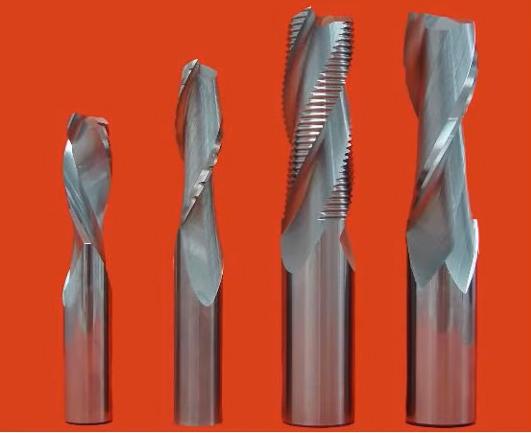
Cutting tool performance can be optimized by choosing the best tool for the application. For CNC machining, the best options are either solid carbide bits or PCD bits.
PCD tooling achieves the best return on investment when it is dedicated to cutting homogenous material. This means using dedicated tools per material.
The only time a carbide tip tool is an economical solution for use on the CNC is for cutting small profile prototypes, otherwise known as one-off projects.
Homework required
Depending on product and volume, the selection of the most suitable cutting tool requires a bit of homework if best performance and finish relative to investment is desired.
The most common and cost-effective router bit options are based on application. For straight cuts, such as sizing, joining, rebating, grooving, and dados, the options available are solid carbide, carbide insert, or PCD. For profile routing applications, options are either carbide insert or PCD.
For prototype, or one-off needs, a corrugated head provides a cost effective solution.
In addition to the many standard tool designs, it is often necessary to customize a tool for a particular requirement to provide a more economical option over time.
Many tool styles can produce the same cut, so researching cost, time, and yield can impact on tooling budget.
Geometry variety
Solid carbide router bits come in a variety of tool geometries, number of flutes, and edge grind. Styles range from O flutes, compression, up or down cut, chip breakers, roughers, and more.
The flute shape is ground into what looks like a half circle. This particular geometry is used for cutting flexible plastics. The flute is straight and helps keep lightweight flexible plastic from moving up or lifting on the router table during machining.
This tool is most useful on materials such as polycarbonate, ABS, polystyrene, PVC, and other flexible plastics.
The O-flute upcut bit has the same O-flute geometry needed for the efficient chip removal when routing plastic. It also has an upward shearing angle to bring the chips out of the cut and achieve a clean edge finish.
This tool is the preferred router bit for hard and rigid plastic materials such as acrylics, nylons, and Plexiglas.
Blowing out the chips
The up cut spiral bit is used when getting the chips out of the cut is critically important. These bits are also used when the material is laminated or coated on only one side while being machined face down.
The tool geometry does present a risk that the top of the material can chip or fray. This tool is a good choice for mortise and tenon cutting needs and also provides an excellent option for short runs on Corian and Phenolic material.
Up cuts feed faster than down cut bits because the chips are pulled out of the cut by the upward shearing action and keep the tool running cooler.
Ball nose tool
A ball nose tool is not only a great choice for cove and fluting operations, but it is the number one go-to tool when complex shapes have to be surfaced. A flat bottom bit would leave lines and a poor finish.
However, a ball nose bit, due to its rounded shape, provides seamless passes. Another option for this tool is a carbide insert version, which is always much more cost effective if the project is ongoing with continuous tooling needs.
Down cut spiral bits provide a superb top surface finish, but it does run the risk of pushing chips into the cut and bogging down the bit. However, with good dust extraction and proper chip load, this shouldn’t be a problem.
One thing that is important to remember is to always use the shortest possible cut length for dados, grooves and rebates, as the longer tools will have more deflection and can break more easily or even provide poor surface finish due to deflection.
Source: GDP Tooling. To see the guide, read wdwrk.net/56duj6pv. For information, call 800-544-8436 or visit gdptooling.com.


Have something to say? Share your thoughts with us in the comments below.