


Editor’s note: This column was produced before Gene Wengert died in 2025. It is printed here in memoriam.
Q How deep should needles go in rough or planed lumber using a pin moisture meter? Insulated or uninsulated?
A We have two needle types:
#1. Needles that are shiny from top to bottom with no coating.
#2. Needles that have an electrically insulated coating from top to the pointed end. The pointed end is not coated.
#1. Uninsulated needles. These measure the wettest spot along the length that is driven into the wood. Commonly, the wettest spot is at the core, but not always. Lumber exposed to foggy air can be wetter on the surface. Uninsulated needles give a valid MC reading of the wettest spot along their length, but we likely do not know the precise location of this wettest spot.
I suggest measuring the surface MC. Then drive the needles deeper. If the MC reading is constant, surface to core, you might have the wettest wood at the wood’s surface, or the MC could be uniform, shell to core.
#2. Insulated Needles. As only the tips conduct electricity, the MC reading is at the depth the tips are driven. When using insulated needles, drive the tips 1/16-inch deep for the surface MC; 1/4 of thickness of the lumber for average MC; and 1/2 the thickness for the core MC.
As the coating on the needles wears off, install new needles.
With insulated needles, use insulated washers to avoid having metal nuts or other metal touching the wood’s surface.
Tips for needle and meter usage
Make sure needles are well fastened to screws or other fastener. Needles loosen with pounding and give false readings.
Appreciate that needle-type moisture meters give an estimate of the MC by measuring electrical resistance. The estimate is usually within 1/2% MC of the true value as determined by a properly done oven test.
If the surface is quite wet (over 20% MC), the needles, insulated or uninsulated, will tend to pull the surface moisture deeper. The MC readings are obviously incorrect, except the surface MC.
If the MC reading slowly drops after the initial reading, use the initial reading.
For most dry wood North American species, the Douglas-fir species specifications are used, except for southern pine and many foreign species. Some species corrections for North American species are not reliable. Use a meter made in the USA. The temperature of the wood, not the air, is used to adjust the MC reading.
There are at least three lengths of needles with some meters: 1/2 inch, 1 inch, and 2 inches. The short (1 inch) needles break less easily than longer needles. With dry dense wood like oak, the needles tend to follow the grain. Forcing them to go in another direction often results in breakage of the needle and considerable time extracting the broken needle from the wood. A vice-grip and knife are handy tools.
In general, for hardwoods, the average dried moisture should be 6.8% MC. Further, final MC should be uniform, shell to core — moisture difference should be smaller than 1% MC.
Q How does the bendability and strength of composites, like MDF compare to solid wood?
A Here is a chart from Chapter 12 of the 2021 version of” The Wood Handbook,” published by the USDA Forest Products Lab. This should answer your question.
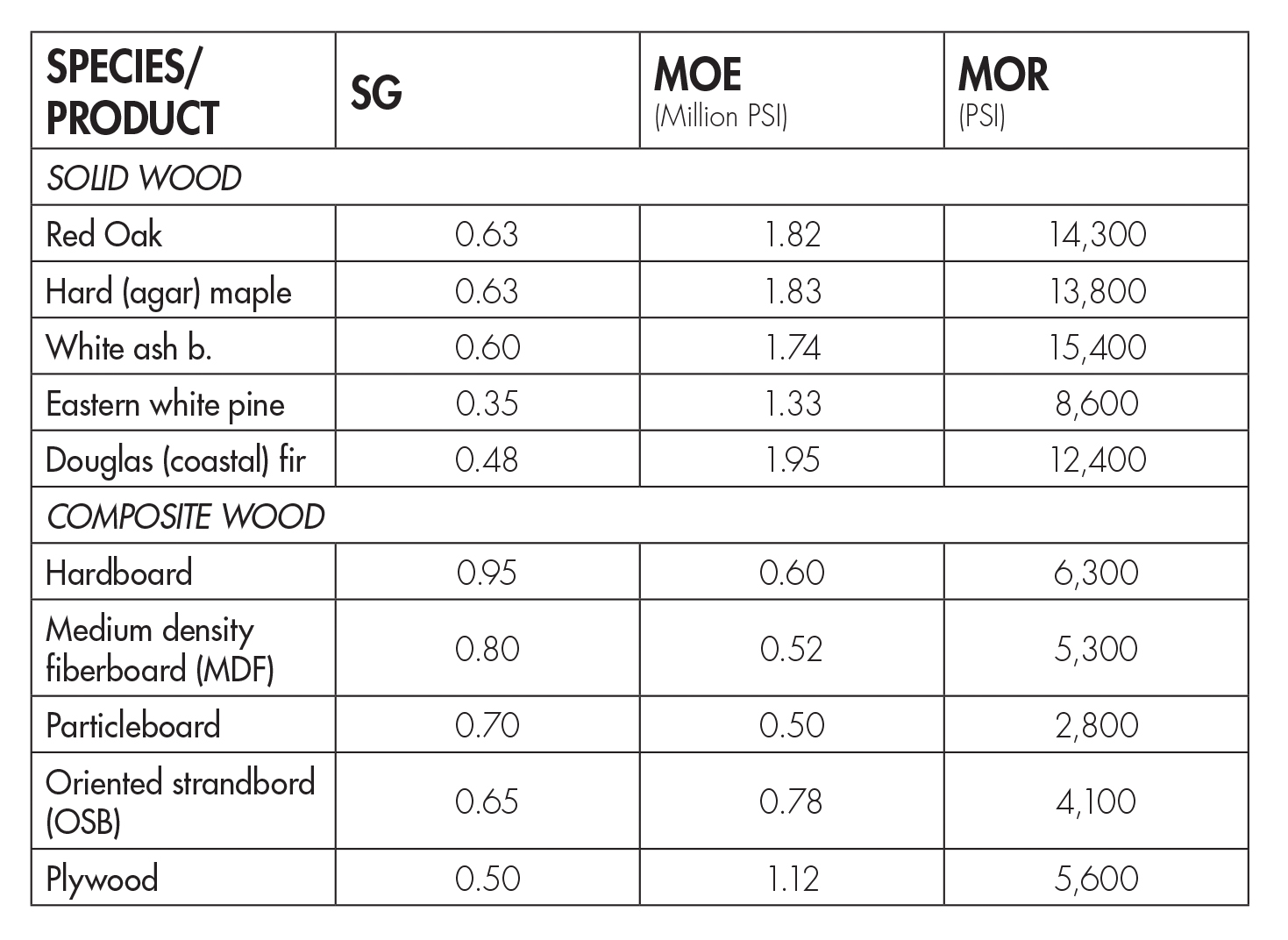
Chart notes: The values for solid wood are for clear, knot-free, straight grain wood. Specific gravity (SG) is the weight compared to an equal volume of water. Bendability is the modulus of elasticity (MOE). Strength is the modulus of rupture (MOR). In reproducing this chart, appreciate that there is a range of SG, MOE AND MOR. For example, the MOE of MDF ranges from 0.4 million psi to 0.8 million psi.
Numbers given are median values, to assist in a general comparison between products. Ask the product manufacturer for precise, actual values for their product.
Q We keep having issues with sticker stain. We keep our sticks dry, but the stain is still sporadically popping up. Do you have any common remedies?
A The key concept is : “Differences in drying rate at moistures above about 40% MC cause differences in the color of the wood.” Faster drying means whiter color. Wood under the sticker dries more slowly than the wood between stickers, so this drying difference can result in sticker stain.
You do not sticker stain lumber under 40% MC. Look for errors in handling and drying at higher MCs. A freshly harvested tree in warm months that is not quickly sawn into lumber, and any lumber not prompted stacked and dried at an appropriate low relative humidity, will have more color changes. If you use very dry stickers, the wood under the sticker might dry faster and very white. Wood between the stickers can dry slower. The end result is white sticker marks. To avoid sticker stain, use dry, but not too dry, stickers and handle the lumber as quickly as possible.


Have something to say? Share your thoughts with us in the comments below.