


Editor’s note: This column was produced before Gene Wengert died in 2025. It is printed here in memoriam.
Q. We make cabinet doors, using solid wood for the rails (horizontal pieces) and the stiles (vertical pieces). We use MDF for the inserted panel. We are careful to make sure the panel has room to move, with rubber bumpers in the grooves. All too often however, the joint between the rail and stile cracks open and looks ugly. Can you provide any guidance? P.S. We even tried epoxy.
A. The key concept is that wood only changes its size or shape over time when the moisture changes. So, in your case, the rails and stiles are changing moisture content (MC) after manufacturing. The suggested moisture for interior hardwood (leaf tree) is 6.8% MC. Softwoods (needle trees), to enhance machining, are better at 9.5% to 10.0% MC. Also, 99% of the lumber pieces must be within plus or minus 0.9% MC.
End grain of wood is hard to glue and achieve a strong joint. Splines and special fasteners can be used, but using the correct MC is the key.
A second key point is that too much pressure when gluing can mean a weak joint. Most wood adhesives can make a joint stronger than the wood itself. Such a joint must have freshly prepared wood and must use a pressure that will squeeze out enough, but not too much, of the adhesive.
This is especially true when the joint pieces fit together very tightly before glue. If using epoxy, one good idea is to make the epoxy joint hollow ground so that the top and bottom edges fit well, but the interior of the joint being hollow allows for the required adhesive thickness.
Tips for epoxy joints
Epoxy is especially sensitive to using excessive pressure. As part of the curing process, epoxy generates heat. If the pressure is too high, and there is not enough adhesive in the joint, there will not be enough heat generated to correctly cure the epoxy. In other words, epoxy requires a thicker joint than does PVA adhesive. PUR is another adhesive requiring some thickness to the joint. By thickness, I mean the thickness of the adhesive in a cured joint.
Q. I have a question about improving defect marking. How accurate and close to the defect do we need to be? I am referring to marking the width of defects with a person and crayon-type marker. Feel free to share our results.
A. This question can best be answered using a typical example. Assume there is a defect in a piece of lumber, with the defect 10 inches long and 1 inch wide. The first choice for the human marker is whether to mark the defect for the rip saw, or to ignore the defect and let it be cut out by the crosscut defect saw.
Next, let’s assume that the marker puts the line (or even a computer might be programed to do this). Assume the desired ripping is 2-1/2 inches wide or so. With a 1/8 inch error, this means a 5% yield of the typical hardwood lumber piece. I hope you are surprised at this loss, especially because $1,000 worth of cuttings is worth $10 as fuel. The bottom line is that vertical markings need to be exactly at the edge of the defect. (Make sure to define a defect accurately as a section of wood negatively affecting manufacturing.)
Now consider the markings to control crosscutting. The amount of sawdust is very small, compared to the sawdust from one rip cut. Marking the defect so it is 1 inch too long only affects yield about 1/2% for this case. Stated another way, chop saw operations do not require the high accuracy in marking, compared to ripping.
Bottom line is to work on rip marking, and know what the optical reading does with fat marks and marks not parallel to the lumbers edge.
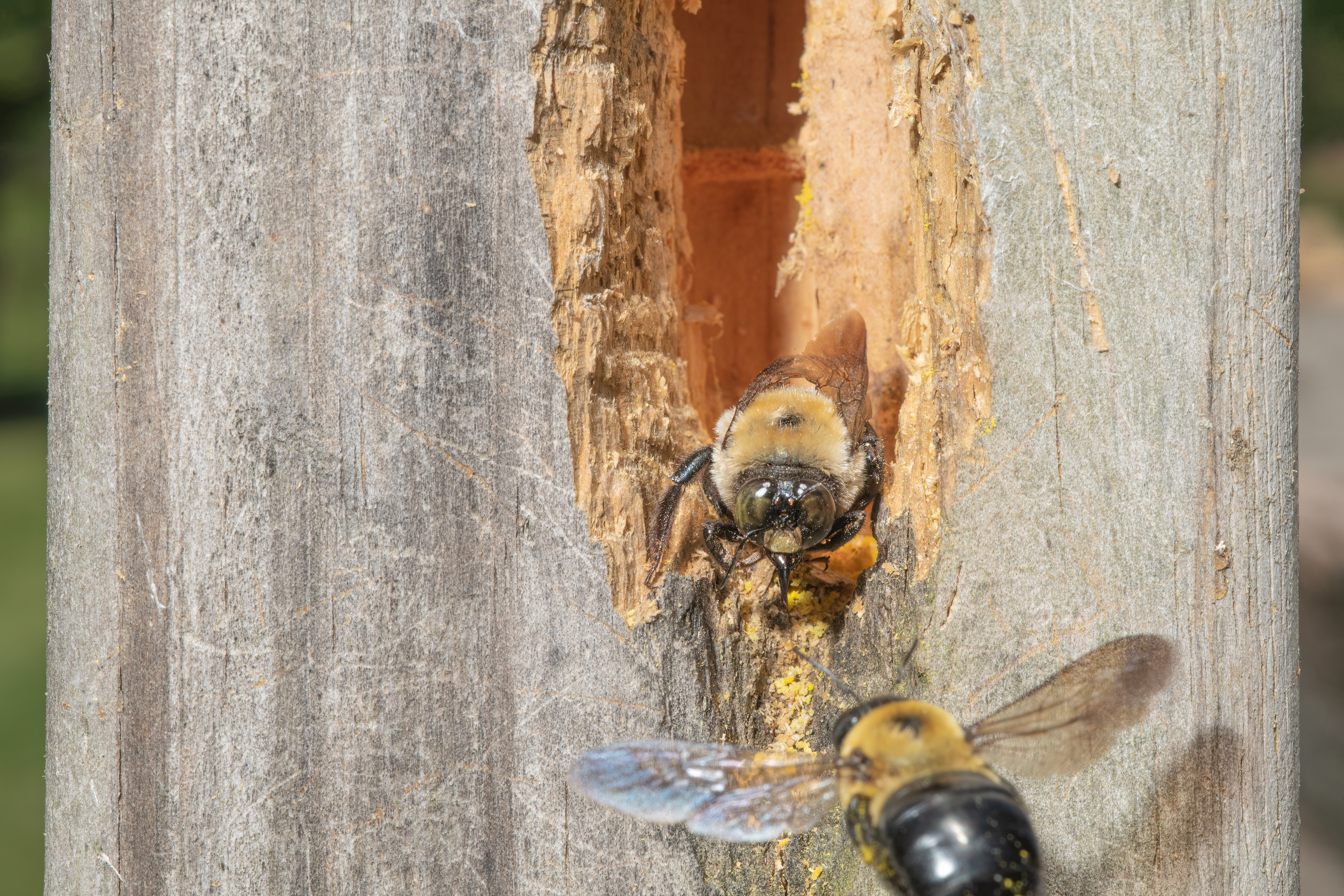
Q. What wood species do carpenter bees prefer?
A. Carpenter bees are unique in that they tunnel into wood to make their nest, but do not eat the wood. Further, these bees return to their nest from last year — amazing as they migrate far south in the winter. How do they find that same piece of siding or picnic table year after year?
Carpenter bees prefer unpainted, weathered wood. They prefer softer wood, such as redwood, cedars, cypress, and pines. Painted or pressure-treated wood is much less susceptible to attack. Common carpenter bee nesting sites include eaves, rafters, fascia boards, siding, wooden shake roofs, decks and outdoor furniture.
Control of the bees is best after they have created the nest tunnel. An insecticide is applied into the hole, usually in the evening when the bee is nesting. Then, immediately, the nesting hole is plugged with a wooden dowel…hardwood preferred. Contact your county extension to find out the approved insecticide.


Have something to say? Share your thoughts with us in the comments below.