

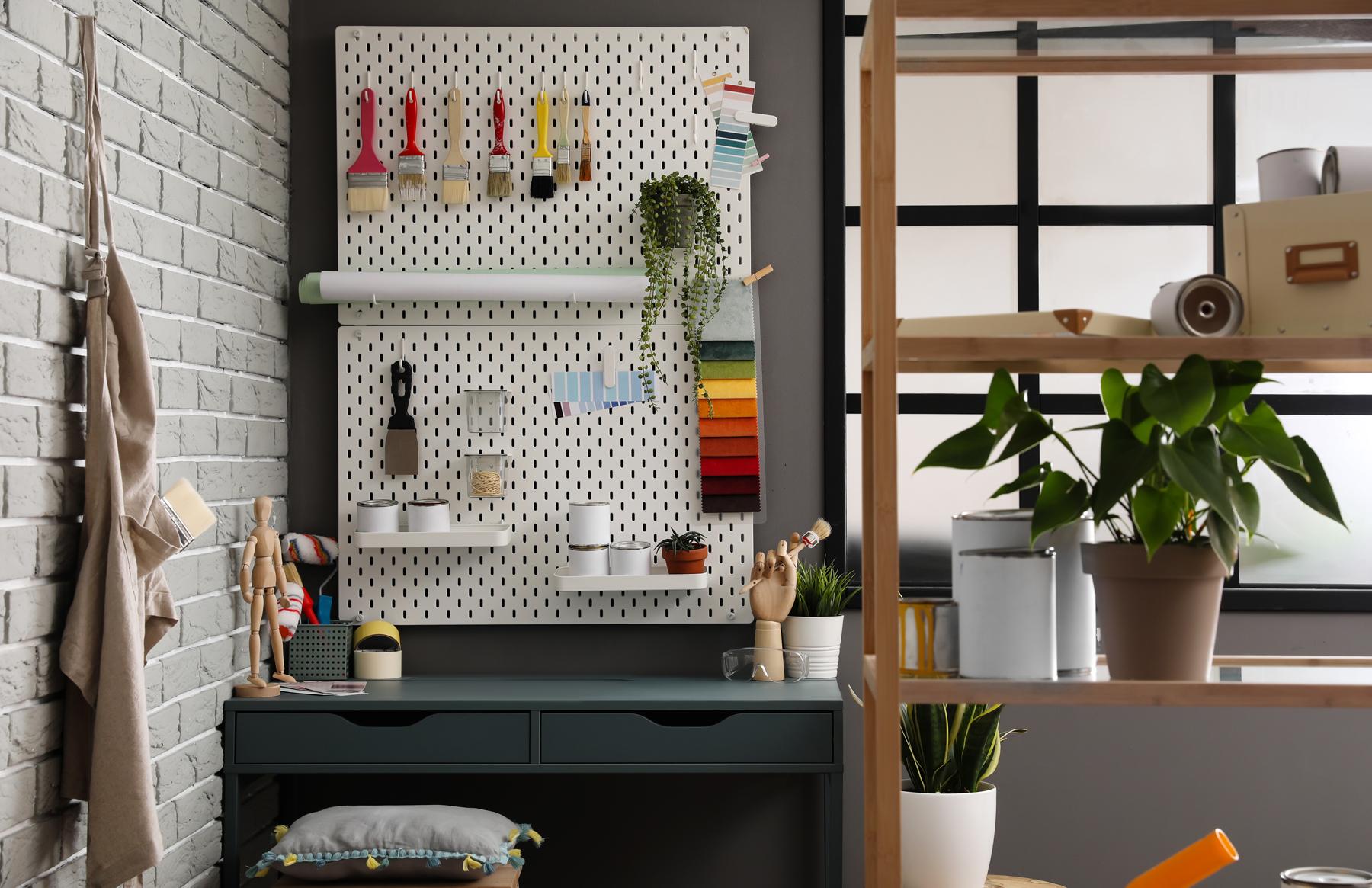
Hardboard offers a smart, lightweight solution for furniture and interior wall panel backing, combining a thin profile with dependable strength. Perforated hardboard is also a popular choice for home organization and storage systems.
Produced from inter-felted lignocellulosic fibers compressed under heat and pressure, hardboard delivers consistent thickness and density with a grain-free surface. Additives can be included during manufacturing to increase resistance to abrasion and moisture, and to improve overall strength and durability.
Hardboard can be cut, routed, shaped, and drilled using standard woodworking tools and can be reliably fastened with glue, screws, staples, or nails. For added design versatility, hardboard can be laminated with paper overlays, plastic laminates, or veneers.
Hardboard: Engineered for Reliability
Hardboard delivers exceptional durability and versatility, with effortless machinability that supports producing furniture components, wall paneling, perforated boards for home organization, and moulded door skins and underlayment.
MORE INFO Composite Panel Association More information, plus industry news, testing & certification, policy and stewardship at the Composite Panel Association's website CompositePanel.org | 
|
Product standards
ANSI A135.4 Basic Hardboard is the North American industry standard. It classifies hardboard by thickness and physical properties, and includes five classes: Tempered, Standard, Service-Tempered, Service, and Industrialite.
ANSI A135.5 for Prefinished Hardboard Paneling establishes the property requirements for dimensional tolerances and moisture content, along with resistance to abrasion, fading, heat, humidity, scraping, steaming, and staining. Requirements for washability, gloss, workmanship, and flame spread are also specified. ANSI A135.4 and A135.5 are sponsored by CPA in conjunction with producers, users, and general interest groups. Copies are available at CompositePanel.org.


Have something to say? Share your thoughts with us in the comments below.