

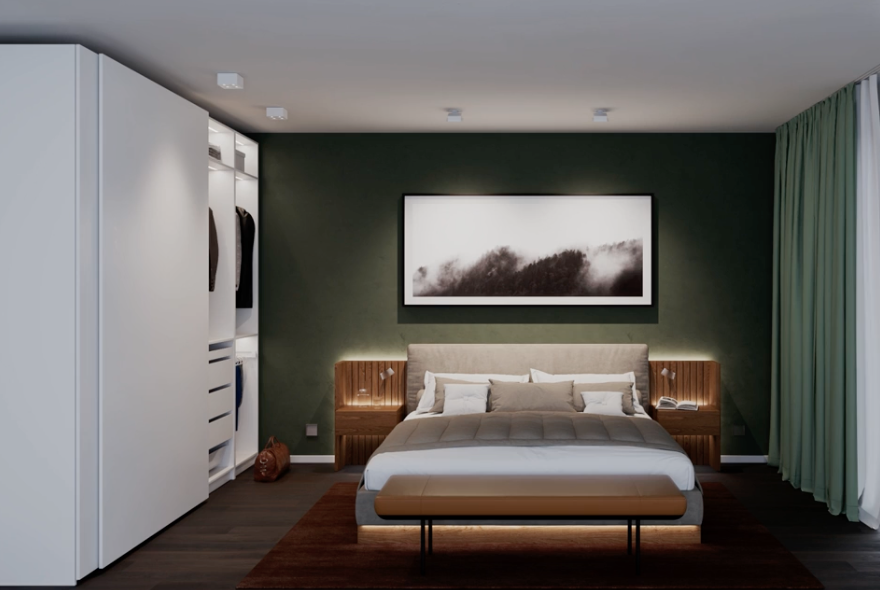
Design professionals are specifying higher-grade surface materials for closets as client expectations for these spaces evolve. Once viewed as utilitarian storage, closets are now often designed with finishes comparable to primary living areas, shifting the focus from layout to the quality and performance of every component.
Recent industry shows in 2025 have highlighted a range of surface materials with improved aesthetic and performance characteristics.
New trends in materials allow designers, architects, and custom builders to add value and differentiate their projects by focusing on material specification for all closet components, including back panels, doors, and countertops.
These forward-thinking design developments reflect a market that increasingly treats closets as fully finished rooms rather than simple enclosures.
Back panels offer design options
The back panel of a closet system is now being treated as a primary design element. Design professionals are using a variety of materials to add texture and integrate lighting, fundamentally changing the character of the space.
Textured thermally fused laminate (TFL) is one of the most prominent materials in this category. Manufacturers like the Italy-based CLEAF produce panels that accurately replicate the look and feel of natural textiles, such as linen, grasscloth, and raw silk. For designers, these products offer a significant advantage over their natural counterparts. The engineered surface offers consistent color across large projects, is more resistant to wear, and can be easily cleaned. This allows for the introduction of soft, textural looks without compromising on durability, a consideration in a space used daily.
For higher-end projects, panels are being specified wrapped in materials such as suede, vegan leather, or other textiles. Suppliers such as Spinneybeck and EcoDomo offer a range of leathers. Beyond the visual and tactile luxury, these soft surfaces from Spinneybeck, in particular, serve a functional purpose as well, absorbing sound. This acoustic dampening contributes to a quieter, more serene environment within a dressing room or primary suite.
Another design approach is the integration of light. Hardware vendors from Richelieu and Hardware Resources to Hafele America and Rev-A-Shelf offer numerous options. Backlit panels made from translucent resin, acrylic, or natural stone, like onyx, are being used to create feature walls. Companies, including 3form, specialize in resin panels that can be customized with a variety of colors and patterns. When illuminated from behind, these panels provide soft, ambient light and transform storage for items like handbags, shoes, or watch collections into curated displays.
Doors and drawer fronts
As the most visible and frequently touched components in a closet, doors and drawer fronts require a balance of aesthetic appeal and robust performance. The market has responded with surfaces that are both visually appealing and highly durable.
Super-matte finishes continue to be a leading specification. Materials such as Fenix NTM from Arpa Industriale utilize nanotechnology to create a non-porous surface that is soft to the touch, has extremely low light reflectivity, and is resistant to fingerprints. A key feature for clients is the material’s ability to thermally heal superficial micro-scratches, ensuring the surface maintains its unblemished appearance over time. This low-maintenance quality makes it a practical choice for high-use closet systems.
Architectural details are being introduced through three-dimensional surfaces. Companies like Designs of Distinction by Brown Wood are offering fluted and reeded profiles. Once reserved for high-end furniture, they are now widely available in both solid wood and medium-density fiberboard (MDF) panels. These profiles add texture and create subtle shadow lines, giving cabinetry a more substantial, custom-built appearance. MDF provides a stable substrate for paint or lacquer, allowing for a high degree of color customization.
Alternative finishes are also being used to create distinct looks. Liquid metal coatings, which consist of metal particles suspended in a polymer binder, can be applied to various substrates to achieve the look of solid bronze, brass, or copper without the associated weight and cost. For a contemporary aesthetic, high-gloss acrylic doors offer a mirror-like finish and a greater sense of depth than traditional lacquers.
Horizontal surfaces and shelving
Countertops on closet islands and other horizontal surfaces have to withstand direct contact with hard objects like jewelry, keys, and belt buckles. This has led to the widespread adoption of sintered stone and other ultra-compact surfaces.
Manufactured by compressing minerals under intense heat and pressure, sintered stone from brands like Dekton by Cosentino or Neolith is exceptionally dense and non-porous. This process results in a surface that is highly resistant to scratches, abrasion, and staining. The material’s availability in large-format slabs allows for the creation of seamless islands, including waterfall edges where the surface material flows vertically down the sides.
Shelving has also evolved beyond basic utility. Thicker profiles, often one inch or more, are being specified to give the closet system a more substantial, furniture-grade appearance. Integrated lighting is now a standard feature in high-end projects. Hardware suppliers like Hafele and Richelieu offer sophisticated LED systems that fit into recessed channels within the shelves, providing even, downward-facing task lighting without visible fixtures.
For display purposes, glass shelving in clear, bronze, or gray tints is used to create a lighter, more open feel while still providing strong support.
The expanded use of premium materials in closets allows design and construction professionals to increase project value and meet client demands. A thorough understanding of these material options is becoming a key differentiator for professionals operating in the competitive custom storage and interior design markets.



Have something to say? Share your thoughts with us in the comments below.