

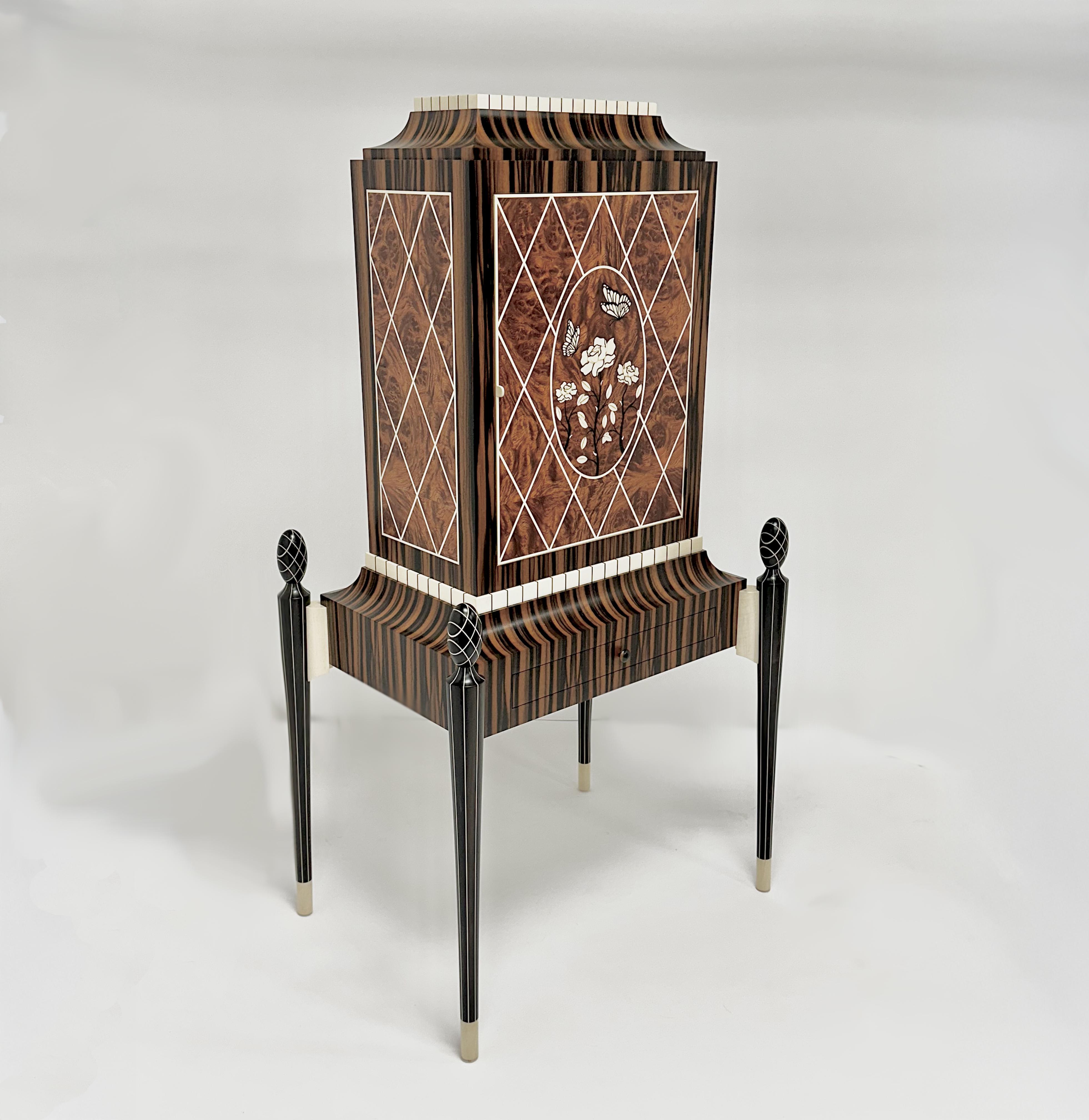
Combining spectacular veneer, exemplary craftsmanship, delicate marquetry, and Art Deco panache, recent work by veneer artist and furniture craftsman Dennis Zongker takes viewers back to an elegant furniture style that had its heyday in the 1920s.
“My goal was to design a jewelry cabinet to fit into the high society of the Roaring Twenties,” said Zongkers. “In this time period the Art Deco movement was at full swing. It was a decorative style that influenced art and culture in Europe and the United States.”
Art Deco inspiration
The inspiration for the design came from both Jacques-Emile Ruhlmann (1879-1933) and the Art Deco movement, which was an international decorative style that ran from 1919-1939, said Zongker. He has explored a number of veneer projects with an Art Deco theme in the past including an eye-popping music box that captured the grand prize in the 2023 Veneer Tech Craftsman’s Challenge.
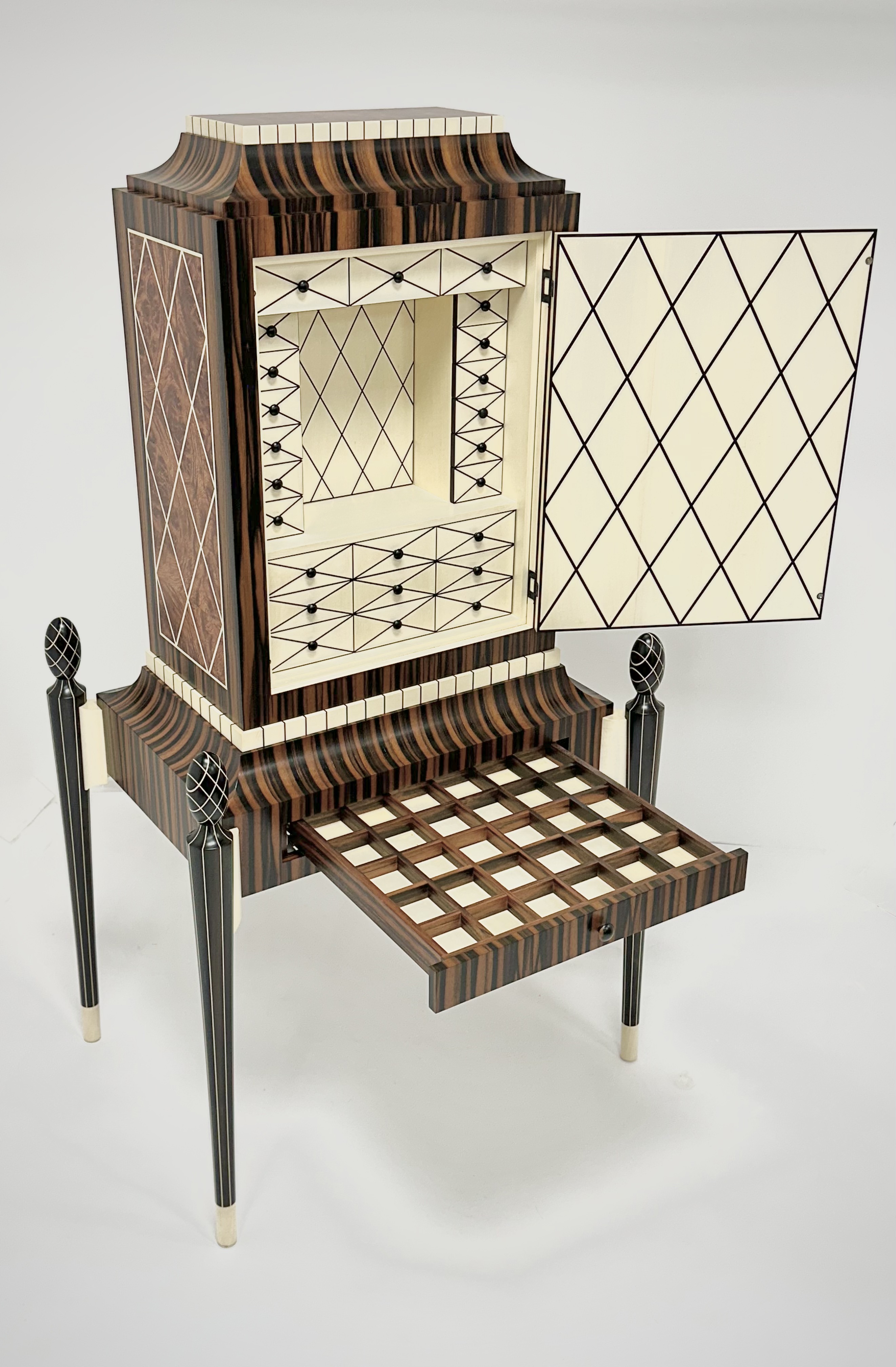
His jewelry cabinet measures 36-1/2 inches wide, 26-1/2 inches deep, and 69 inches tall. It is made out of four different species of hardwood and veneers: American holly, Macassar ebony, Gaboon ebony and bubinga burl. Cherry hardwood is used as a substrate. The cabinet features one outside drawer, 24 inside drawers and a hidden door compartment.
One of the more striking features of the cabinet is the delicate tapered legs topped with elliptical finials.
“Designing and making the legs with the elliptical shaped finials was the most challenging for me,” Zongkers said. “It took me several weeks to figure out how to make the diamond shapes mixed with the elliptical rings.”
He used Gaboon ebony for the solid larger segmented pieces and American holly for the thinner rings. Each finial has eight elliptical rings, with four rings facing right and four facing left, all cut at 30-degree angles.
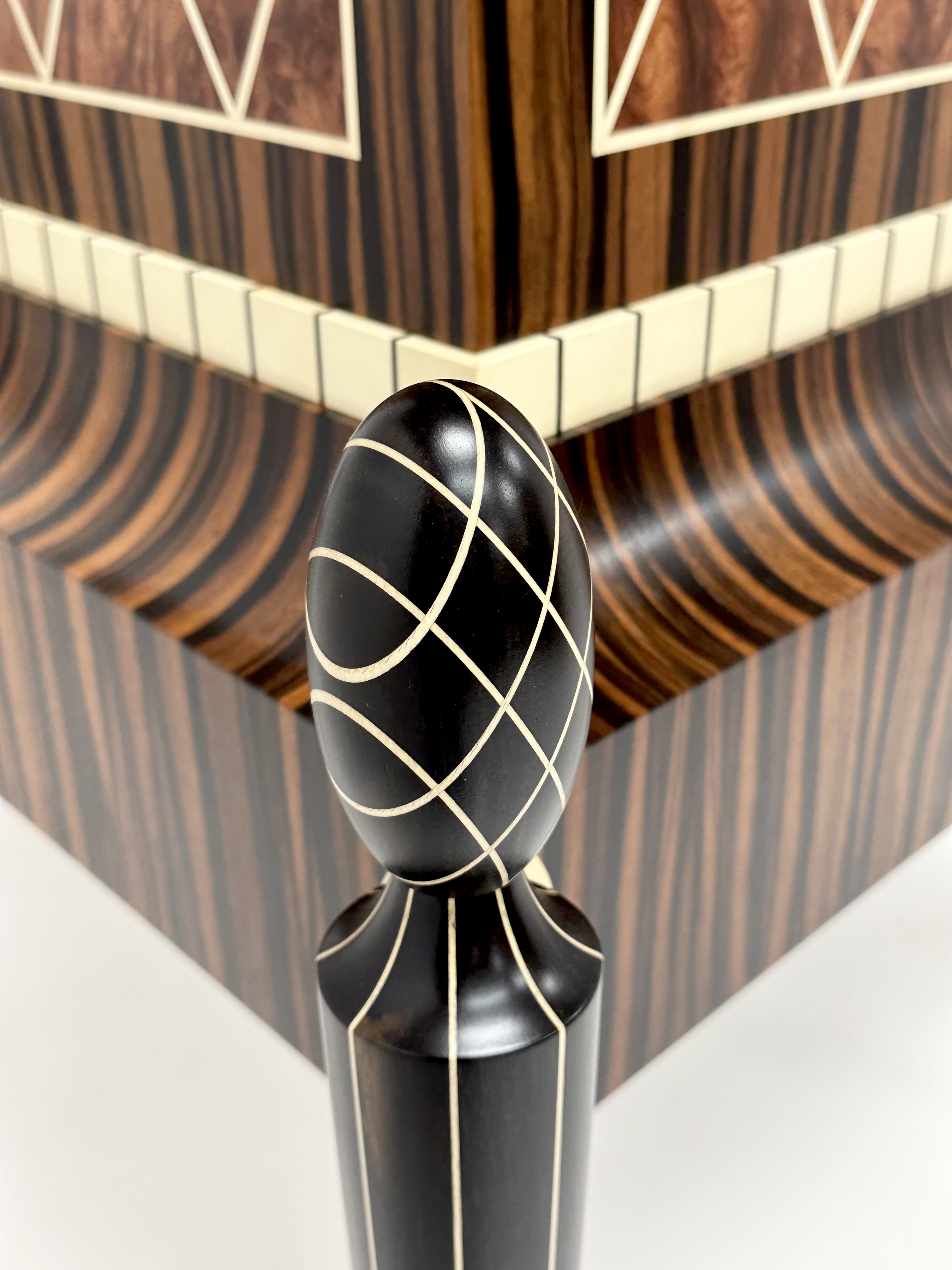
“The segmented glue up is very challenging getting all the rings to line up,” he said. “Turning them on the lathe was the simplest and fun part of making the top finials.”
He said making the long-segmented legs was a little less challenging, but still took a while to get them glued up. “The yield on the solid Gaboon ebony was not very good considering the cost,” he said. “I purchased a very large piece of Gaboon ebony that was 2 inches thick, 11 inches wide, and 10 feet long.”
To cut out the 32 pieces into isosceles triangles, Zongker made a jig for the table saw to cut out the 22-1/2-degree angles. First, he cut boards to width and thickness, then he used the jig for the 22-1/2-degree angle cuts, flipping boards over to cut the opposing angle.
The next step was to cut the 1/16-inch-thick American holly, 32 pieces, eight for each leg. To glue and clamp the 16 pieces total of holly and ebony for each leg, he used large rubber bands and wrapped around the pieces after brushing on wood glue.
“I also used small bar clamps to help tighten up the glue up,” he said. “After the glue had dried my next step was to glue a piece of holly for the foot of the leg by using a mortise and tenon joint.”
Veneer matching
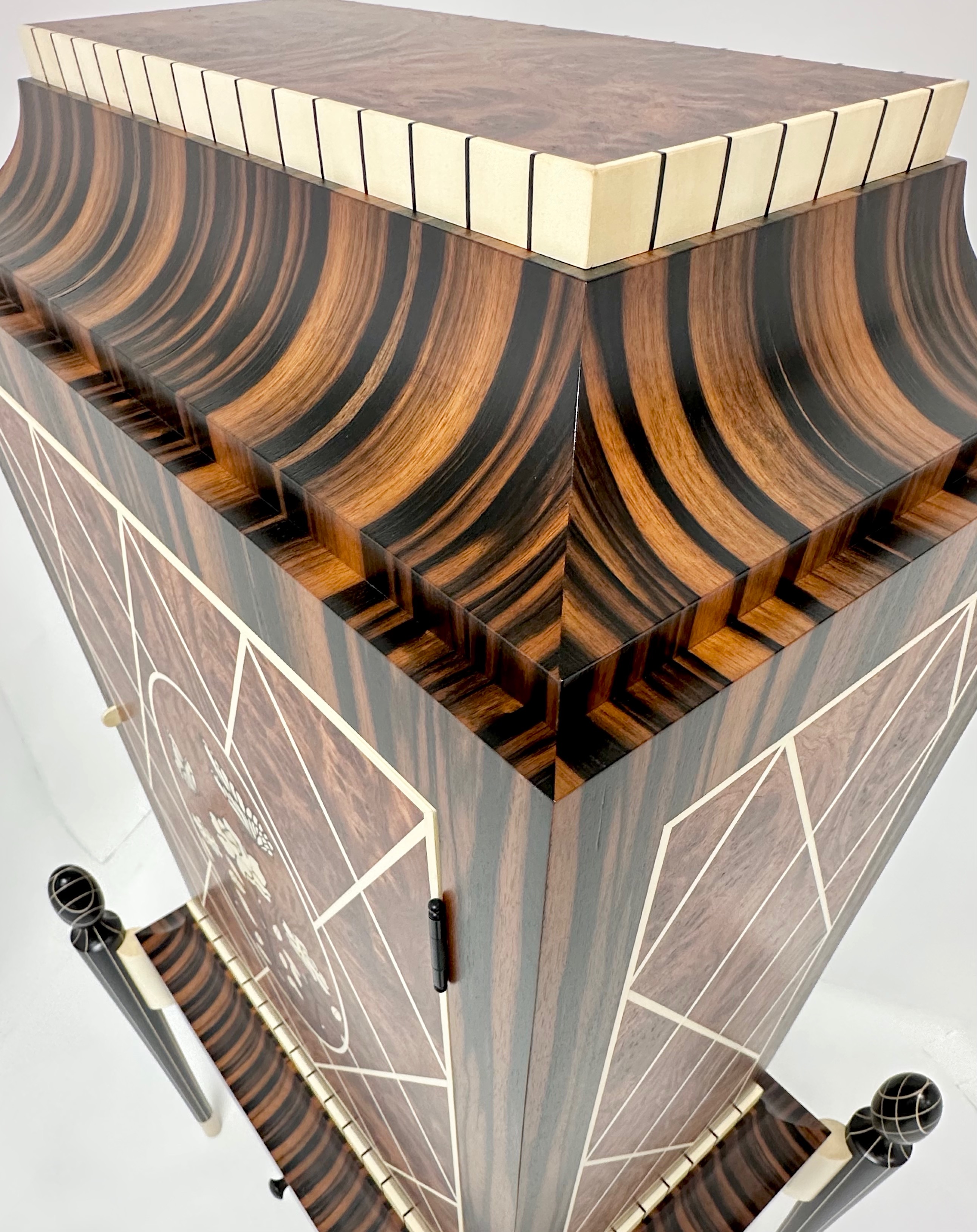
In building the main carcase, he paid special attention to lining up the Macassar ebony veneer. He had to purchase a large flitch of veneer so that all the grain would match up. “The nicer looking Macassar ebony is where the light brown and black stripes alternate almost like a zebra with its alternating colors,” he said. “Matching up the wood grain edge to edge is just as important as matching up the length of the grain. I like to figure the veneer out first to make sure I have enough to finish the whole project.”
The lower carcase has a large radius cove, which he made out of solid cherry hardwood. He says it is a great wood to veneer over because the grain is very smooth with small pores, and won’t telegraph through the face veneer.
“To make the large cove I used my table saw, making a straight edge at a 45-degree angle and clamping the edge down to my table saw,” he said. “Then I just lower the blade to where it sets above the table only 1/16 inch, then push the piece of cherry into the blade. Then I repeat this step eight times to reach the thickness needed for the large radius cove.”
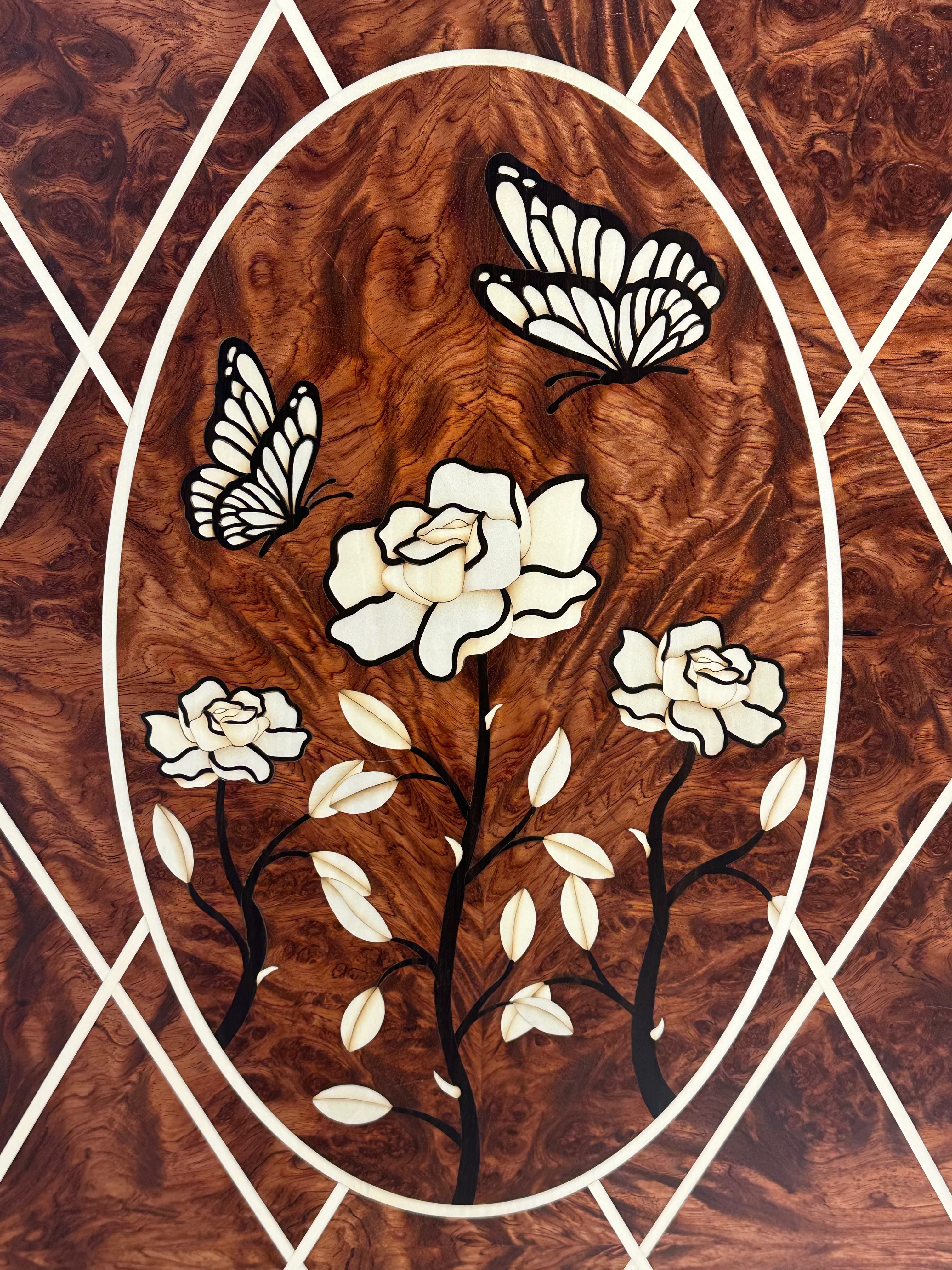
When it came to the marquetry on the door, he designed the roses and butterflies to be simplistic, with unrealistic shapes and less detail.
“This way the Art Deco style marquetry will blend well with the overall design of the jewelry cabinet,” he said, noting he used only three different veneers for the door marquetry: Gaboon ebony and American holly for the butterflies and roses, then bubinga burl for the background veneer.
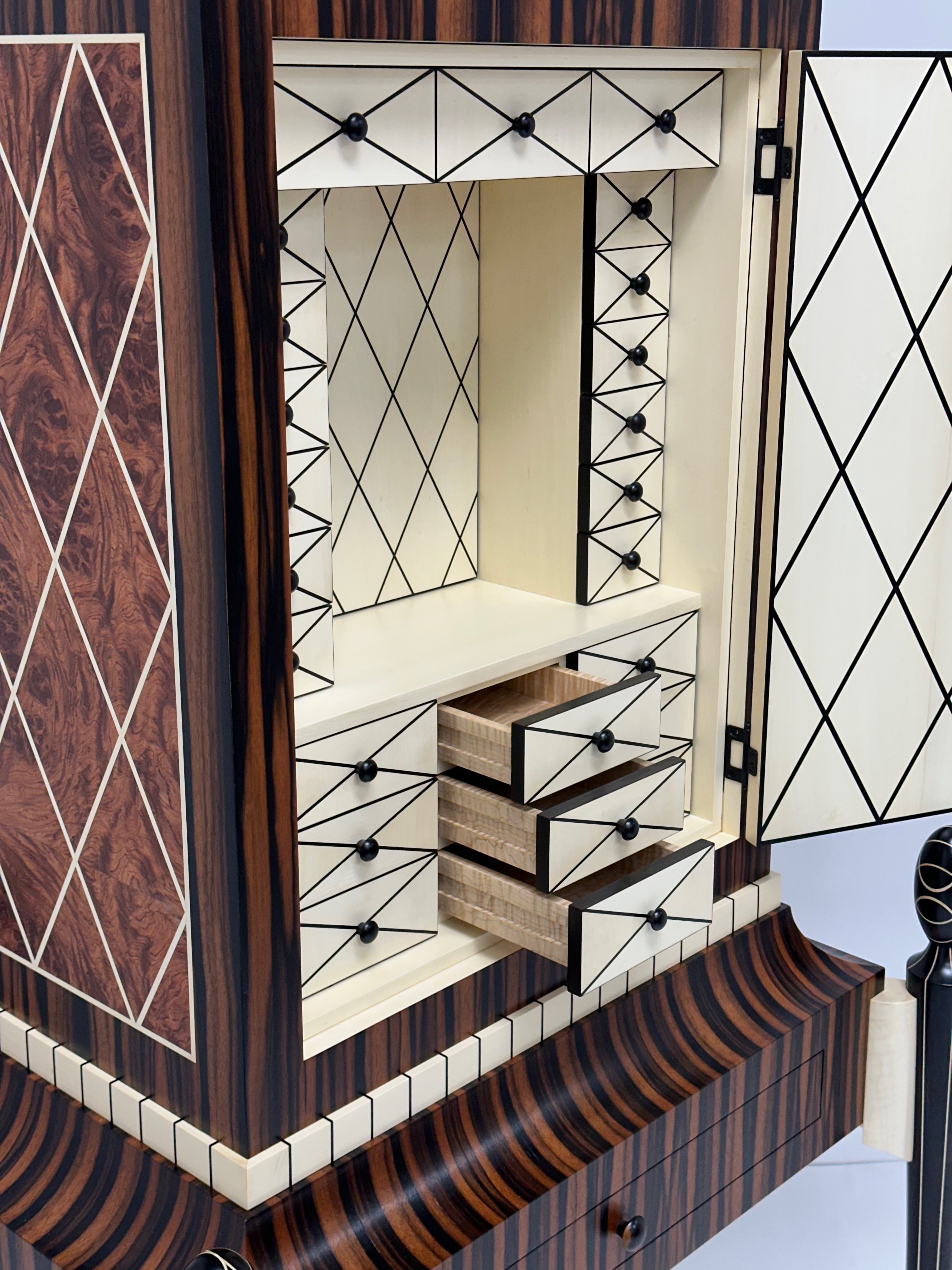
Inside the cabinet, there is a simplified design with Gaboon ebony inlays on a background veneer of American holly. On the back of the door and on the face of the inside hidden door, he used the same diamond shape inlay that is on the outside face of the cabinet.
All of the diamond and straight inlays on the outside and inside were routed in dadoes to the thickness of the veneer. “Then I cut the inlays on the table saw with a veneer jig that I made,” he said. “To fit the inlays, I used a straight chisel by cutting and fitting into the dadoes. Then I brushed yellow glue into the dadoes and placed the parts into the vacuum press bag with a caul on top.”
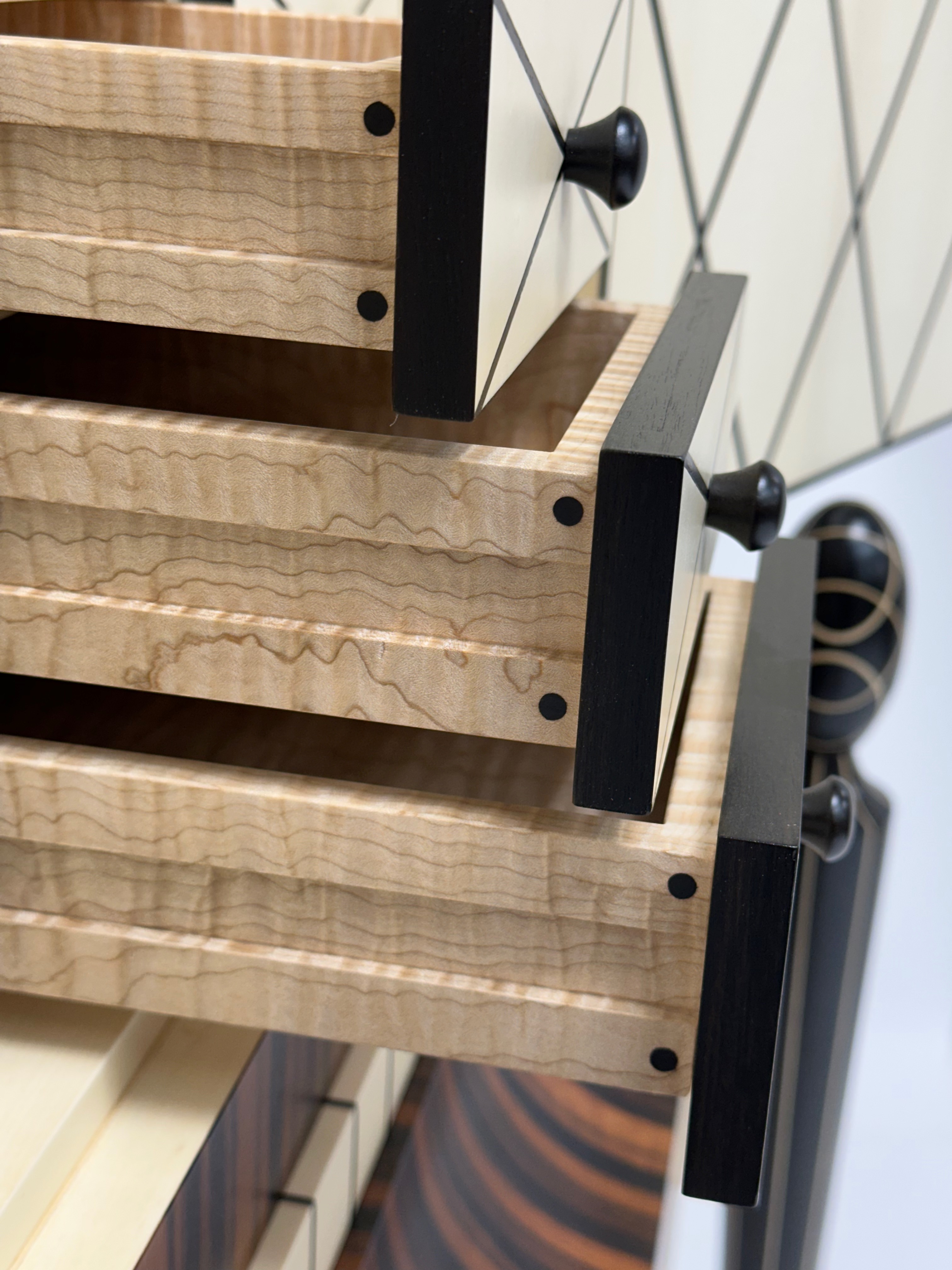
The lower outside drawer is made out of solid Macassar ebony with hand-cut dovetails. The ebony drawer dividers have lap joints that rest on top of the drawer bottom, which is made out of solid American holly. The 24 inside drawers are made from soft heavy curly maple.
“Instead of dovetailing the drawers I used a lap corner joint,” he said. “Then I made my own 3/16-inch-wide, 3/4-inch-long ebony dowels by using a dowel maker tool. I made them this way to blend with the Art Deco style.”
Zongker has been a professional woodworker for nearly 30 years and is the owner of Zongkers Custom Woods in Omaha, Nebraska. Learn more at zongkers.com.



Have something to say? Share your thoughts with us in the comments below.