

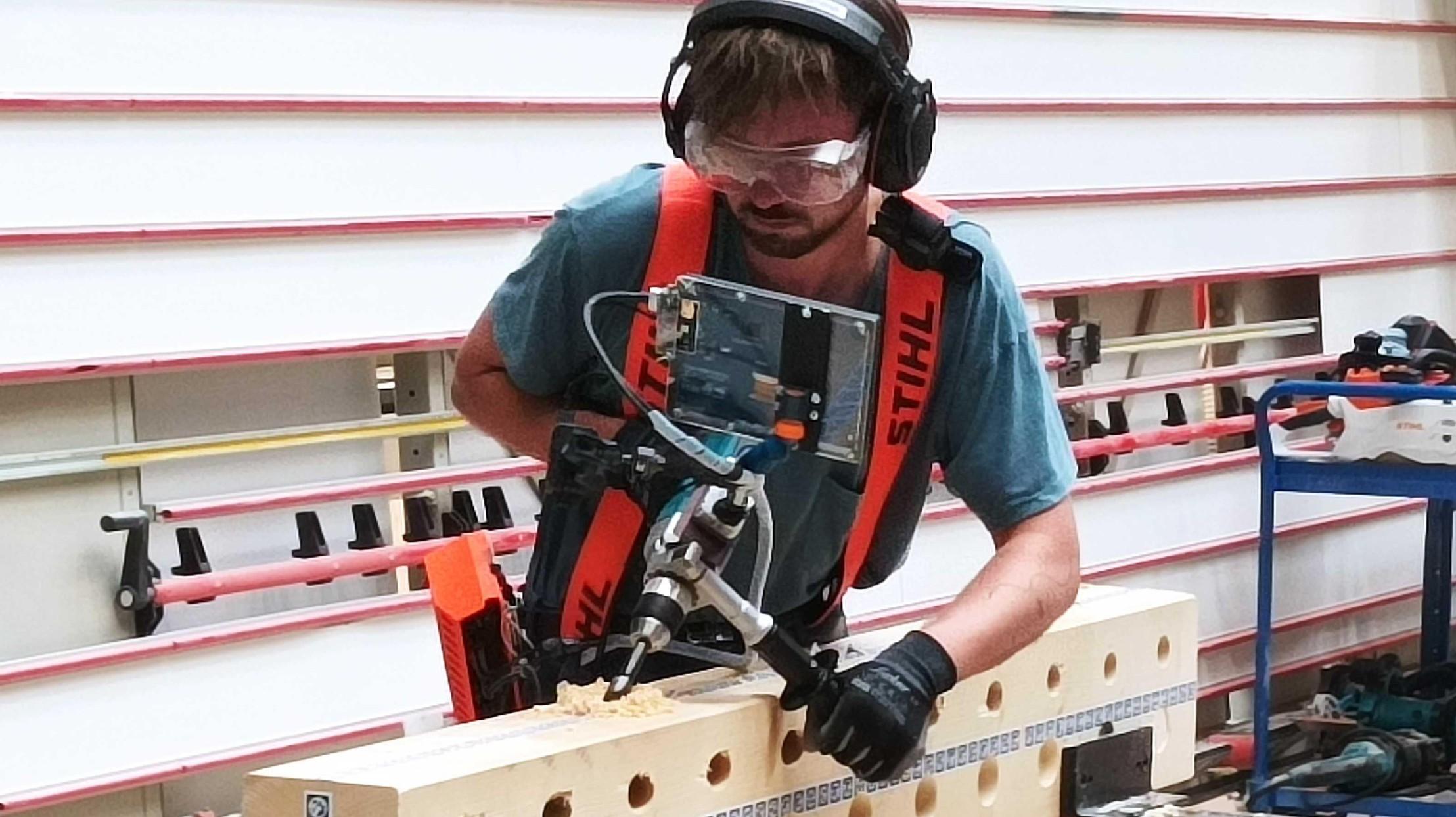
A system developed at Switzerland’s École Polytechnique Fédérale de Lausanne (EPFL) uses augmented reality (AR) to help make extremely precise timber cuts without having to measure or mark up beams.
The EPFL hybrid approach is an AR-based system that available in open source codes that the researchers said will make this digitally assisted technology affordable for small businesses, woodworkers and construction professionals.
The system is the result of four years of research, development, and testing by Andrea Settimi, an EPFL PhD student who is working on his thesis. Augmented Carpentry wants to promote timber construction also among a broader public not disposing of expensive industrial equipment or a workforce with advanced carpentry skills, by keeping the human in the digital fabrication loop.
According to EPFL, a tablet is mounted directly onto a carpenter’s saw, drill, or router. The tablet's camera scans the wood on which markers have been placed to detect its orientation and position in 3D. The system can then produce holograms with sub-millimeter precision to guide human operators. The physical device consists of a screen that displays a virtual workspace overlying pieces of timber.
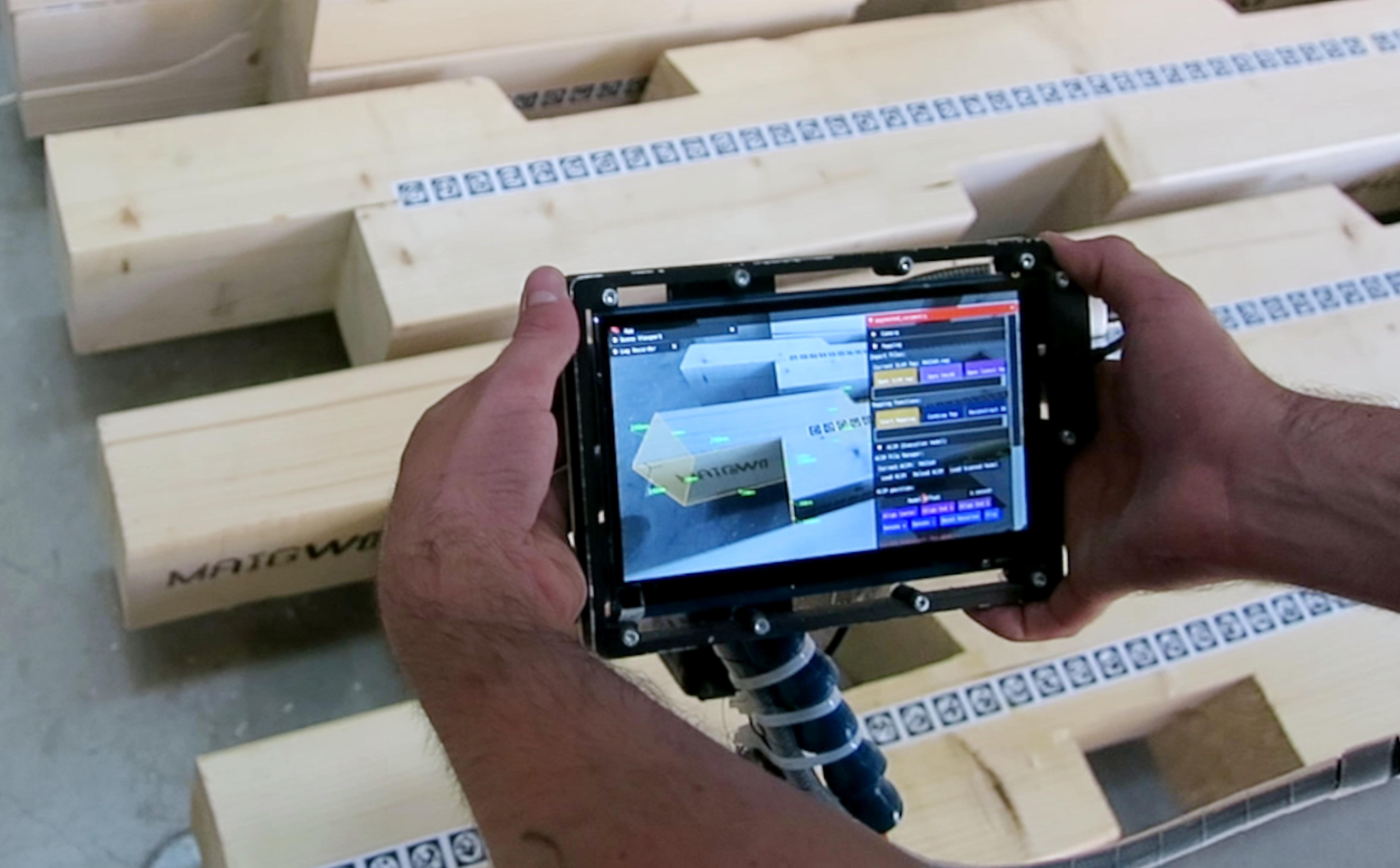
so that the system can detect their orientation and position. Photo: 2024 EPFL/Andrea Settimi
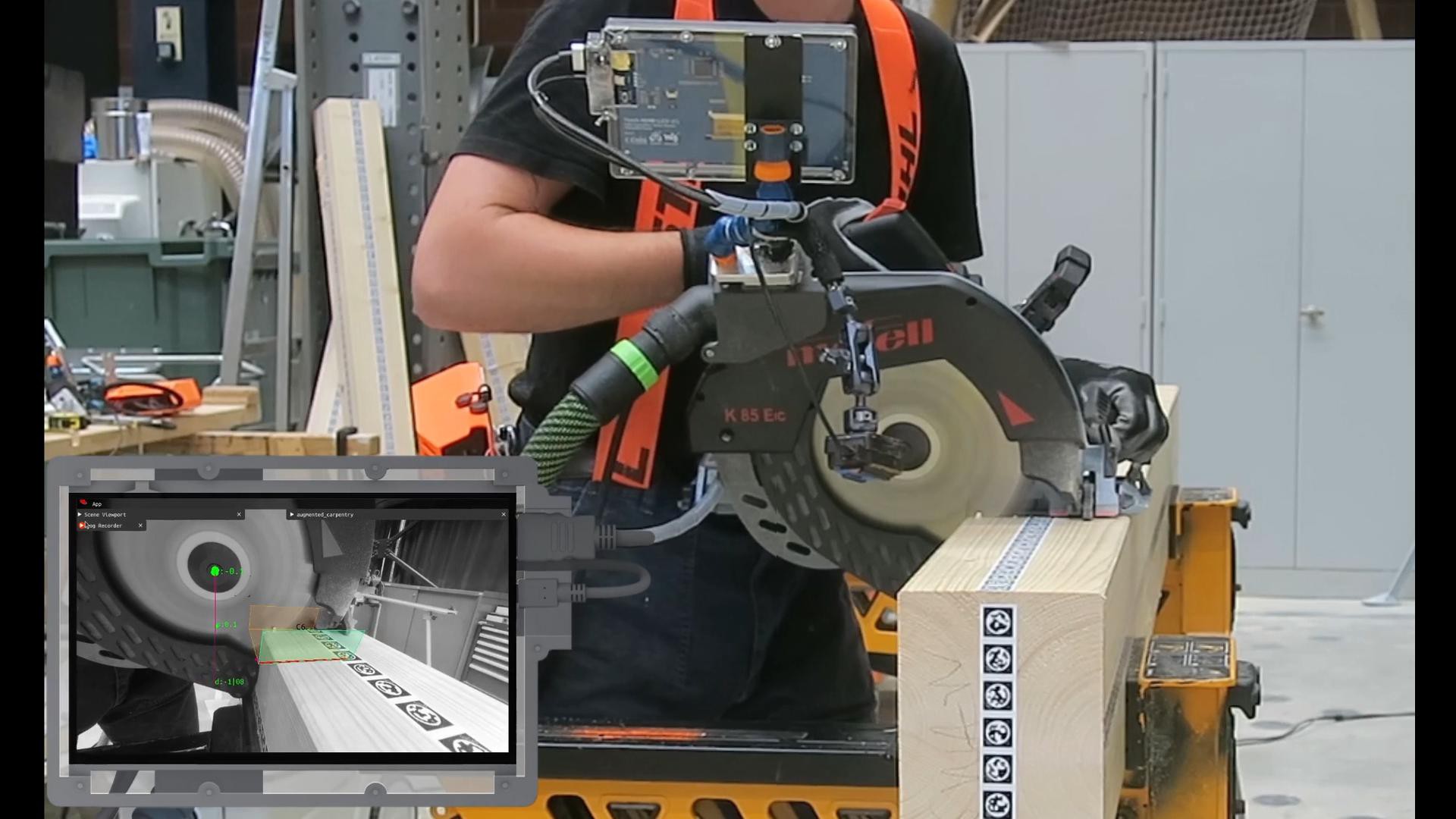
Lines of different colors give numerous indications such as how to position the tool, how deep to drill, what the right cutting angle is, and how long a cut should be. “Our system includes a detection mechanism and integrated sensors that give feedback in real time,” says Settimi. “If the woodworking tool or the beam it’s cutting slips, for example, the virtual overlay will remain aligned with the actual piece of timber so that operators can instantly see how to adjust their movements.”
The research team studied various aspects of computer-vision technology and integrated them into its device so that it could incorporate the woodworking tool as well as the specific piece of timber and woodworking plan. They scanned and generated 3D computer models of commonly used tools, creating a vast database. To use the system, operators first scan their timber pieces by lot, enabling the program to record the details of each one. Then the operators place markers randomly on the timber pieces so that the system can detect their orientation and position. The last step is to upload the woodworking plans, which are integrated directly into the program in 3D and displayed in augmented reality.
Using computer vision and sensors, standard woodworking tools can become smart devices capable of guiding users in real time. The system visualizes cutting lines directly on a beam, for instance, showing operators exactly where to guide the saw. This significantly reduces the risk of human error and improves precision during assembly.
A key aspect of the research project was to develop advanced computer vision methods for detecting items and positioning the camera in complex, cluttered spaces like workshops. These spaces generally contain various types of objects – other pieces of wood, tools, panels, etc. – scattered about in no particular order, making it hard for computer vision systems to map the environment. The research team worked with EPFL’s Center for Imaging to develop programs that could accurately recognize and locate the items of interest – in this case, woodworking tools and timber pieces. Such capabilities have never before been implemented at this scale for timber construction and are essential for making sure the virtual workspace aligns with the physical reality.





Have something to say? Share your thoughts with us in the comments below.