

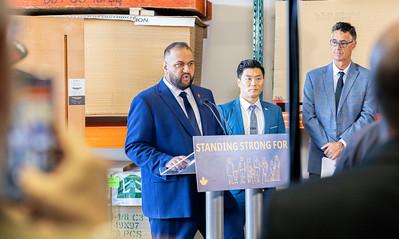
VICTORIA, B.C. — British Columbia is investing $2 million to launch Make More in B.C., a new initiative aimed at creating regional economic hubs that will protect existing forestry workers, generate new jobs, and extract more value from every tree.
The initiative is intended to support the production of value-added wood products, including mass timber, pulp, and paper products for domestic and global markets. The initiative will focus on fostering regional collaboration among manufacturers, contractors, and First Nations partners while expanding access to fiber and supporting new economic opportunities across the province.
“On the ground in forest-dependent communities, we’ve heard it loud and clear: Forestry needs predictable access to fibre, more local logs going to local mills, to create more jobs,” said Ravi Parmar, Minister of Forests. “The Make More in B.C. project is about building a stronger, more resilient forest sector that is never again dependent on a single trading partner like the United States. We cannot allow forestry workers and communities to remain vulnerable to duties, tariffs, and global uncertainty. We need to make more in B.C., create more jobs in B.C., and build a future that keeps more value here at home.”
The Province will support forestry sector businesses, which understand their own needs and the needs of their local forest economy, by empowering them through economic hubs, giving them the tools to work together on long-term strategies and solutions, to get local logs to local mills, get paychecks to workers, and to get wood products to markets in B.C. and beyond.
As part of the Make More in B.C. project, this grant will create jobs industry in working collaboratively across the forestry sector and with government to unlock more value from B.C.’s forestry supply chain.
Nick Arkle, CEO with West Kelowna’s Gorman Group, recently found success with this innovative concept of sector-specific economic hubs, bringing a group of like-minded forestry colleagues together in March 2026 as the first example of how this work can benefit B.C. businesses.
In addition to strengthening wood processing, manufacturing and new business opportunities, these collaborative initiatives will help find predictable fiber supply in the province and build on work happening across government to create predictable fiber supply for generations to come.
The groundwork Arkle has laid through his Merritt-based working group, sets the foundation for British Columbia’s first official economic hub in the Merritt Timber Supply Area.
“This cluster initiative is about a region finding the delicate balance between long-term generational stewardship on the land and economic, social and cultural interests,” Arkle said. “With First Nations and communities guiding the stewardship portion the goal is to seek greater security of a sustainable and affordable fiber flow that will, in turn, encourage investment and innovation to produce higher value end products along with additional products such as wood residues into the forest-based bio economy.”
The Province will advance and champion the Make More in B.C. Project by providing data and co-ordination support to help industry collaborators reduce barriers, find new partners and leverage federal or provincial supports where possible.
“Through the Make More in B.C. project, we’re building a stronger and more competitive value-add economy defined by world-class wood products,” Parmar said. “The same products that will ensure B.C. can compete in global markets and win.”
This funding supports the Province’s Look West strategy and its goal to triple the amount of B.C. wood used in construction by 2030.
Look West is the Province’s plan designed to deliver major projects, strengthen B.C.’s and Canada’s economic security in the face of economic threats, and create good jobs and opportunities for people to train for careers in the skilled trades.





Have something to say? Share your thoughts with us in the comments below.