

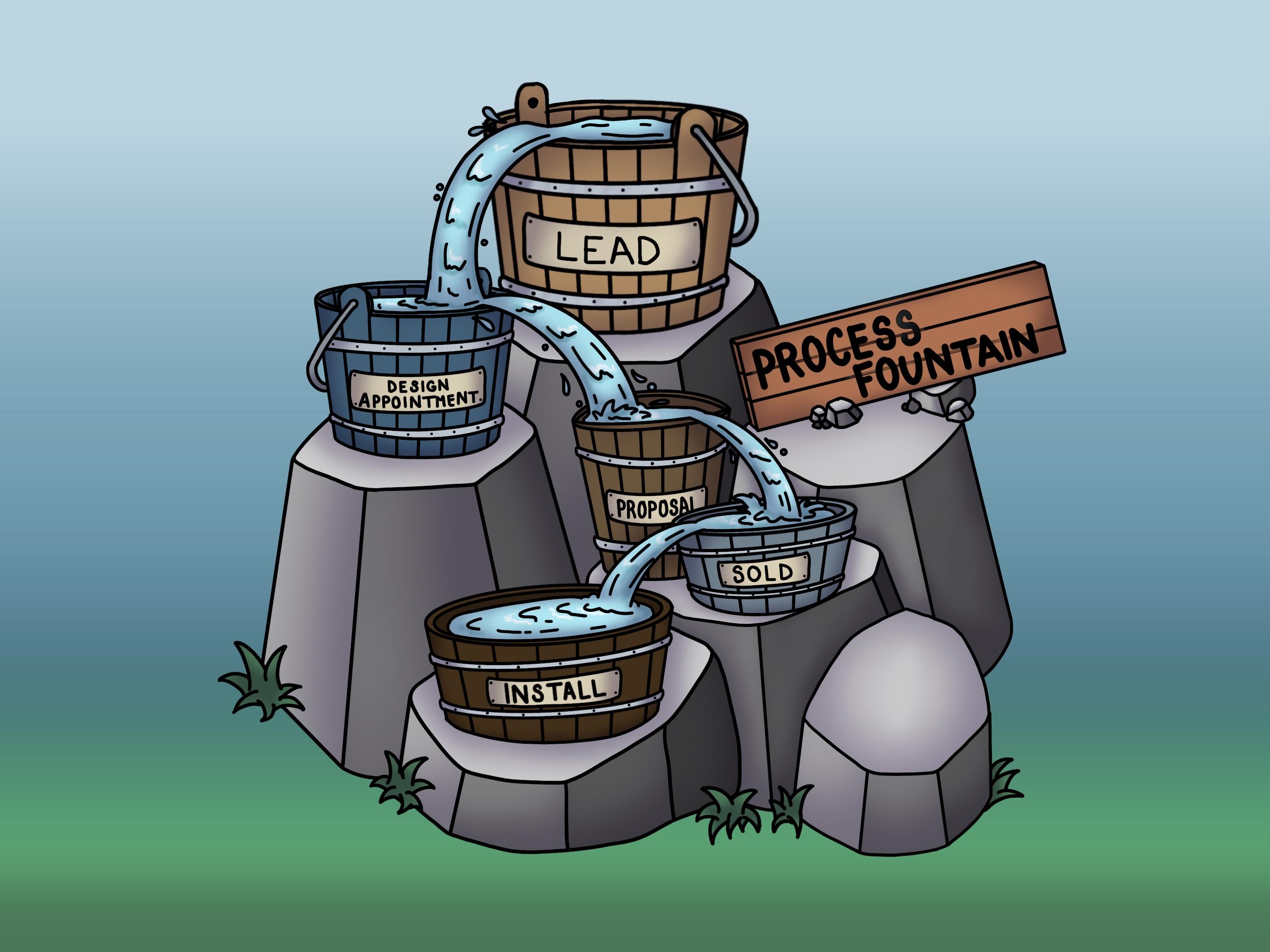
What is a bucket? I use the visual of buckets flowing from one to the other for all the stages that a customer will go through. They begin in this order: 1) Lead, 2) Design Appointment, 3) Bid/Proposal, 4) Sale/Sold, and 5) Install.
In the perfect world, we want each of these buckets to be, as Goldilocks said, “Just Right”. Too many leads cause your prospect to wait too long, too many design appointments will cause you to be late or canceled, the customer will have to wait too long for the design and proposal, or you will have to work too many hours to keep up. Too many jobs sold will cause your install schedule to be pushed further out, or installers to work overtime.
If your buckets are not full enough, well, you already know what happens: people go home early, layoffs, no cash, etc.
Step 1 is making sure that everyone understands this process. Keeping track of these “buckets” each week or month will help you to see a problem coming and be prepared, rather than being surprised when it happens.
Step 2 is to establish what fills each bucket. How many leads are “just right” to get to the right number of design appointments? How many appointments are “just right” for a full-time designer?
The proposal bucket consists of all the proposals you have given to a client that are not sold and not lost. These are the customers that you must follow up with, and that hopefully say yes. If there are too many that say no, there is a problem. However, there is also a problem if they all say yes at once!
How much should be in your sold bucket but not installed? This is your pipeline or backlog, and this too has a number that is right for your schedule.
Your install bucket allows your installers to work 8 hours a day, not more and not less. For example, if you are a $1 million company, your revenue is approximately $20,000 a week. If you have two installers, that is $10,000 a week each, divided by 5 days, or $2,000 a day to be completed in an 8-hour day, or $250 an hour. (I understand if you allow an hour to load and 30 minutes each way to the job, but in that case, you’ll have a 6-hour install day.)
Step 3 is to determine your timeframe. I kept track of each of these numbers every week. My company ran on an 8-week average, from lead to install/paid. So, I would add up the previous 8 weeks, divide by 8, and that would be my weekly sliding average. If I noticed that the sliding 8-week average was moving too far in either direction, I would act. I did not want to be affected by a bad week or too good a week.
For me, I always felt that 8-10 design appointments in a week were a full week. Using 8, with an 80 percent conversion rate from lead to design appointment, I would need to average 10 leads a week for each designer.
Step 4 is action-based on your buckets. What would I do if the leads bucket were too low? Something to generate leads. This could be to reach out to past customers to inquire if they were ready for more, or to ask them for a referral. You can also increase social posts with ideas of value, send an email to past clients with a tip or hack, increase the amount you spend on advertising, hire someone to help you spend money on social media smartly, perhaps put yard signs at the jobs when you are installing, or leave door hangers with your clients’ neighbors announcing that you are working in the area.
Look at your ratio of lead to design appointments and of design appointments to sales, and if it is too low, then the problem is in training, or you need to change how you do things. If you are getting leads that do not want a design appointment, consider whether you are marketing to the right people. If the close ratio is too low, are you qualifying prospects before taking the appointment? Does your design appointment need improving? Is your price too high?
What about when these buckets are too full? Yes, this happens, and the first thing is to make sure that everyone is aware. Let your staff know that they may be called upon to work extra hours. Let your customers know what to expect to avoid miscommunications and disappointments. Be aware of your cash position and make sure customer deposits cover your costs. Slowing down your lead generation seems logical, but think about it before stopping altogether. Sometimes just reducing the quantity can keep things moving, but at a slower pace.
If your buckets are not “just right,” look at your ratios. Are they where they should be? If your buckets are too large for too long, begin to look at hiring and training designers and/or installers. Also, do not forget about the support that you will need in the office or for bookkeeping.
If the ratios are too high for a longer period, consider raising your prices.
Thinking about your business in these different phases helps to narrow your focus, which allows you to improve each phase of your company. If you would like to talk more about this, please reach out to me.





Have something to say? Share your thoughts with us in the comments below.