


Editor’s note: This column was produced before Gene Wengert died in 2025. It is printed here in memoriam.
Q We have small shop, and the person running the planer talks about planing, with rather than against the grain. Claims it is smoother with less chips. True or false? How do we determine if the first time we plane a piece of lumber, what direction is the grain?
A True indeed.
Definition of grain direction: When talking about machining wood, grain refers to the orientation of the long, skinny cells (think of miniature soda straws about 100 times longer than the cells’ diameter). In most wood species, over 90% of the cells run vertically in the tree. This direction, sometimes a few degrees from perfectly vertical, is the grain direction. (Short, stubby cells run in from the bark to the center of the tree. These cells store starches and sugars and have little effect on machining.)
Here’s what is going on when machining, especially planing, jointing, routing and other cutting of wood. A knife cutting wood actually cuts a small chip of wood rather than slicing off the excess wood off. We can think of a knife in a planer as a small chipper. The separation of the chip from the main piece of wood occurs in front of the knife. This breakage follows the grain, as wood is fairly weak in splitting strength.
So, when planing against the grain, the cutting split actually follows the grain into the piece of wood we want to save. As this split gets longer and deeper, the knife final breaks out a chip. (Have you ever looked at the chips coming out of the planer?). Unfortunately, this brocken out chip leaves a void where it came out of the good wood surface. Some people call this chipped grain.
On the other hand, if we are planing with the grain, the splitting ahead of the knife follows the grain, but the grain goes into the planer waste and not the good wood. So, the surface of the good wood is smooth.
If you are planing against the grain on one face of the lumber, simply turning the wood over side to side means you will be planing with the grain on the opposite face. To plane with the grain on a face that you just planed against the grain, the the good wood needs to be rotated, end to end. Now, you will plane with the grain on this one face, but the opposite face will be against the grain, so, the wood needs to be rotated end to end when feeding and trying to plane this face. Handling of the wood pieces can be difficult when rotating end for end. In fact, in a high speed planing operation, handling issues are why changing boards end to end is not done. Sanding and putty are cures.
So now you ask “How can I determine grain direction before I start planing?” When looking at the grain on the edge of a piece, when grain angle is steep enough, will show grain angle. The steeper the angle, the worse chipped grain. But even the visuals edge assessment is not 100%. Some species, most notably hard maple, have grain angle whirling and changing direction on one face. Further, the grain around or near a knot when planing lumber, swirls in all direction. I guess that is why they invented sandpaper and putty.
If planing both sides, perhaps plane the worst looking side first. If it seems to be with the grain, then reverse end for end before planing the opposite face.
One more hint: The deeper and faster the feed rate, meaning the larger the knife split, as mentioned above, the bigger the void, or the worse is chipped grain. Many people quote 20 knife marks per inch as creating a premium surface.
Q We are working with pine in our shop. People talk about the stickiness when handling freshly sawn pine pitch, rosin and sap. Are these the same? How can we minimize stickiness in dried pine?
A Within the trade, we consider these three names referring to the same thing. It is easy to eliminate the part of this sap that is sticky by heating it. Although heating to 150F works pretty well, 160F or 170F are faster and more thorough. Hotter than 170F tends to increase brittleness.
Incidentally, only softwoods (needle trees) have pitch. Hardwoods (leaf trees) sometimes have gum pockets, but nothing like pitch.
Now, let me diverge slightly. When sailing ships, which were made of wood, were finished, the hull was coated on the outside with pine pitch. This pitch made the ship’s hull waterproof. The product was also used on spars and masts. So, when British explorers found the southern longleaf pine trees in what is today North Carolina, the resource became valuable in the 1700s. (With distillation, tar could be produced. Did you wonder where the nickname “Tar Heels” came from?).
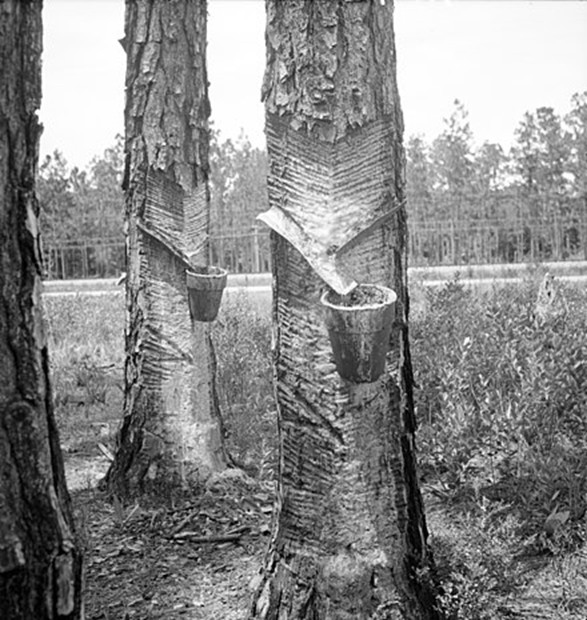
The trees were tapped to collect the resin. See the photo from Florida in the 1930s. The products collected were called naval stores. Other chemicals were produced and collected, including turpentine. Hemp fibers mixed with pine pitch were used to plug larger openings to keep rain and other weather out of ships, cabin walls and roofs. Wilmington, North Carolina, became the center of production, sales, and shipping of pine pitch products.
Turpentine, distilled from pine pitch, mixed with grain alcohol, was the primary fuel for lamps in the USA in the mid 1800s. The fuel was branded as Camphine. A tax on this fuel helped pay for the Union’s Civil War expenses.
So, today’s stickiness was gold in past centuries.




Have something to say? Share your thoughts with us in the comments below.