


Editor’s note: This column was produced before Gene Wengert died in 2025. It is printed here in memoriam.
Question: How much does lumber shrink in drying? We process red oak and yellow poplar mainly.
[Wood Doctor’s Note: CAUTION: The numbers widely published and used to predict shrinkage and swelling of wood in-use can be interpreted incorrectly. That is, the shrinkage for lumber being initially dried cannot be used for moisture changes in manufacturing and use. See Figure 4.2 in Wood Handbook: research.fs.usda.gov/treesearch/62200. Although there is a line between the three curves, this middle line is valid only if hysteresis, and large cycles of humidity occur. Likewise, for the formula for size change using formula 4-9.]
Answer: This is a good question indeed. The U.S. Forest Products Lab published, over 100 years ago, shrinkage values for lumber being dried. The numbers are from soaking wet to oven dry. These numbers are published for clear flatsawn lumber (shrinkage in the radial (r) direction) and for clear quartersawn lumber(shrinkage in the tangential (t) direction) during drying.
The lumber shrinkage values published in the Wood Handbook are for freshly sawn (often called “green”) moisture content (MC) to 0% final moisture content (FMC). Because we do not dry to 0% MC, but perhaps 7.0% MC (hardwoods) and 10% (softwoods), the tabular shrinkage numbers in the table should by adjusted by multiplying the tabular values by [1 - (FMC / 30]. For hardwood dried from green to 7% FMC, [1 - (FMC / 30)] = 0.77; softwood dried to 10%, = 0.67.
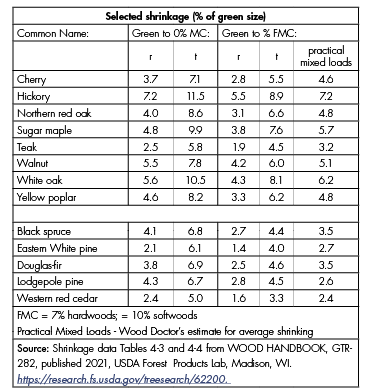
The table shows some examples of total “r” and “t” shrinkage to 0% FMC, and 7% FMC (hardwoods) and 10% FMC (softwoods).
Then “t” values are the thickness shrinkage for perfectly quartersawn lumber. As it is rare to produce perfectly quartersawn, the “t” values represent a rare piece of lumber. Stated another way, perfectly quartersawn lumber shrinks more in thickness that any other grain orientation.
Then “r” values are the thickness shrinkage for perfectly flatsawn lumber. As it is rare to produce perfectly flatsawn, the “r” values represent a rare piece of lumber. Stated another way, perfectly flatsawn lumber shrinks less in thickness that any other grain orientation.
The shrinkage from green to 7.0%MC of most pieces will be between the “r” and “t”values; see “practical” heading in Table.
From a production viewpoint there will be some variation of thickness from piece to piece and even within an individual piece. As a result, the sawmill will typically cut lumber thicker than the 1.00 inch required for 4/4 lumber. (Technical note: Hardwood lumber grades are based on the clear area present. So, the actual thickness of green or air-dried lumber is the thinnest spot of the clear grading area. Wane is not a thickness issue as wane is not considered part of the clear grading area.)
In case it is new to you, designations like 4/4 and 6/4 refer to the thickness in quarter-inches. The slash is a division sign. So, 5/4 is 1.25 inches.
Kiln dried rough lumber 2/4 through 7/4 can be 1/16 inch scant of the standard thickness. For example, 4/4 can be 15/16 inch. Kiln dried rough 8/4 and thicker can be 1/8 inch scant, with special exemptions.
There are special rules for surfaced lumber. For example, 4/4 surfaced lumber can be as thin as 13/16 inch.
Shrinkage in Width: For perfectly flatsawn, use “t”; for perfectly quartersawn, use “r”.
Buyer and seller can make special arrangements on thickness.
Q. I have some air dried lumber that needs to be sterilized. After sterilization, I will put it in my Nyle dry kiln, which only gets to 115F, rather than the 130F required for sterilization. I am worried that I will damage the wood when I go to 130F in a separate chamber. What advice do you have?
A. I need to make sure you understand the sanitizing process. Several decades ago someone in the government decided that the correct temperature for sterilization or sanitation of lumber was 133F. This temperature had to be reached throughout the entire piece of lumber and not just on the surface. To achieve 133F throughout a piece of lumber in a reasonable length of time, the ambient air should be 145F or hotter. Cooler temperatures take too long to assure that 133F on the interior of the wood has been reached.
Second, the idea of heating wood to 133F is to kill all the lyctid powderpost beetles – larva, eggs, and so on. However, this species of powderpost beetle doesn’t infect wet wood but instead prefers wood under 20% moisture content. Unless lumber has been air dried for many months or the environment is especially dry, it is unlikely that air-dried lumber will be infected with the lyctid powderpost beetle, which likes very dry hardwood. No other insect except the termite can infect both wet and dryer wood.
Third, you need to define what moisture content the lumber is at now. There is no firm definition of what air-dried means. Some people think 20% to 25% MC is appropriate, while others believe that under 40% MC is enough. Nevertheless, heating wood to 133F above 10% MC has no or minimal benefit.
In other words, sanitation of wood is done at the end of the drying cycle. As you appreciate, many dry kilns exceed 145F as part of the normal kiln operation. But in an older kiln like yours, we need to provide the supplementary heat at the end of the cycle, most likely in a separate chamber.
Fourth, when heating wet wood, above 15% MC, The temperature of the wood is most likely closer to the wet bulb temperature then the dry bulb temperature. (The dry bulb temperature is the standard air temperature measured with a thermometer that is dry. The wet bulb temperature is the temperature of a thermometer that has a wet wick on it. This wetness of the wet bulb causes the temperature to drop – a small drop at high and a larger drop at lower humidities.)
Kiln drying wood that is above 25% MC will cause the wood, because it is wet, to have a temperature significantly below the air or dry bulb temperature — close to the cooler wet bulb. For this reason, the ambient air temperature during sanitation of wood needs to use a dry bulb temperature of 145F or hotter to assure that the wood temperature, which is closer to the wet bulb temperature, will reach 133F. This wet bomb effect is also the reason that dunnage, which is very wet, is heated with live steam (212F approximate wet bulb temperature). Some literature seems to confuse ambient air temperature with the temperature throughout the piece of wood. These people are confused.
Fifth, you need to appreciate that sanitation is only assured while the temperature exceeds 133F. It provides no lasting protection after the lumber is cooled and potentially exposed to the lyctid powderpost beetle.


Have something to say? Share your thoughts with us in the comments below.