


One of the first things you will learn about lean manufacturing is the two pillars established by Toyota.
• Respect for people
• Continuous improvement
We all get pretty good about the continuous improvement part. After all, there is copious amounts of information about it, books, videos, you name it, and a quick Google search will find it.
But when it comes to respect for people, there is almost nothing to be found, and we are all left to guess and assume what that means and how to deploy it.
All too often, I think respect for people translates into keeping everyone at all costs. This column is dedicated to those people you know you should let go, but for some reason or another keep them around.
This was inspired by messages I got the other day from one of our customers:
“Hey, gotta vent for a minute. We are a team of five, and we have one guy who has been with us for eight years. His skill set is very limited, and attendance is very unpredictable. Our lean journey is about 10 years old, but religiously for over a year. Since joining Quantum Lean. He argues about every video of yours and refusing to read the “2-Second Lean” book. We are “brainwashing,” and “we are like the military.”
This employee’s comments alone are enough to send me off the deep end. My favorite part is the comment about being like the military.
Was that supposed to be an insult? You mean we are like the group of brave men and women who defend our nations?
Who go to work with passion and a meaning far greater than a paycheck? The same group that all dresses the same, exercises together and would put themselves in a position to die for one another?
Yeah, I’m 100% ok with being called “like the military.”
I think we can go one level deeper on this for anyone working at any factory any size. And feel free to read this to your people as I think it’s important, and most people don’t realize it.
We should be more like the military, because they are not the only ones at war. We are too.
If you think for one second your competitors are not trying to kill you, you’re crazy. Any business is dog-eat-dog, and you are no exception. Your competition wants to eat your lunch, take your customers and remove the very business you have that feeds your family and puts your children through school.
Is that not worth fighting for? Is that not worth reading a book or two? Or doing some things that your competition isn’t doing?
In the case of business, our only defense is to outwit our competition. Find better ways for orders to flow from one end of the factory to the other.
Lucky for us some very smart people have already figured this out, all we have to do is study them, then practice it. Is that really too much to ask?
Practicing lean is not just to benefit the employer. It’s for everyone in the company, so that they may provide for their families, and see that all of our children have a better life than we did.
Rant over, let’s jump back onto the subject of “Respect for People.”
So, you have one of these people and you’re hanging on because perhaps they are talented, or hold valuable tribal knowledge.
Maybe you are taking too much responsibility for their behavior. You think if you just did a better job helping them, they would come around.
I came to this realization about five years ago. I was in the latter category, I knew there must be a better way to help them, I just needed to learn it. What I learned was I have a woodworking company to run, and I’m not Tony Robbins. It’s past my ability to help everyone, so it’s a simple case of, “I’m not smart enough for you to work for me.”
Maybe someone else can save them, but when it comes to respect for people, I also have to consider the rest of my team. If setting one person free to save everyone else is what I have to do until I can improve, then so be it.
One of my favorite sayings in our little lean community is, “No matter how hard you try, you can’t turn a donkey into a racehorse.”
Letting people go is probably the hardest and worst job any one can imagine. Even though we have done it many times, it never gets easier to make that decision.
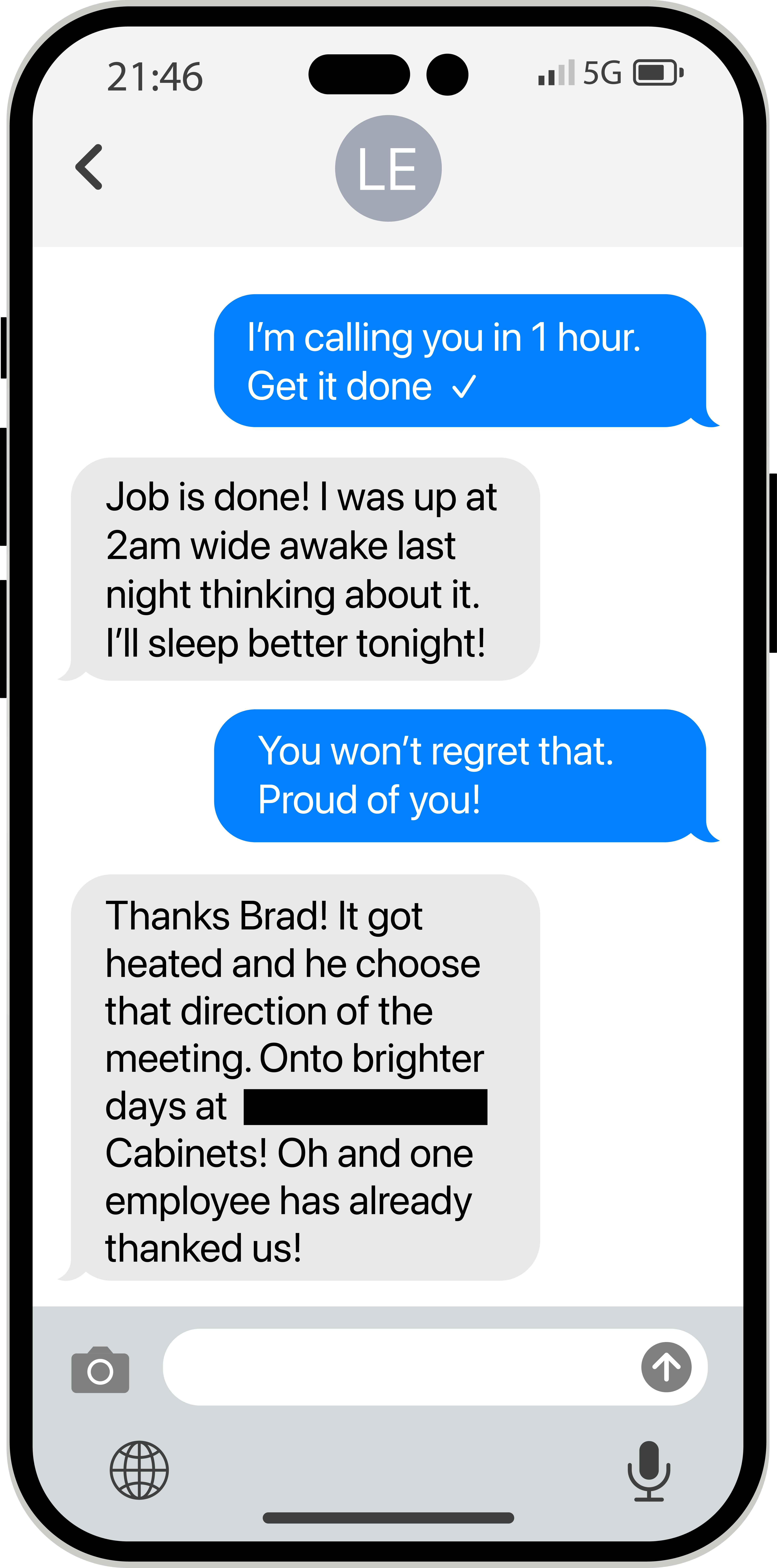
However, the pattern that follows is almost exactly the same every time. It starts with kicking yourself for not doing it sooner, followed by the rest of your team thanking you.
This was the message I got after the person was set free to pursue their dreams of not being lean somewhere else.
What pissed me off was myself. I let someone who didn’t want help affect my personal life and get to me. He was with us for almost 9.5 years and should’ve been two months! I always think of a quote from Lynn Thomson of Quantum Lean: “You get what you tolerate.”
At my company, we make sure to send all those people to our competitors with a raving review.



Have something to say? Share your thoughts with us in the comments below.