


Lets face it, we all have that one spot in our business that we know is a problem, and we spend copious amounts of time talking about it, arguing about it, and usually in the end, we walk away with little or no action associated with fixing the situation.
Why is that?
People operate in small bubbles of immediate gratification. If it can’t be solved in 15 minutes, it gets put on the back burner because there are 400 other things that require our attention.
But, there is a solution for tackling this problem. Companies worldwide use this approach. The globally accepted name for this is a “Kaizen Event.”
In a nutshell, this is a selected group of people in our company tasked to solve a specific problem you’re experiencing. Why would you want to do this? Well, let’s review some typical results:
- Cut lead time by 90%
- Reduce staffing requirements
- Reduce inventory by 50%
- Reduce floor space by 50%
- Reduce defects by 60%
- Reduce transportation waste by 90%
- Cut set up times by 90%
- Connect the customer to the shop floor
That might sound unattainable, but you know the crazy part: Those are conservative numbers!
Setting the target
I have been doing these for years and just when you think you know something, you talk to someone who knows more. I just had the pleasure of sitting down with Art Byrne, who wrote “The Lean Turnaround.” Something he said hit me like a freight train. It was about setting the target for a kaizen event.
Let’s say you have a bottleneck operation that produces 100 pieces a day. It is reasonable to think that a one-week kaizen event would yield a 20% increase, which would be pretty good, right? Wrong. The goal is to set the target so out of this world crazy that no one can think, “We will just work a bit harder, and we can hit it.”
If you remember one point from this article, make it this one: The target should be so high that the only possible solution is to change everything. It snaps people out of the idea that the way they are currently doing just needs a small tweak. We want everyone going into this with a total blank slate. If you’re doing 100, target 300 with the same labor, same machines and same space.
Get organized
Here’s how to get organized:
- Facilitator: Who is going to facilitate this? Should be an experienced lean leader.
- Timing: Decide on the duration of your kaizen event. Four days is pretty typical.
- Team: Who will be on the kaizen team. Make sure you include people from other departments.
- Define the current state and why it needs to change.
- Targets: Set the new targets (make ’em big!).
- Requirements: Include financial, space, resources and tools.
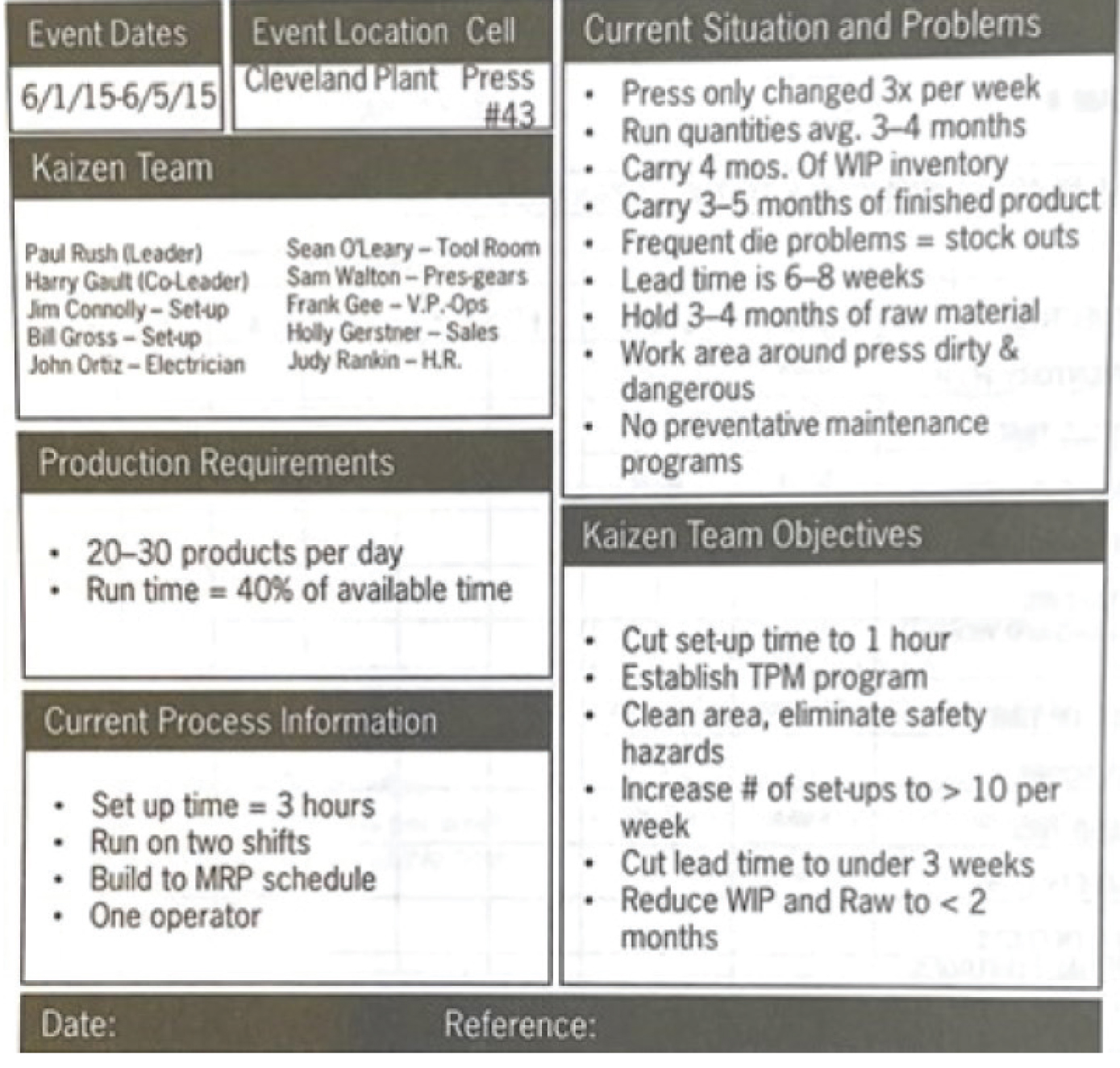
Now you can create a simple Kiazen event chart (see below)
Now the fun part!
This will be the magic sauce for 99% of kaizen events, but feel free to tweak.
Step 1: Get the team to execute the current process as it’s being done today. And video the whole thing.
Step 2: As a group, go to a meeting room or somewhere where everyone can watch the video. Watch it as many times as you need to, pausing and discussing where necessary, but the goal is to identify all the opportunities for improvement. Everyone must take notes.
Look for internal vs external set up. That’s basically, how many tasks can be done while the machine is running that you usually do after it stops. This may seem like waste from an operator perspective, because perhaps there is more movement or transportation on the part of the operator, but in the counterintuitive world of lean manufacturing, sometimes you have to watch the figurative baton, not the runners.
Step 3: Compile notes and ideas to develop a trial run of the process with the new ideas and improvements. This might require moving machines, building things, or learning new techniques. So, turn everyone loose playing on their strengths to get what you need done.
Step 4: Run the experiment! Do a couple dry runs to get the hang of it. Write down the rough steps so people can follow a standard. When you feel like you’ve got it, then video the new process.
Go back to Step 2 and repeat. Do this loop over and over until you have exhausted all the ideas your team has. Note the improvements compared to your Kaizen sheet with the targets on it. Likely you will have hit or surpassed your targets. If not, it might be time for expert advice or broader team input.
This is too easy!
If you are thinking, “This sounds too easy,” you’re right. It’s not hard, and your people already have all the answers. The hardest part is just giving them the time. Art Byrne said every CEO needs to do 12 Kaizen events per year. I don’t know any CEO doing a full Kaizen per month. If it was easy, everyone would do it.
If you have any questions about doing a kaizen event or would like some help. Just text “KAIZEN” to 519-494-2883 and we will send you the kaizen form and some digital assets to help you along the way.



Have something to say? Share your thoughts with us in the comments below.