


 The threat of fire continues to grow and evolve in the woodworking industry. Just this past year, my employer, Pennsylvania Lumbermens Mutual Insurance Company (PLM), has seen significant increases in fire claims, most notably caused by dust explosions.
For business owners in the sawmill space who want to stay ahead of this trend, while keeping their insurance costs from spiking, good housekeeping, partnered with a comprehensive dust mitigation program, is key.
What is fueling this trend? Higher fire frequency and increased claims costs are putting pressure on insurers to raise premiums. At the same time, increasing losses have led several insurance companies to exit the wood niche, tightening capacity.
Severe fire claims like these are increasingly complex as supply and equipment prices rise and extended building times become the norm. Many business owners are finding their businesses are underinsured, realizing they may not have the funds to replace inventory or rebuild structures in the event of a fire. Further, these claims leave business owners in a precarious position as they navigate reopening. Often, in the time it takes for the business to recover from a fire, reliable staff members have left for competitors and customers have found new vendors to fill their wood product needs leaving business owners with shortfalls in staffing and revenue.
The truth is that one major fire can entirely derail a woodworking business. For this reason, as well as for the safety of your team, business owners and safety managers should take time now to reassess the leading fire causes and best practices for addressing them.
What causes a fire?
Inconsistent housekeeping programs are the most frequent source of fires we see today. Too often, significant sawdust accumulation serves as a fire source at woodworking businesses. With enough sawdust, a simple spark can cause a fire so massive that fire extinguishers will not be able to stop the spread and by the time the fire department arrives, nothing can be done.
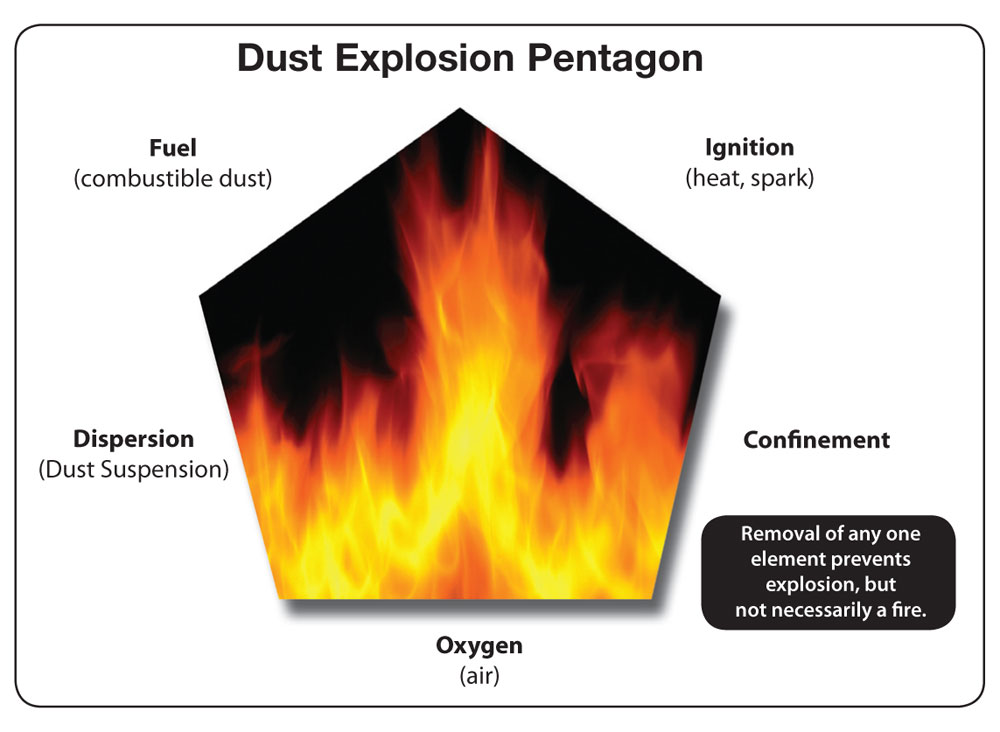
Dust accumulation also frequently leads to explosions when combined with poor safety practices. We recently worked with a large sawmill facility with a professionally designed dust collection system. This customer had installed the system themselves to save money. They failed to consider the complexity of the system and did not set up the abort gate correctly. Later, when a spark ignited, the spark detection system failed to extinguish the spark. Without a properly maintained spark detection system and abort gate, the spark was able to reach the sawdust silo, leading to an explosion so powerful that it fractured the silo. Debris from the explosion also caused damage to their boiler and several additional structures. The damages from the incident totaled several million dollars.
What lessons can woodworking business owners take from this example? A focus on risk mitigation and doing things correctly can greatly reduce fire incidents and the corresponding claims.
An emphasis on safety
Start your safety program with a focus on housekeeping, regular maintenance, the right technology, and training.
All woodworking businesses should have a formal housekeeping program in place. Dust accumulated just to the thickness of a dime can create an ideal situation for an explosion. For smaller operations, a simple checklist detailing key cleaning practices is sufficient. Safety managers should have comprehensive cleaning schedules in place that call for the cleaning of rafters and trusses and opening electrical panels to carefully remove any dust. These schedules should include daily and weekly cleanings and a quarterly dust inspection by supervisors.
At PLM we also recommend regular equipment maintenance. All equipment and motors should be regularly checked and deep cleaned, including under the machines where sawdust often builds up most, to prevent any unnecessary exposures,
Investing in the right technology for risk mitigation can also pay dividends. For example, dust fans are available that prevents dust from accumulating on trusses and in hard-to-reach places.
In addition, any woodworking company with more than five major woodworking machines with a dust collection baghouse should have a spark detection and suppression system, abort gate, and an explosion isolation valve. These can prevent explosions that can injure employees and destroy buildings. Additionally, professional thermal imaging can help identify hotspots in motors and electrical panels. If a woodworking company does decide to invest in thermal imaging equipment, consider professional training to properly interpret images and determine at-risk areas.
In addition to these steps, training is always key. Team members should be trained at hire to understand their cleaning responsibilities. There should also be an annual refresher where a supervisor conducts a walkthrough of all necessary housekeeping tasks with the team. Lastly, in the event supervisors notice any notable safety issues, there should be retraining on the how, where, and why associated with the risk exposure.
Sawdust is a dangerous threat to operations in the woodworking industry. One small spark can bring down a business. A comprehensive insurance policy, preferably provided by a reputable insurer who knows the wood niche, is key, but should not stand alone. Good housekeeping, maintenance, technology, and training can greatly minimize your risk of fire, reduce potential damage and down time, and bring your business back to safe operation as soon as possible. Consider revisiting your fire safety plan and ensure your team is taking the risk seriously with enforced, comprehensive cleaning and safety procedures before a fire ignites at your operation.
The Author
Mike Seiwert is a senior loss control representative with Pennsylvania Lumbermens Mutual Insurance Company (PLM), the oldest and largest mutual insurance company dedicated to the wood products and materials industry. He can be reached at [email protected]. To learn more about PLM, click here.



Have something to say? Share your thoughts with us in the comments below.