

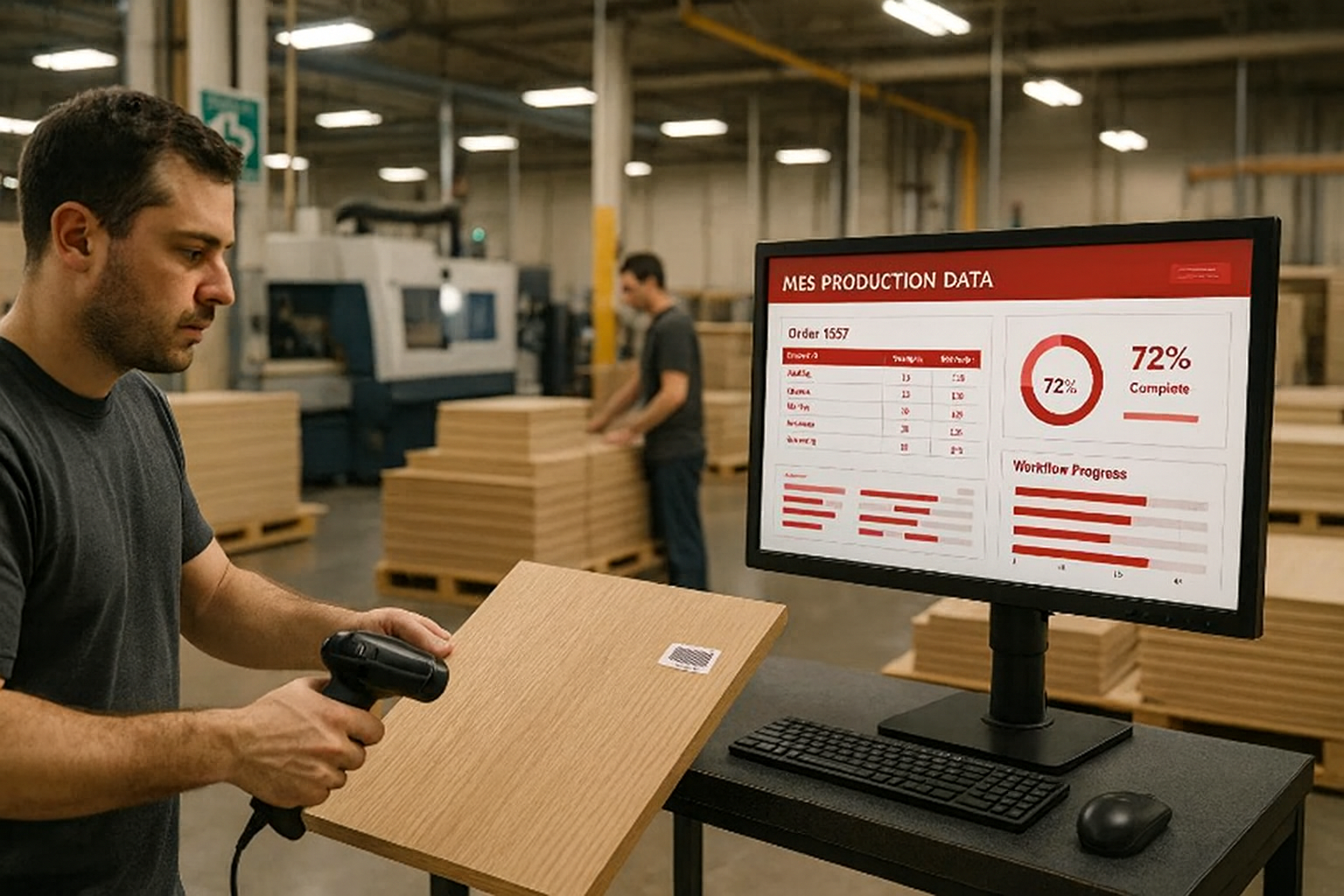
Implementing a Manufacturing Execution System (MES) has become a best practice for kitchen cabinet manufacturers seeking to modernize operations. An MES is the digital bridge between designing cabinets using CAD/CAM software and delivering information to business planning systems, such as ERP. In other words, it fills the gap between the drawing board and the boardroom, ensuring that what gets designed in theory is executed efficiently on the shop floor.
As labor shortages and the drive for efficiency push the industry forward, MES technology is no longer a luxury – it’s a strategic necessity.
MES: Bridging design and ERP
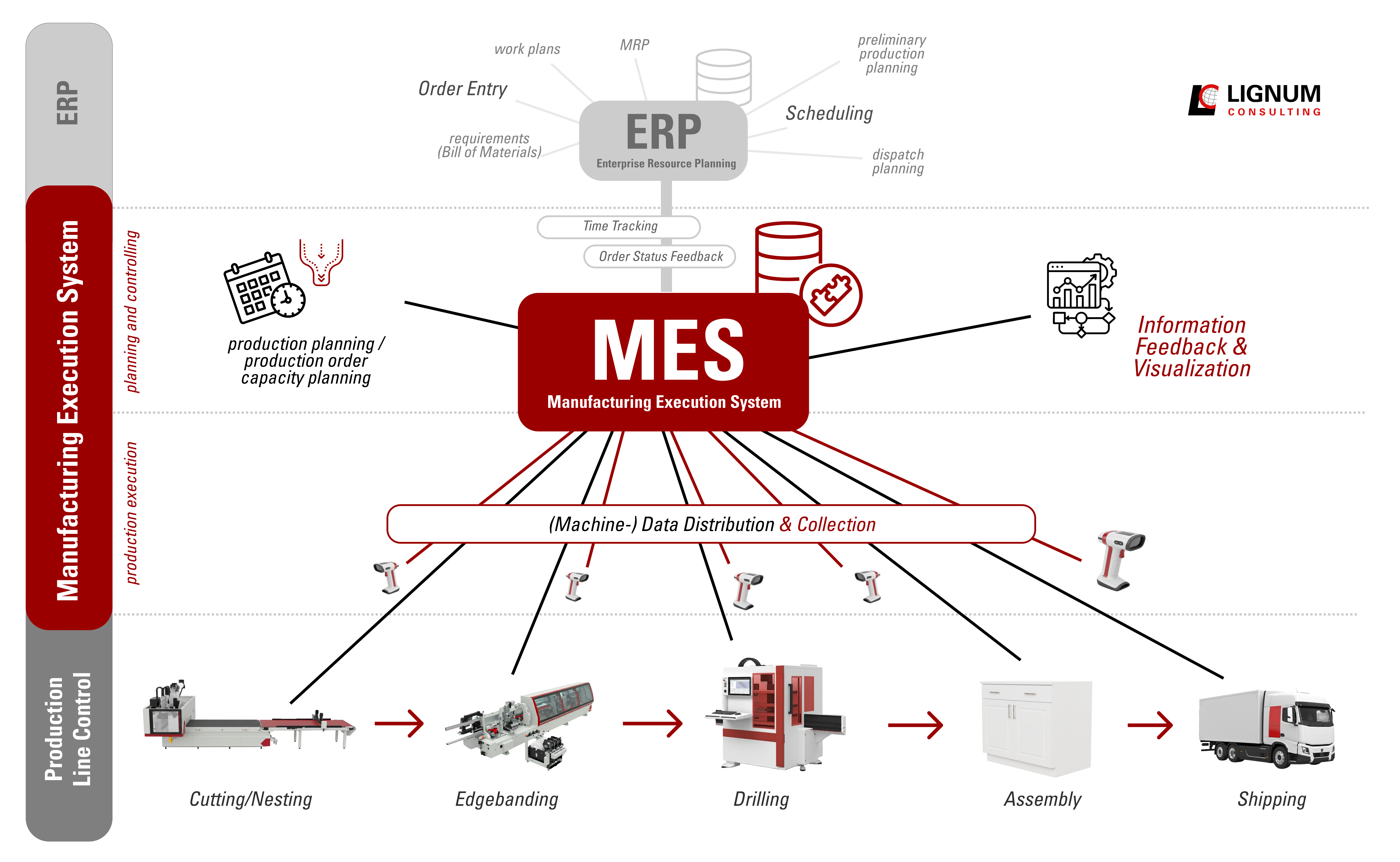
Well-implemented MES systems link technical design data to real-time production management and feedback with enterprise systems. Unlike ERP, which handles a wide range of business functions, MES tracks every cabinet component and its production status step by step.
For instance, a mid-sized cabinet shop designing kitchens in CAD can send cutting lists and CNC programs directly to the MES. The system then monitors each board cut, drill, and assembly task in real time, sending completion data back to the ERP.
This closed loop leads to better coordination: sales orders update as cabinets progress, and design changes or rush orders are instantly reflected on the shop floor. In one family-owned plant, switching from paper job travelers to barcode-scanned MES tracking eliminated manual entry and cut errors. It provided workers with live visibility of progress on large screens – improving both workflow and morale.
Adapting MES to automated and manual environments
Every cabinet operation is unique; some are highly automated, others are more manual. Best practice means tailoring the MES to fit the environment:
- Automated factories: MES integrates directly with networked machines and robotics. Automated saws, CNC routers, and edge banders feed data to the MES without human intervention. Modern production can achieve over a 40% increase in throughput at its bottleneck edgebander once MES is fully integrated with machine data.
- Manual or mixed shops: Here, MES supports people with simple, user-friendly tools. Barcode scans or tablets at workstations log progress without slowing down operators. With such systems, producers can enhance assembly reliability by introducing MES-driven kitting, ensuring that each cabinet batch is complete before proceeding – thereby dramatically reducing rework.
The lesson: configure MES to fit your process, whether that means orchestrating conveyors or prompting a person to confirm a step.
Keys to a successful MES implementation
From industry experience, four best practices consistently stand out:
- Strategic Planning: Define clear objectives (reduce lead times, cut waste, improve delivery) before selecting software or equipment.
- Data and System Readiness: Standardize part numbers, product codes, and BOMs; equip machines with scanners or interfaces; pilot on one line before scaling.
- People and Training: Involve managers and operators early. Provide training, appoint “MES champions,” and emphasize how the system reduces paperwork and guesswork.
- Continuous Improvement: Treat MES as an ongoing journey. Use its data to identify bottlenecks and refine processes on a regular basis.
The role of independent guidance
MES projects succeed when technical rollout aligns with organizational goals. Many manufacturers benefit from engaging a neutral, industry-focused facilitator who can assess readiness, guide system selection, and lead change management. Vendor-neutral expertise ensures the MES supports the business rather than dictating it – and that improvements last long after going live.
Implementing MES in cabinet manufacturing connects people, machines, and data in real time. It bridges the gap between design and production, offering strategic benefits such as improved visibility, increased efficiency, and on-time delivery. The best results are achieved by customizing the system to fit your production style, preparing data and staff, and utilizing MES as a platform for ongoing improvement. With careful planning and a focus on best practices, MES can evolve from an industry buzzword to a daily reality – creating smarter, more efficient operations that are equipped for today’s challenges and future opportunities.
About the author: Cornelius Timmermann, a senior consultant at Lignum Consulting Inc., assists the wood and furniture industry in addressing its evolving challenges and offers expert guidance to enhance operational efficiency and drive growth. He can be reached at [email protected].



Have something to say? Share your thoughts with us in the comments below.