

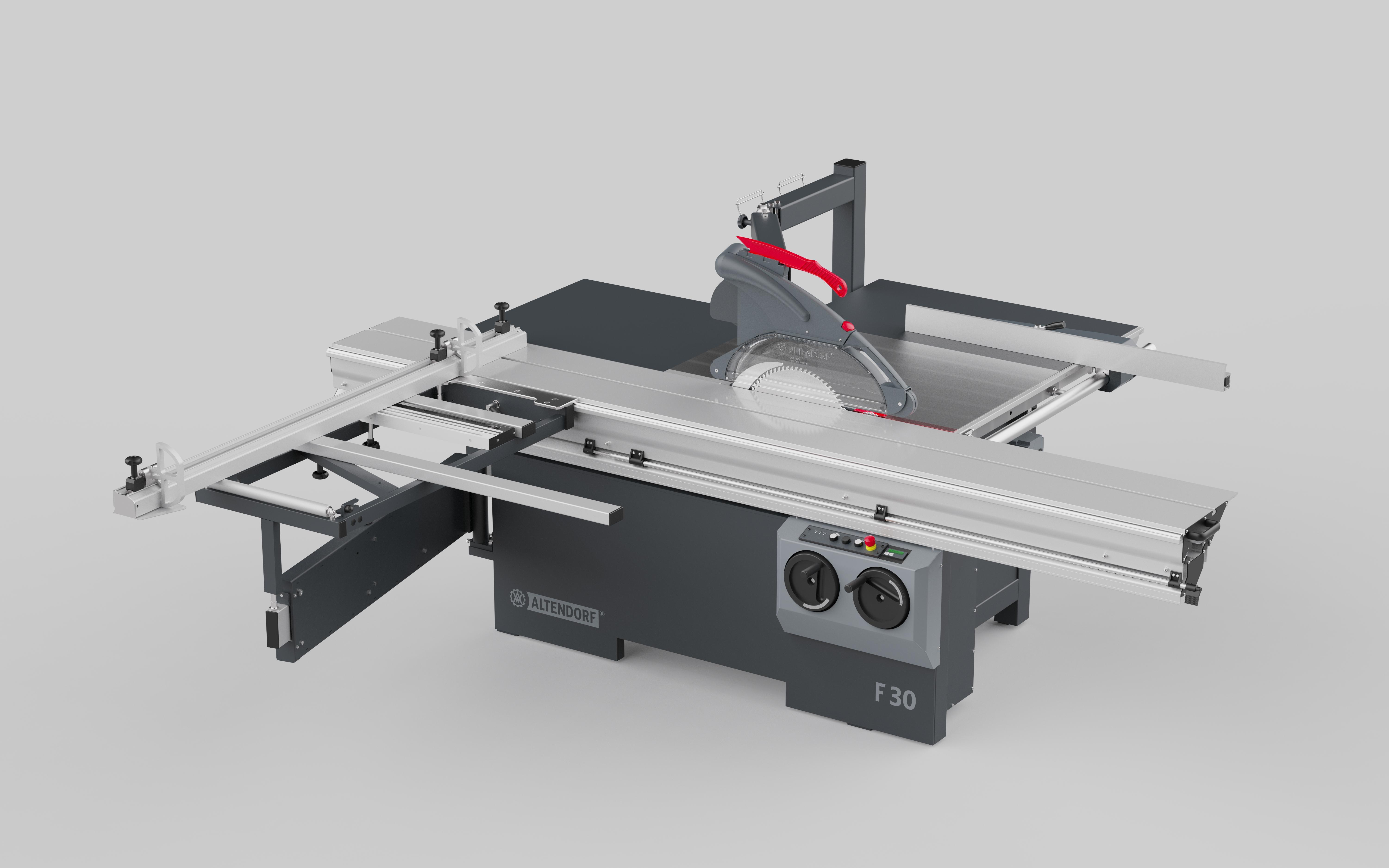
With the new Altendorf F 30, Altendorf is expanding its portfolio with a sliding table saw for the craftsman segment. The F 30 was developed specifically for businesses that value precision, stability, and clearly structured operation – while also offering an attractive entry point into the world of Altendorf sliding table saws.
As a further development of the company's well-known WA-8/80 series, the F 30 closes the gap between the F 25 and the F 35. It takes, the company adds, familiar workflows and combines them with modern technology, offering a future-proof solution for classic applications in the craft sector.
Robust construction for everyday use
The F 30 is based on a particularly stable, five-sided closed machine stand in a tubular frame construction. The solid machine table made of ribbed cast iron ensures smooth running and consistently precise cutting results – even with intensive use.
The 3,200 mm long double roller carriage, based on the proven Altendorf system, ensures smooth, play-free guidance. An additional hard chrome-plated round bar serves as a precise interface for accessories and supports maximum angle and dimensional accuracy.
 Flexible equipment options
The new F 30 is available in several variants – from solid basic equipment to advanced digital functions. Depending on the model, analog or digital displays, motorized adjustments, and CNC-supported stop systems are available. This allows the machine to be specifically adapted to different requirements in craft businesses:
- Type 1 is the mechanically focused entry-level solution. With a powerful main motor, three selectable speeds, and an analog cutting width display, it is aimed at businesses that value robust, clearly structured operation.
- Type 2 adds digital displays and motorized adjustments to the equipment. The rip fence with digital cutting width display up to 1,300 mm and an integrated scoring unit enable precise and tear-free cuts – especially with coated panel materials. This variant is therefore suitable for businesses that combine solid wood and panel processing and want to increase their process reliability.
- Type 3 offers Altendorf an entry into CNC-supported precision. The electrically driven, CNC-controlled rip fence ensures reproducible settings and reduced set-up times. The optional DIGIT L digital length display complements the range of functions and supports exact measurement transfer in series or repeat operation.
Powerful main motors with up to 7.5 kW, three selectable speeds, and the company's Pro-Lock quick-change tool system ensure efficient work and high productivity. Optionally available scoring units enable clean, tear-free cuts in coated panel materials.
Modern requirements
During the development of the F 30, particular emphasis was placed on clear, ergonomic operating logic. All controls are clearly visible and easily accessible. Depending on the equipment variant, digital displays support precise adjustment and increase operating comfort without losing the familiar character of classic Altendorf machines.
With the F 30, Altendorf is specifically targeting craft businesses that are looking for a robust, precise, and versatile sliding table saw—as an entry-level solution or as a replacement for existing machines. According to the company, the new series combines "proven quality and modern technology in a balanced overall package."


Have something to say? Share your thoughts with us in the comments below.