

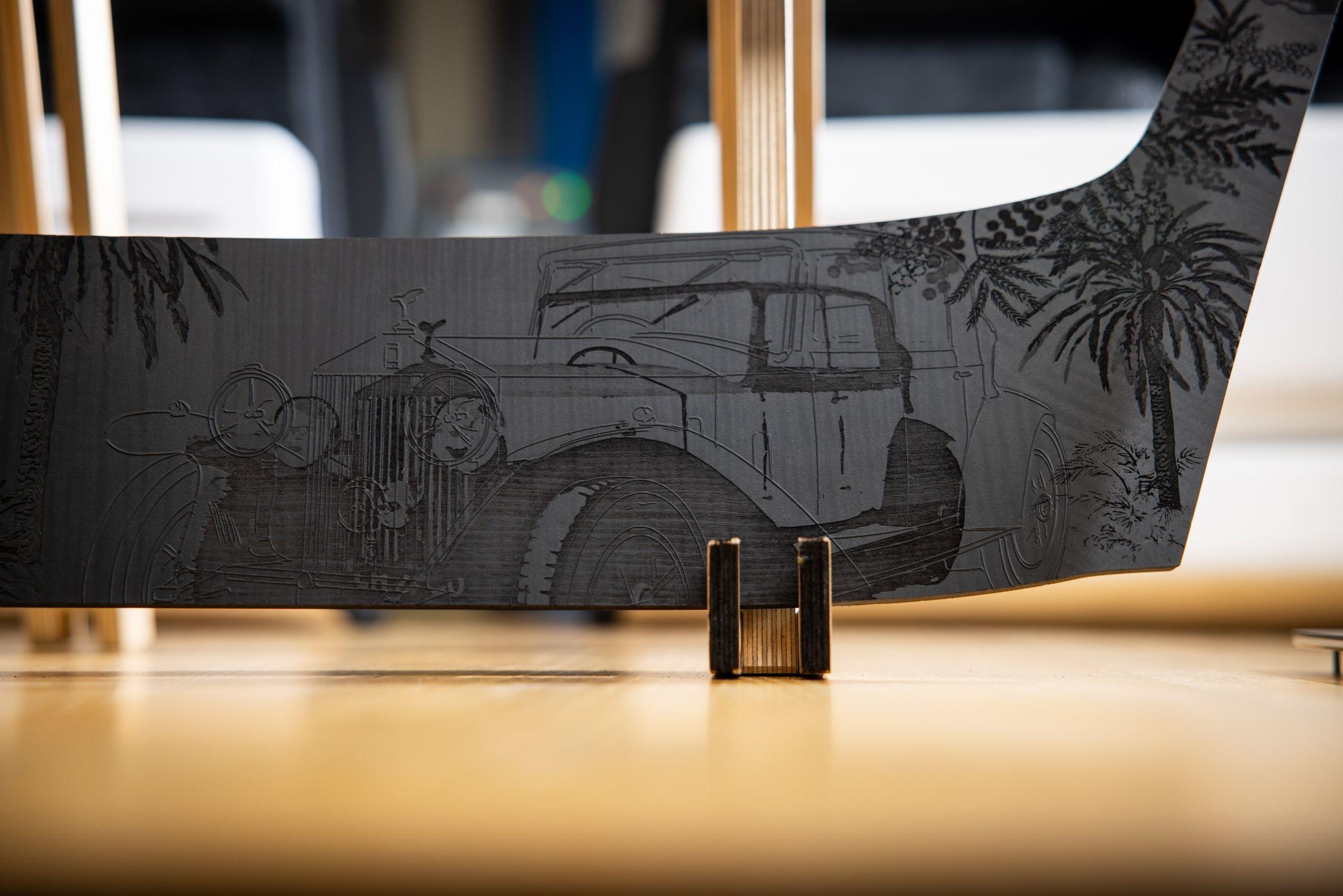
Rolls-Royce has revealed its "most intricate woodwork ever" that blends laser etching, 3D marquetry, ink layering, and 24-carat gold leaf artistry to create a textured wood sculpture that captures "places, moments and journeys" that have shaped over time the Phantom model, an iconic, century old Rolls Royce vehicle.
Artisans from the the home of Rolls-Royce at Goodwood, West Sussex, England, undertook special training as part of a one-year development process to create an interior reserved for an exclusive Rolls-Royce Private Collection, soon to be revealed to celebrate Phantom’s centenary. The Phantom, which debuted in 1925, was a low volume, hand-built limousine, which in its first four generations was custom coachbuilt to the customer's requests, and sometimes extravagant desires.
Each composition, crafted in Blackwood veneer, tells a different story. The scenes are first sketched by hand, then translated into digital form and recreated in wood. These innovations give the woodwork an intricacy and richness that hint at the extraordinary methods and technologies behind their creation, according to Phil Fabre de la Grange, Head of Bespoke, Rolls-Royce Motor Cars.
“Our Bespoke Collective of designers, craftspeople and engineers are exceptional at what they do," he said. "To honor Phantom in its centenary year, they pioneered groundbreaking techniques in their mastery of wood, combining 3D ink layering, 3D marquetry and gilding within a single surface.
"These intricate processes push materials to the limits of their natural tolerance, transforming each panel into a stunning, tactile sculpture. Having seen first-hand the challenges and possibilities with wood techniques at Rolls-Royce, I can say with certainty that the Collective has unlocked remarkable new possibilities for Bespoke, a breakthrough made possible by their extraordinary dedication to the Phantom nameplate on its 100th anniversary.”
In 2025, Rolls-Royce Motor Cars marks the centenary of Phantom – a name that has defined the pinnacle of luxury for 100 years. Across decades and continents, Phantom has remained the measure of what can be achieved when the rarest and most precious materials are placed in the hands of master craftspeople.
To mark this milestone, Rolls-Royce will soon unveil an exclusive Private Collection. For this landmark motor car, which honours the brand’s pinnacle product, designers, craftspeople and engineers pushed their artistry further than ever, developing three woodworking techniques never before seen on a Rolls-Royce: 3D marquetry, 3D ink layering and gold leafing.
Intricate doors
The interior door treatment created for the upcoming Private Collection to celebrate Phantom’s centenary is the most complex and detailed in Rolls-Royce history, with every journey etched into its surfaces. According to the company, it took a full year to develop these pieces alone, "pushing the medium of veneer to its sculptural limits." The artwork visually blends geographical maps, winding routes, sweeping landscapes, floral elements and depictions of experimental models into a single, stunning composition.
The creation of the door pieces is achieved by individually crafting sections of the overall composition and then assembling them like an intricate mosaic. Rendered in Blackwood, selected for its unique grain pattern, the design uses textures, contrasts and reflectivity to celebrate the material, creating a rich visual effect with a monochromatic palette.
Oversized veneer sheets were specially commissioned for this project to accommodate the generous size of Phantom’s doors. Based on the natural grain pattern of the piece, each of the large veneer leaves is assigned to a specific section of the composition. The designer responsible gave particular consideration to how the grain catches the light at different angles, ensuring that new details and textures are revealed at every glance.
To ensure nothing detracts from the overall composition, Phantom’s metal speaker grilles are replaced by small openings milled directly into the wood. The expansive panel is then stained to ensure absolute color uniformity.
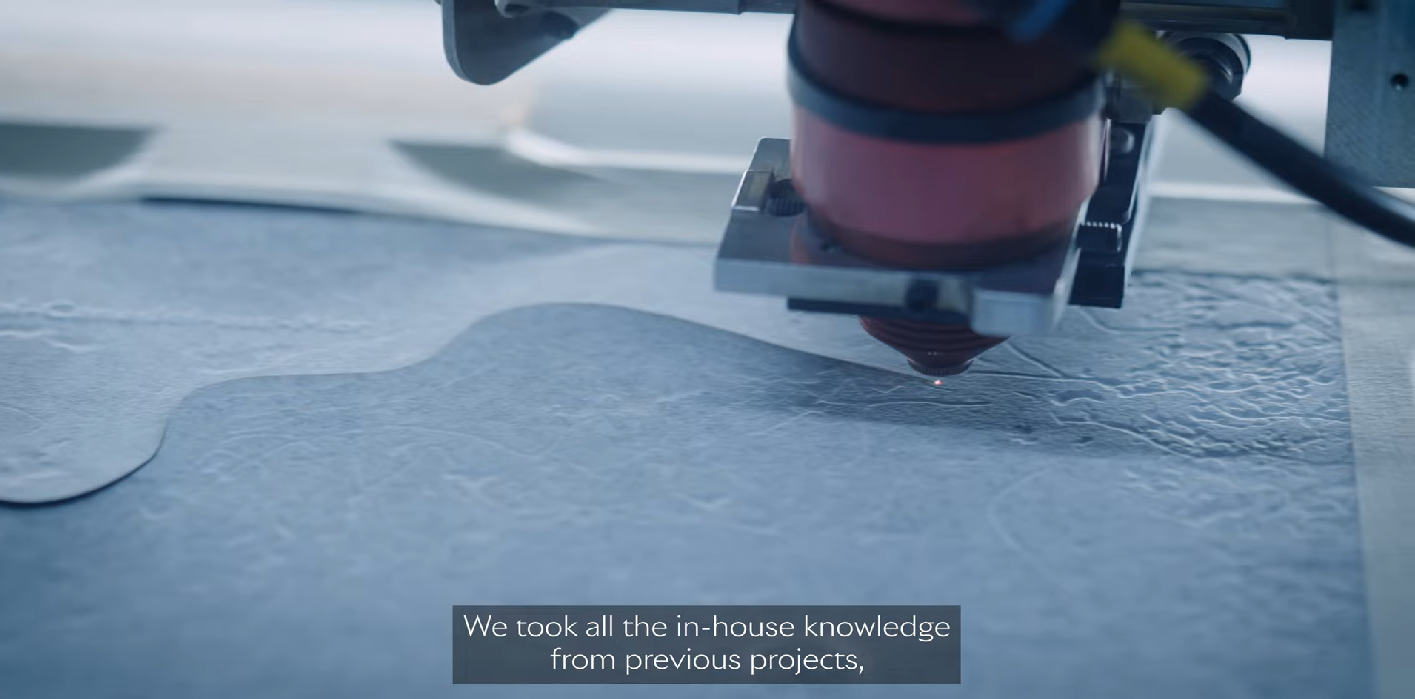
Laser-etched elements
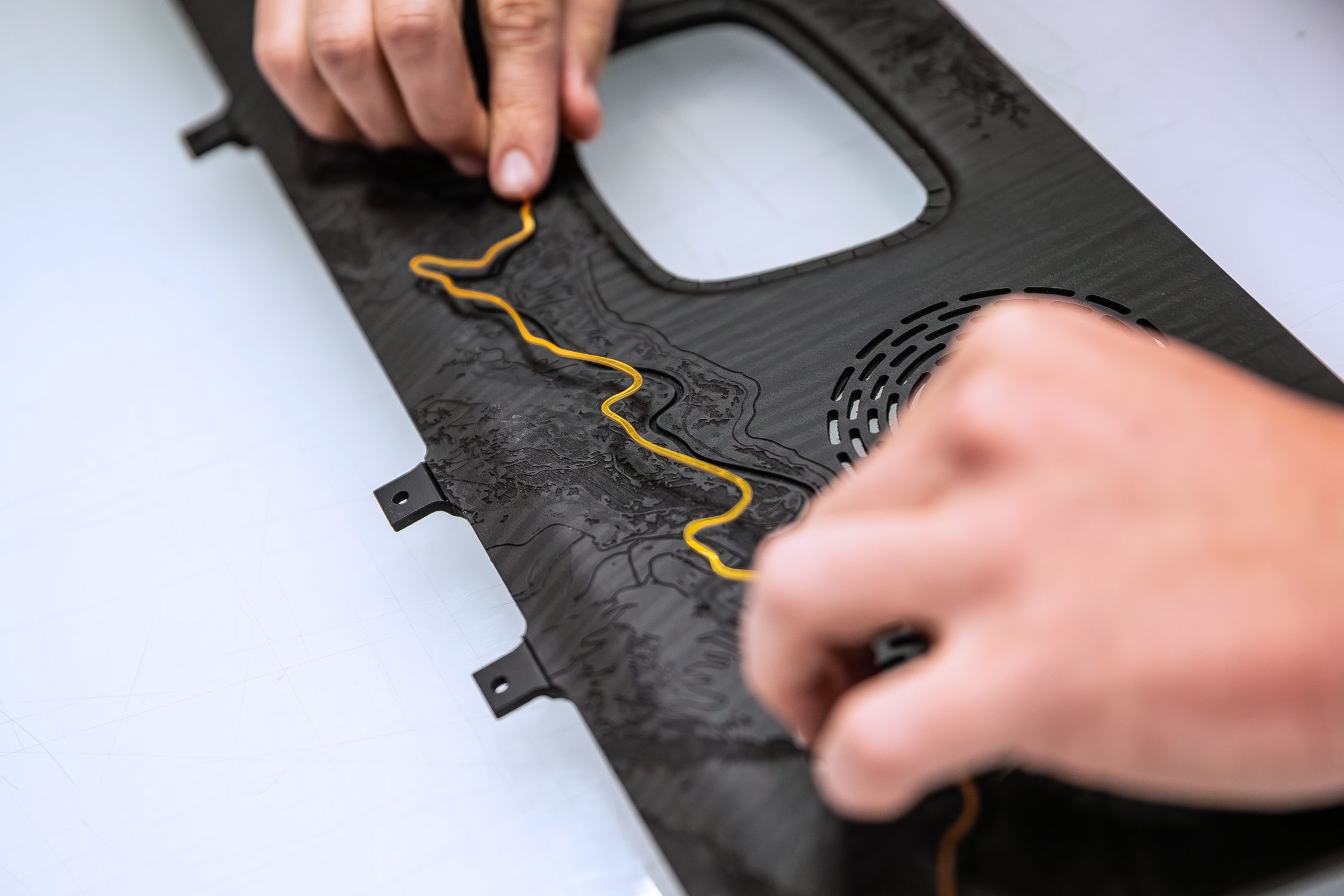
The design motifs, which include maps, landscapes, flowers and trees, are etched onto the wood at three different depths using a laser, each line of light and shadow carrying echoes of Phantom’s century of stories. Areas more deeply-etched into the wood appear to be darker, providing a contrast to the more reflective surface of the unetched veneer. This produces subtle shifts in colour and light, adding a sense of movement and texture beyond the linework.
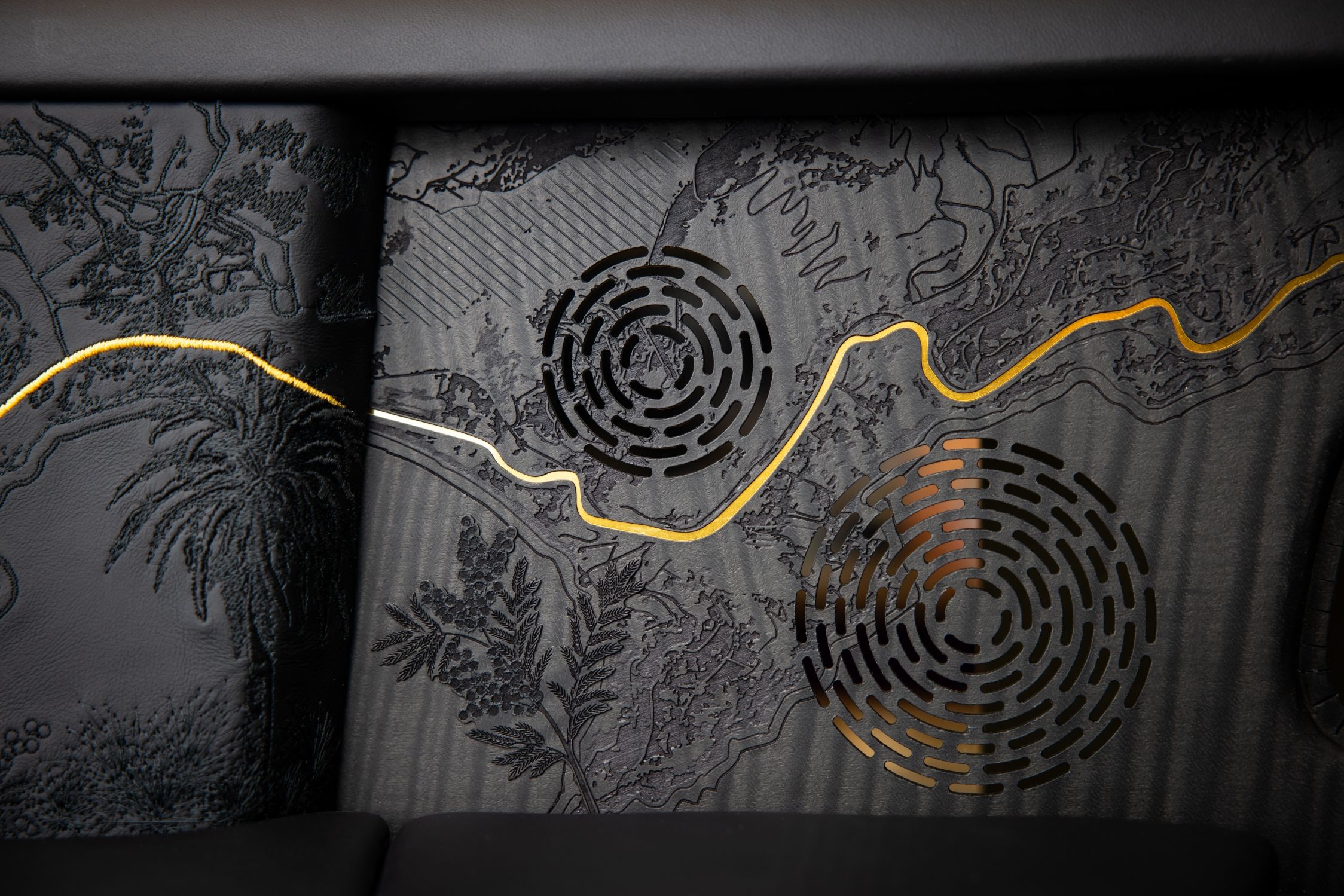
3D ink layering
In contrast to the recessed, etched motifs, the marque’s artisans developed a 3D ink layering technology to add fine textures and intricate patterns directly onto the surface of the wood, building Phantom’s narrative in gradual strokes. Built from individual layers, these embellishments achieve an extraordinary level of precision and clarity.
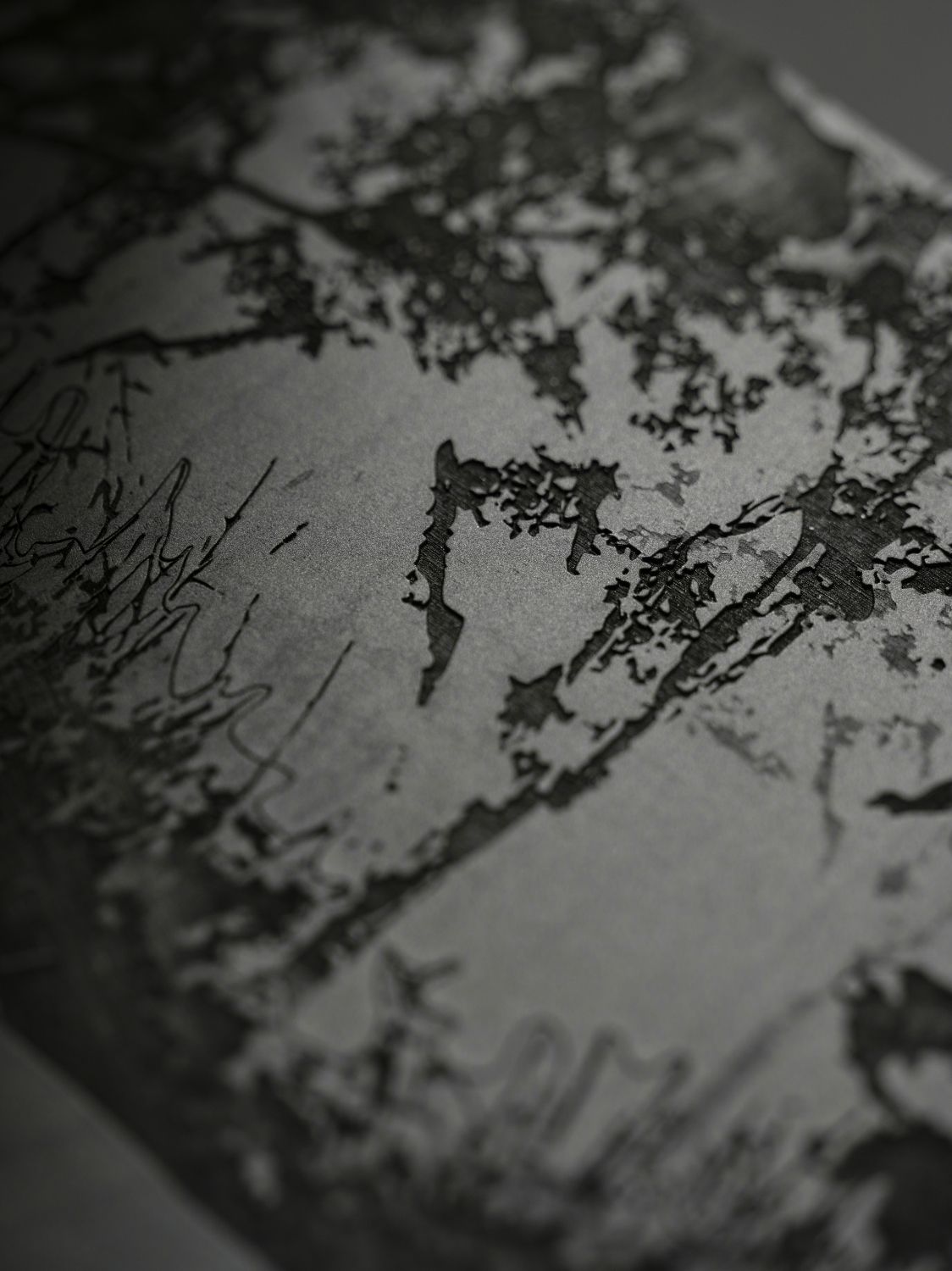
3D marquetry
To add further texture to the artwork, the designer employed 3D marquetry. This introduces raised motifs, embellished with engraving and 3D ink layering, on top of the main wood surface, allowing Phantom’s history to rise in new dimensions and be felt as much as seen. This three-dimensional approach adds depth, detail, and a sense of tactile intrigue, inviting occupants to explore the motor car’s surfaces and textures with their hands.
According to the craftsman in the video, said, "What I love about this project is that the marquetry pieces are all angled differently. By applying the veneer of different angles, we have brought to life what would have otherwise been a very dark surface."
The company said they have "created more of a tactile experience with the addition of 3D marquetry pieces. This three-dimensional approach adds depth, inviting the occupants to explore the multicar surfaces and textures with the hands as we sculpt the landscape of the veneer."
Gold leafing
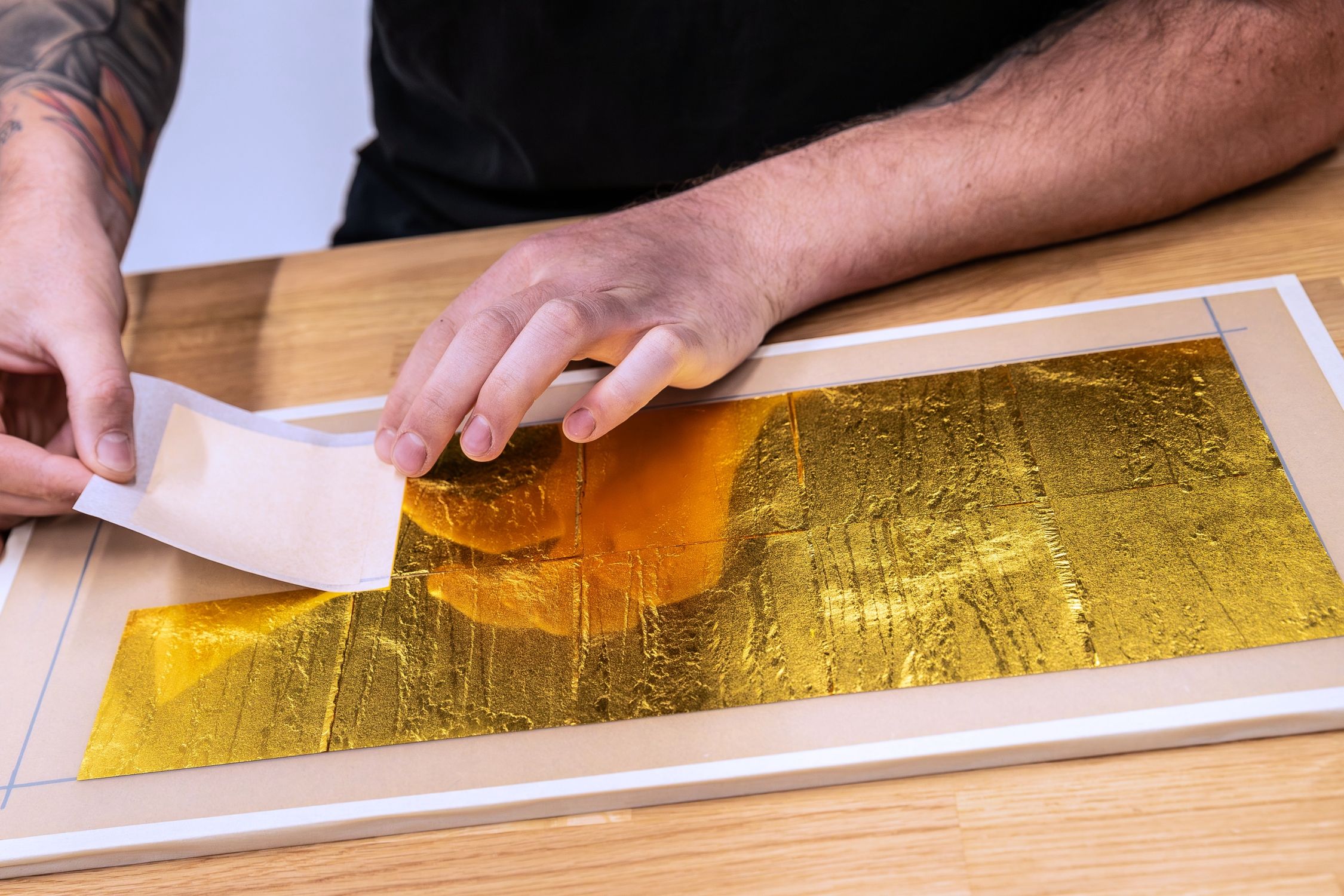
The company says that the Phantom's unique woodwork introduces another Rolls-Royce first: gilding, also known as gold leafing, transforming Phantom’s most significant journeys into luminous threads of history. Drawing on centuries-old cabinet-making traditions, this process was adapted and perfected by Rolls Royce to meet the marque’s extreme temperature and humidity testing parameters. Five artisans from the Interior Surface Centre undertook a specialist course at West Dean College, a celebrated center of craftsmanship in West Sussex, to master the technique.
"The final touch is gold leafing," said the video's narrator. "This remarkable wood treatment represents a completely new form of wood sculpting and a significant evolution of contemporary craft."
Once the wood sections were completed, artisans used 24-carat gold leaves to depict roads on the map section – each one a gold thread in Phantom’s story. Squares of gold leaf, typically just 0.1 micrometers thick, are hand-laid then sealed with a protective coating that achieves a hard-wearing, high-gloss finish. The ‘road’ is precision-cut and inlaid within the marquetry composition.
The company believes that the complexity, precision and visual effect of this wood treatment represents a "completely new form of wood sculpting and a significant evolution in contemporary craft. It is only fitting that these exquisite innovations will first debut on a Private Collection celebrating Phantom, the pinnacle of Rolls-Royce."



Have something to say? Share your thoughts with us in the comments below.