

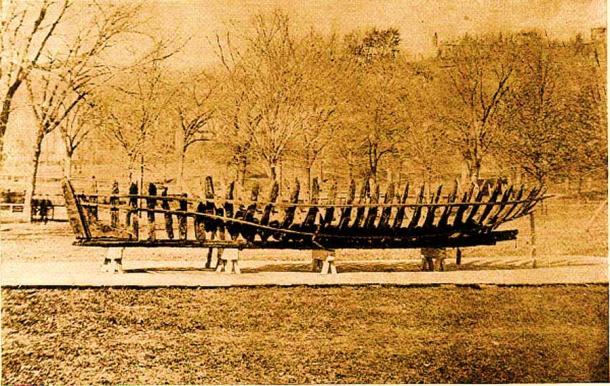
In 1863, two men discovered what they believed was a 1626 shipwreck off Cape Cod. A ship known to be carrying pilgrims.
New research indicates they were right. New analysis links timbers to the legendary Pilgrim-era boat Sparrow-Hawk — the oldest known shipwreck of Colonial America.
In 1626, a ship foundered in stormy seas and wrecked on Cape Cod, where the passengers were aided by the local Indigenous population and the Pilgrims in nearby Plymouth.
Now the most in-depth scientific analysis of timbers found more than 150 years ago has provided the best evidence yet that they belonged to the ill-fated vessel known as the Sparrow-Hawk.
The results of an international, multiyear study on the remains of the ship were recently reported in the "Journal of Archaeological Science: Reports."
Through the application of techniques that can accurately date wood and trace it to its place of origin, the scientists involved in this study have linked the pieces of timber found on a Cape Cod beach in 1863 to the shipbuilding industry of late 16th and early 17th century England.
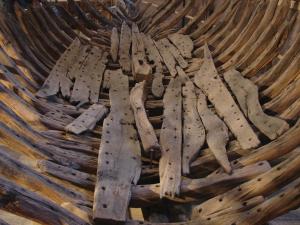
The 40-foot small pinnace ship that was scuttled just off-shore in Cape Cod in 1626 was built in England, and there are no other known shipwrecks in the region that match the characteristics of this vessel.
“I am just over the top about this news," said Donna Curtin, executive director of the Pilgrim Hall Museum in Plymouth, where the 109 timbers alleged to have come from the Sparrow-Hawk have been kept since 1889, told the Associated Press.
It should be noted that no one knows what the name of the ship that was lost in Cape Cod in 1626 was. For reasons that remain obscure, that ship was first called the “Sparrow-Hawk” by the 1863 discoverers of the wreckage, and that name has been used ever since.
Researchers used wiggle-match dating, a form of radiocarbon analysis, and dendrochronology, the study of tree ring growth, to narrow down roughly when the Sparrow-Hawk was built.
The wiggle-match dating indicated that the wood used to make the boat was harvested between 1556 and 1646, according to the study.
Wiggle matching, also known as carbon–14 wiggle-match dating (WMD) is a dating method that uses the non-linear relationship between 14C age and calendar age to match the shape of a series of closely sequentially spaced 14C dates with the 14C calibration curve. A numerical approach to WMD allows one to assess the precision of WMD chronologies.
The rings on a tree are like the "fingerprint based on the climate of the region in which the tree grew," Daly said. The ring patterns of the Sparrow-Hawk's wood matched tree-ring chronologies from 17th century southern England, according to the study.
The same techniques were used to study the Vasa, a Swedish warship that went down on its maiden voyage in 1628, just two years after the Sparrow-Hawk wrecked.
"By showing that the ship is built with English timber and is unlikely to be later than the mid-seventeenth century, it indirectly supports the identification," the authors wrote. "How many other early seventeenth-century English vessels are likely to have been lost in the same place?"
Another clue that the Sparrow-Hawk is from the early 17th century is the oak and elm from which it is constructed, said the Vasa Museum's Hocker, who specializes in the history of shipbuilding.
"That combination of woods is a traditional combination of materials in shipbuilding in England in that era," he said. "Everything I looked at just screamed 17th century to me."
Although they have been exhibited publicly in the past, the Sparrow-Hawk's remains are currently in storage at the Plymouth museum. More scientific study is planned, and Curtin would like to use digital modeling to construct a 3D image of the ship, to put it back on public display in 2026, the 400th anniversary of the wreck.




Have something to say? Share your thoughts with us in the comments below.