

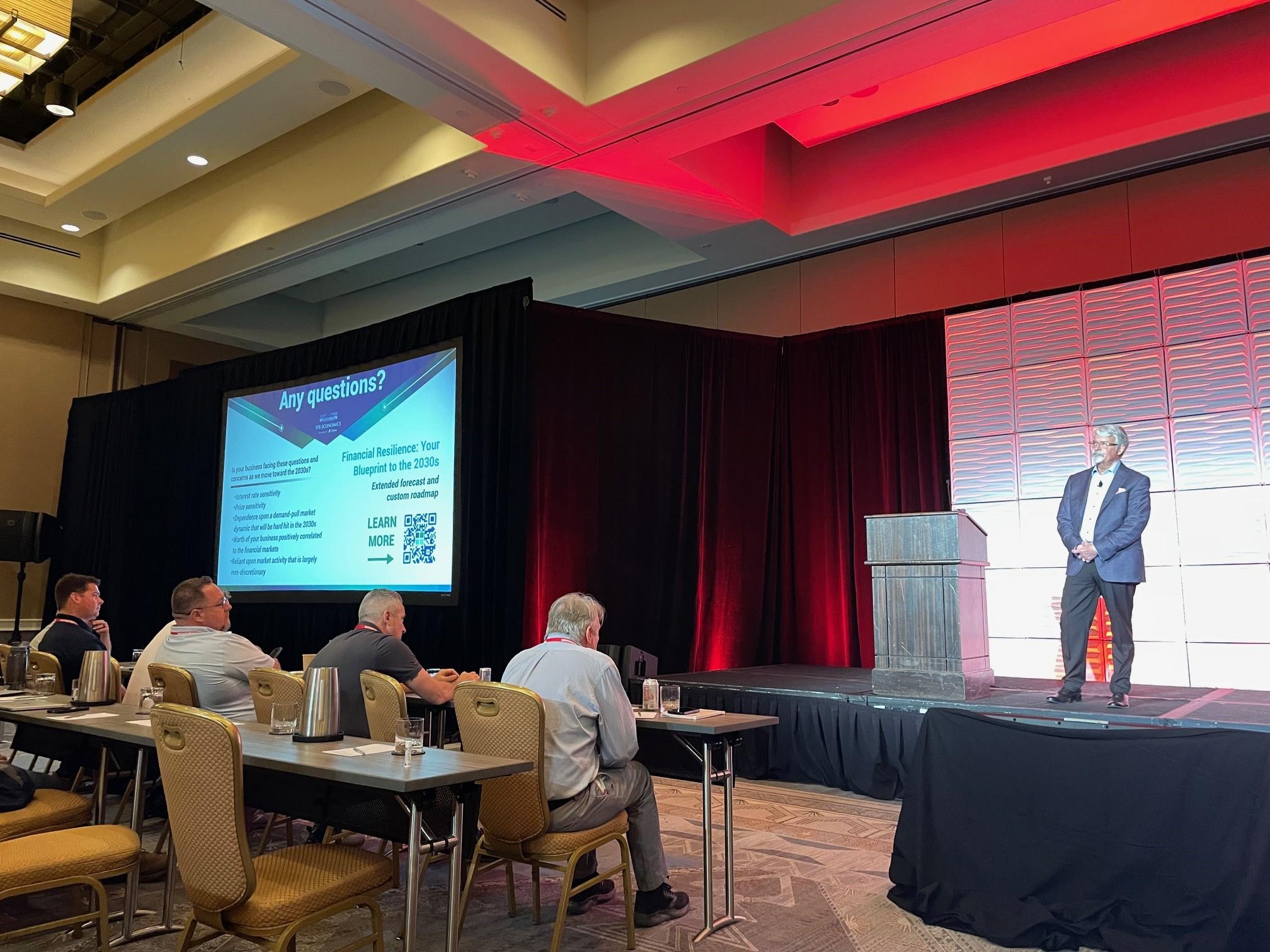
With an unparalleled track record of economic predicitions (94.7% accuracy four quarters out), Brian Bealieu’s ITR Economics has provided actionable forecasts for the woodworking industry for years. That meant people were ready to listen when he addressed the Wood Industry Conference in Scottsdale, Arizona, May 1.
Would he stick to past predictions for an economic crash in 2030? What would he say about tariffs and the current chaos gripping markets? He did not disappoint.
“The uncertainty index is off the charts,” he said. But then he went on to explain how ITR, which recently became a Crowe company, and is the oldest privately held, continuously operating economic research and consulting firm in the U.S., can cut through the uncertainty to offer data-driven predictions for key indicators in the economy.
“I can’t forecast the administration, but I can forecast consumer trends,” he said, noting that leading indicators continue to rise, and the Federal Reserve is putting money back into economy.

Overall, he painted a picture of continued growth for the economy during the next five years, but a precipitous drop after that, which would likely extend to 2036. Extended rise is outlook for economy, slow growth. His forecast was for a “slow crawl in 2025-2026 and continuing up in 2027-2029.
His confidence in doing business in America was unshaken. “America is the best place to be long term,” he said. He noted this country’s competitive advantage and increasing use of technology.
On the international front, he said China keeps him up at night because that country is “increasingly antagonistic and difficult to deal with.” But he decried the growth of nationalism and tariffs as boosting uncertainty. He predicted “more clarity in the second half of year” as to the tariff situation.
Manufacturing
For those interested in bringing back manufacturing jobs in the U.S., he said, “We don’t have the people to bring back manufacturing. We can’t fill the jobs that we have. Technology only gets you so far.” He also noted the time needed to create new manufacturing facilities. “You can’t build a new manufacturing plant in 18 months.”
He said, 77% of all steel consumed in U.S. is made in U.S. but cautioned that we can’t produce all the metals we need here. Turning to wood products, he said 85% of wood products are domestically sourced.
Debt concerns
Beaulieu raised concerns about the national debt. “The national debt is going to continue to go up. Interest rates are going to go up,” he said. “We are telling China, Europe they can’t play in our market. Where are we going to get funds to fund debt?” He explained that revenue from tariffs only amount to 1.1% of sales and will not significantly reduce taxes. The strain of the national debt on the economy is significant with 20% of all revenue needed just to pay interest on debt. He predicted a swing back to a free trade economy in 2034.
On the labor front, he noted that unemployment is still low, and he said recent federal reductions in workforce spearheaded by the Department of Government Efficiency (DOGE) need to be put into perspective. He said at least 121,000 federal employees have been fired by DOGE, but there are 2.4 million workers in the federal workforce, so the number of firings is actually quite small, about 5%. He suggested that should be compared to the 7.3% reduction in the federal workforce under Ronald Reagan and the 6 million job openings in U.S.
He noted that despite previous concerns about the Millennial workforce, Millennial labor participation very high, more than 80%. By contrast, the Generation Z labor participation rate is very low, about 30 points less. “We need to stop giving them money,” he said.
Beaulieu predicted median wages will rise 28% by the end of 2029.
Housing and real estate
He had a number of predictions and advice related to housing and real estate. He said he was concerned about the future of the commercial real estate market. He recommended buying houses now (2025-2026) as both prices and interest rates will continue to rise. He said mortgage rates will get to 10% by 2030 and “kill the housing market.” But rates will eventuall go back to 7%, which he says is a norm. He thinks housing in general “will get clobbered in the 2030s,” including a decline in prices for single family homes.
Currently the home ownership rate is 65.7%. The remodeling index is improved, and he expects it to continue to improve.
Business opportunities
As for business opportunities looking ahead, Beaulieu said businesses will have develop their competitive advantage and make strong usage of technology. He said supply chains “look decent,” and he didn’t see any supply chain stresses coming up.
He said one of the biggest challenges for businesses going forward is, “How are you going to institute price increases on a regular basis?”
He sees the Consumer Price Index as “moderated” and labor costs continuing to go up, along with a growing shortage of labor. Deficit spending by the government will continue to contribute to inflation. He suggested businesses should develop tactics in more resilient markets and try to be cash rich and debt free by 2030.
Electricity costs will continue to rise. “We don’t have capacity to supply all the electricity needed,” he said. “Electric costs will go up relentlessly. The future is in small modular nuclear reactors. That’s the only way to produce enough electricity.”
For those who doubt his predictions for a major depression in 2030, he said, “None of factors leading to depression in the 2030s can be changed.” Those include demographics, health care costs, entitlements, inflation, and national debt.
Investments
Beaulieu’s advice for investments was to look at bond market rather than stocks. “Stocks are too volatile,” he said, noting that the bond market sees inflation ahead. “Baby Boomers should move from stocks to bonds. The return will beat inflation.” He said stocks will be depressed in the 2030s, and that gold is the “number one asset class in a depression.”
He urged people to not be “be chained by the past” and to “have your tax adviser on speed dial.”
Bullish about America
But he was still bullish about the long-term future of America, “America is the best place to be long term,” he said.
Incomes are rising in U.S., and people have more money to spend, he said. “More Americans are making more money than ever before,” he said. “The standard of living is better than ever. Capitalism works.”
He said America has more dynamic growth going on than the rest of the world. “The U.S. is 26.4% of world GDP. China is 17% and slipping,” he said. “We will remain the number one economy for the next 100 years.”
He acknowledged that there is more debt across the economy, but he said we can service it, and it is not a problem, as shown by low delinquency rates. Domestic corporate profits remain high.
“Expect retail sales to continue to rise,” he said. “We’re continuing to spend money.”
He urged businesses and individuals, “Be bold for plans for 2035-2037. North America owns the future.”



Have something to say? Share your thoughts with us in the comments below.