


TORRANCE, Calif. — Virco Mfg. Corporation, a leading manufacturer and supplier of moveable furniture and equipment for educational environments and public spaces, reported net losses for the company’s third quarter and nine months ended October 31, 2025.
Virco, an FDMC 300-listed company (#46), has experienced a significant downturn in its financial results over the last several quarters, marked by a recent quarterly net loss and declining revenue compared to highly profitable quarters in the previous year.
The company's results have been impacted by a cyclical decline in the market for educational and public-space furniture, and the strong comparative performance of the prior year, which was boosted by a large, $19 million, non-recurring disaster recovery order.
“It is still our opinion that the market for school furniture and equipment is seeking a new equilibrium following the unprecedented disruptions of the pandemic" Virco’s Chairman and CEO, Robert Virtue, said. "We don’t know exactly what the 'new normal' will look like, but we do believe that education, both public and private, is an essential social function, and that our experience and financial flexibility will allow us to be a reliable partner, whatever form it eventually assumes. We also view this moment as offering similar opportunities for our type of furniture in adjacent public and private markets, and we are actively and enthusiastically exploring those opportunities.”
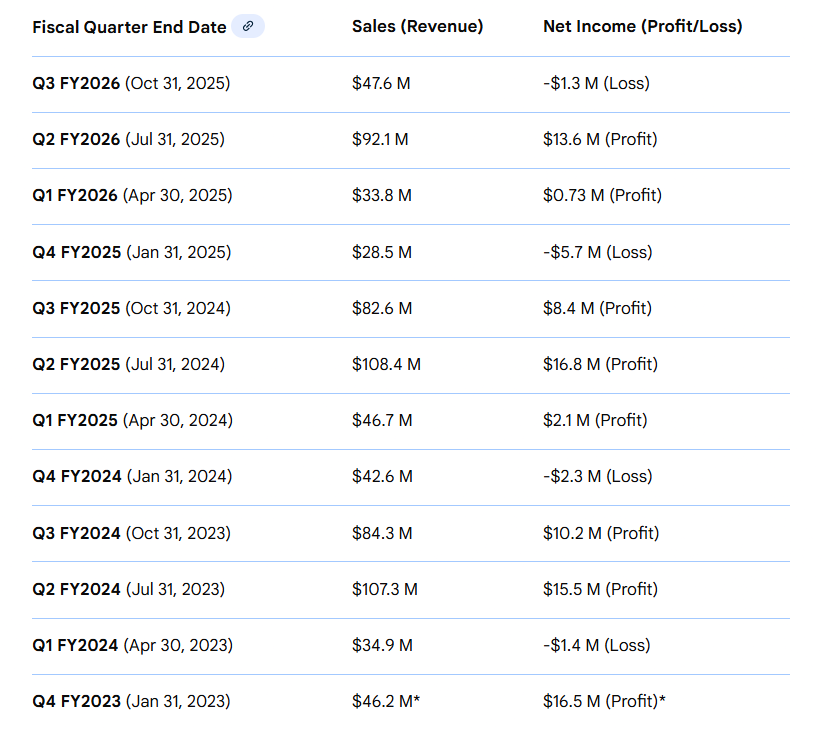
Most recently, Virco reported a net loss of $1.3 million on third quarter sales of $47.6 million, compared to a net profit of $8.4 million on sales of $82.6 million in the same period of the prior year. Gross profit for the quarter declined to $18.1 million, reflecting a gross margin of 38.0%, compared to gross profit of $36.7 million or 44.4% last year. Selling, General, and Administrative Expenses ("SG&A") in the Third Quarter decreased to $19.8 million or 41.5% of sales compared to $25.6 million or 30.9% of sales in the same period last year.
Through nine months, net income was $9.6 million on sales of $173.5 million, versus net income of $27.4 million on sales of $237.8 million in the same period of the prior year. Gross profit for nine months was $75.0 million, or 43.2% of sales, compared to $107.2 million or 45.1% of sales last year. SG&A through nine months was $61.4 million or 35.4% of sales compared to $71.3 million or 30.0% of sales last year.
The downturn resulted from lower sales and related lower production levels, both in the company’s factories and its sales and distribution functions. As a percentage of sales, material and labor costs declined slightly as management adjusted output downward.
Management had warned that year-over-year comparisons were going to be difficult in the current fiscal year given the outsized positive contribution of last year’s counter-seasonal disaster recovery order. Even without that order, which through nine months had contributed $19 million in sales, the market for moveable school furniture, fixtures, and equipment (FF&E) is experiencing a notable downturn of approximately 30% over the last two years.
According to Virco, the most obvious cause for the general slowdown is the expiration of pandemic recovery stimulus funds, also known as Elementary and Secondary School Emergency Relief (ESSER) funds, but Management also points to a very cautious mood among many public and private school administrators, tied in part to the end of stimulus but perhaps also related to uncertainty about the future.
Nonetheless, incoming order rates have begun to stabilize as the Company’s unshipped backlog pulled nearly even with the prior year’s backlog by the end of the Third Quarter. On a year-to-date basis, the Company’s preferred measure of overall business velocity—“Shipments Plus Backlog,” which combines actual shipments with the unshipped backlog—declined 25% from $265 million to $199 million.
Virco leadership said that early indications appear to suggest a stabilization of demand at pre-pandemic levels. Longer term, Management sees the potential for a recovery similar to those immediately following the pandemic, during which the ompany’s domestic U.S. factories and vertical business model afforded good control over multiple operating challenges including higher interest rates, labor shortages, supply chain interruptions, a shifting tariff environment, and evolving customer preferences.
Commenting on the challenging quarter and overall environment for school FF&E, Virtue said, “We heard from our field sales managers that ‘it feels like COVID out here.’ While conditions in the schools weren’t exactly the same—there were no closures or stay-at-home mandates—the general level of uncertainty was very high. The magnitude of pandemic stimulus had been so great that, when it ended, even though it was never intended to support full-time payroll, it had a negative impact on staff morale and related forward planning. Under these conditions, a number of new construction and refurbishment projects were postponed.
“But because many of these types of projects are bond-funded (which is essentially a dedicated form of “earmark”), we anticipated that they would eventually come back online. While the backlog of deferred projects may not be quite as big as it was immediately after COVID, this moment shares some of the same attributes as that event. Our pipeline of projects is beginning to re-fill, along with some positive “surprises” that weren’t on our radar. This might suggest a similar catch-up to normalized business velocity over the next two or three years, again mimicking the pattern after COVID, although likely at a lower degree of magnitude."



Have something to say? Share your thoughts with us in the comments below.