

Question: We have some casehardened lumber, I think. When we saw it, the lumber seems to be really hard. What is casehardening, and can we fix it?
Answer: I do believe that “casehardening,” when referring to wood, is a poorly understood term. The use of “hardening” is misleading. Hardness is due to the species characteristics, along with the final moisture content (MC), especially for hardwoods; drying under 6.0% MC increases the hardness substantially.
Casehardening definition
The correct definition for casehardening (or casehardening stress) in wood is stress in the wood caused by drying. This stress occurred because the outside (core, case, shell) dried first, tried to shrink but could not because the wet core prevented most shrinkage. So, the outside shell dried to a stretched-out, enlarged size, compared to its size if it was able to shrink “normally.” (On rare occasions, the core tries to shrink and is restricted. This condition is called “reverse casehardening.”)
Identification
Casehardening stress causes immediate warp in the machining, especially when ripping, resawing, or planing one face more than another. These actions unbalance the stress, causing immediate warp. However, for these tests or observations to be useful for identification of drying stress, THERE MUST BE NO MOISTURE CONTENT GRADIENT. With a gradient, the results are unreliable. Example: A load of well dried lumber is put on a truck and driven through foggy or rainy weather. The high humidity can increase the shell MC somewhat, making the tests for casehardening show positive. However, as there is a MC gradient, the test results are misleading.
A quick indicator of a moisture gradient is that the wood will move over the next few hours or days, giving different results. With small test pieces, a kitchen-type microwave can be used to remove any gradients in a few minutes (see “Across the grain” below.).
Casehardening can be across the grain (across the width of the lumber) causing cup when machining). Casehardening can also be along the grain (longitudinal or along the length) causing lengthwise bow or side-bend when machining.
Across the grain
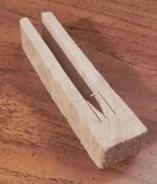
To help with identification in dried wood, a prong can be cut. Without stress, the legs of the prong will stay the same distance apart along their length. Again, there cannot be a moisture gradient, shell to core. With a gradient, the test is unreliable.
The legs on the prong should be about 6 inches long. The legs are about ¼-inch thick, 1 inch wide (along the length of the lumber), and 6 inches long (full width of the lumber, trimmed to 6-inch length; longer than 6 inches makes the test too sensitive).
To eliminate any MC gradient, put a single prong (after cutting to 6-inch size) in a microwave on high power for 15 seconds (air dried lumber and direct steam conditioning) and 30 seconds (kiln dried green-from-the-saw and water mist conditioning). Remove from the oven and let the hot piece sit for 15 minutes. The results after this waiting period give the amount of casehardening stress, if any.
Along the grain
Longitudinal stress is seen when ripping the lumber — the ripped pieces will have side-bend warp. The best test for longitudinal casehardening is to cut a 24-inch-long piece from a pieces of lumber that is 8 inches wide. Then rip this 8-inch piece into two 4-inch-wide pieces. If there is no casehardening, the two cut pieces can be put back together (minus the saw kerf) and will fit together without a gap.
If there is growth stress in the lumber, this test will show a gap. Growth stress is commonly seen as warp in lumber, so use only flat, warp-free lumber for this test.
Removing casehardening
As casehardening developed when the outer shell tried to shrink normally but was restrained by the wet core, quickly adding moisture to the shell when the lumber is hot causes the reverse effect (the shell tries to swell but is restrained by the dry core). This reverse effect cancels or offsets the casehardening. This addition of moisture to remove casehardening is called conditioning.
With 8/4 and thicker lumber, adding too much moisture too quickly can cause reverse casehardening, which is essentially a permanent defect. Be careful with thicker lumber.
The general rule is to add moisture by quickly developing an EMC in the kiln that is 4 percent above the target MC. For example, if the target, final MC is 6.8 percent MC, the EMC is 10.8% EMC. The temperature is best if set at 160 F to 180 F. High humidity can be obtained by injecting steam into the kiln (traditional technique) or by injecting a fine water mist.
When air drying lumber, almost every morning, the humidity outside is close to 100% RH. This high RH removes a little bit of the casehardening, so that air-dried lumber seldom has casehardening. As the lumber is almost always stress-free if air dried before kiln drying, just about any conditioning treatment (including no treatment at all) will give adequate final results. There are many secret or special conditioning treatments that kiln operators will use successfully.
In short, many kiln operators do not condition properly, but with air-dried lumber, it does not matter that much.
One technique to quickly remove casehardening stress is to cool the lumber in the kiln for several hours, opening vents and doors are needed. Then, inject live steam directly into the kiln. The steam will condense on the cool surface of the lumber, removing stress in four hours. The actual time depends on the equipment and steam pressure. It is advisable to cut prongs after an hour or so, checking with the microwave procedure for any stress.



Have something to say? Share your thoughts with us in the comments below.