

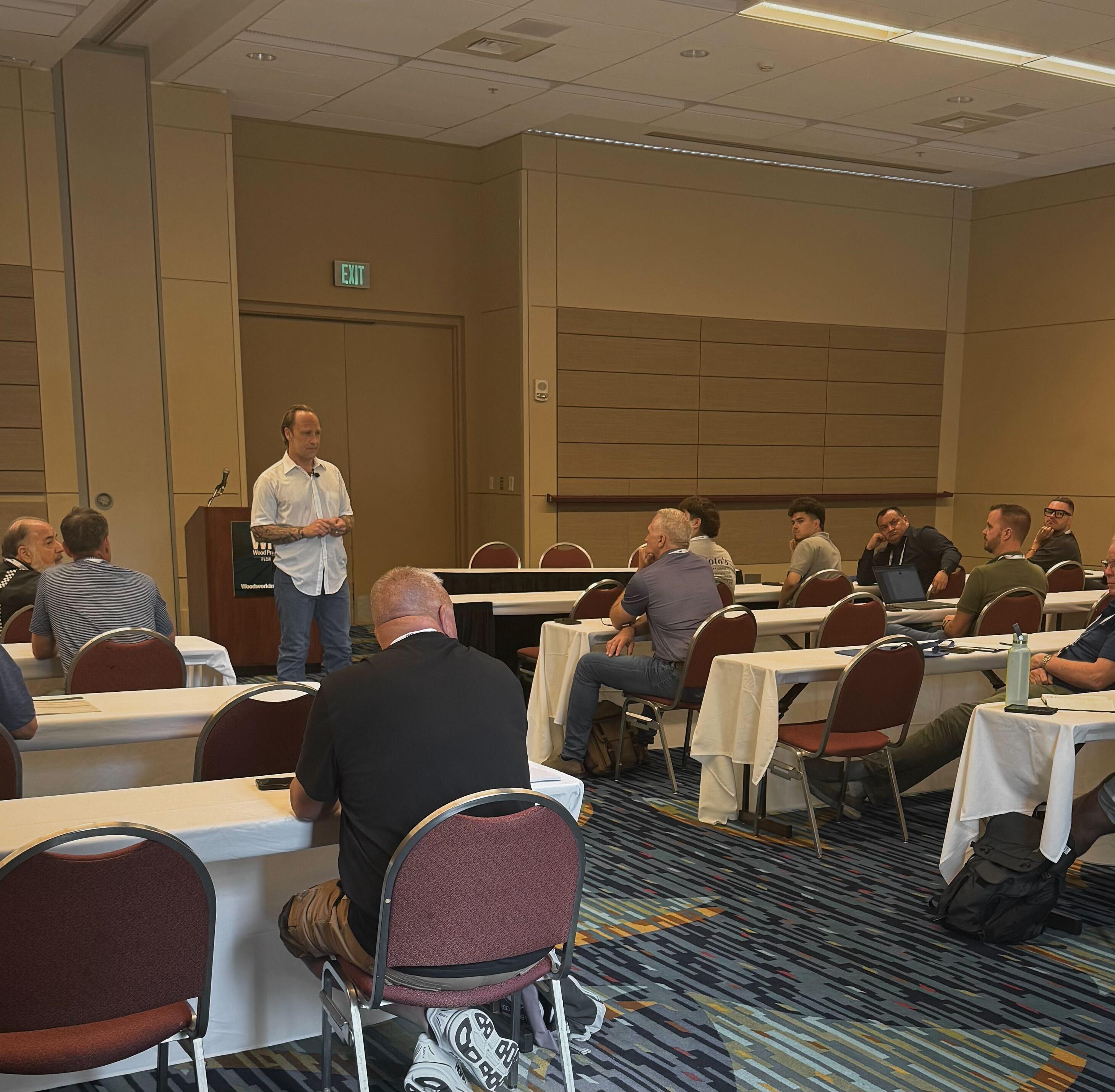
I make my living building furniture for clients, and that is my primary income. In the last few years, invitations to speak, demonstrate, or teach aspects of woodworking at expositions and conferences has increased quite a bit. I have been enjoying it. I mention this because I have observed some trends, and experienced some things while attending these gatherings that I think are helpful for young professional professionals.
Recently, I was invited by Grizzly Industrial to be a guest speaker and machine demonstrator at the tent sale in Springfield, Missouri. The following week I gave two speaking educational sessions at the Closets Conference and Wood Pro Expo in West Palm Beach, Florida.
Geographically these could not be more different and demographically they contrast as well. However, one thing I noticed was how engaged all of the attendees were. Not only with me, but with each other. My experience is not an anomaly.
I have witnessed this many times at woodworking shows and conferences over the years. I also have been an attendee before with lots of questions and benefited greatly from being able to run them by other woodworkers who live and work in similar situations to myself. I even witnessed another woodworker realizing how beneficial this was to him in real time during conversation.
My recent experiences have brought back a lot of memories of running into people along my career while at trade shows and some of the amazing insights and perspectives I have received from showing up and just saying hello to people. I have been the recipient of expected and unexpected solutions to problems I face at work more times than I can count.
I can still remember the first time I went out to dinner with some woodworkers after my first conference and the relief I experienced from just talking shop with them. Many of our problems were so similar if not the exact same, but the solutions varied widely and in many cases, I would not have thought of those solutions on my own. It was also comforting to feel connected and not so alone in my struggles running a woodworking business by myself.
Depending on your business structure and employee count, the isolation you might experience working in this trade is subjective. Typically, it is an isolating profession and especially when you are first starting out with limited cash flow and potentially no employees. It is also a normal experience for many to be the only woodworker in their town. In all the years I’ve been doing this I’ve never brought more than one or two people to help and prefer working alone. It has its pros and cons, but it’s when I do my best work.
It is easy to get stuck in your own head and let the days all run together when you’re captain of your own ship with no crew without anyone to bounce ideas off or to add outside perspective for any problem that might arise from machinery to clients, etc. Many of us also work in buildings in rural areas where an incoming and outgoing of people is not common. In my experience, it is usually not the healthiest situation professionally and personally to stay so disconnected from other people.
We all have a different way of doing things and often there are many right ways to do something, but it is easy to get stuck in only doing it your way or feeling like there is no solution for a problem because you’re too close to it.
I can’t imagine the different turns my career could have taken without some of the helpful people I’ve met along the way who have offered me suggestions that steered me on the right path. People I met as an attendee and asked lots of questions of who I now speak with on the phone often.
After some inspiring discussions in West Palm Beach last week with woodworkers starting their own business (some young wood pros) it dawned on me how important it is to find a network or community of professionals like you to belong to.
Finding this used to be a lot easier back in the day when woodworking actually had guilds on a local level. By being a part of that guild, the benefits could be many, and being a part of that community would have come along with it, too. Unfortunately, that is not the case these days, and finding other professionals to commune with requires a little more effort, but the value you get return is worth it.
One of the more popular ways of people connecting professionally these days is in the online communities. It has its advantages such as being able to connect from across the country in a moment’s notice at the tip of your fingers on a smart phone. I will also add that you need to practice good discernment with what group you choose online because, like anything else online, sometimes it’s hard to know if people are who they say they are.
I see it on social media all the time where there is an online community of people in the comment section building each other up and asking questions. There’s nothing wrong with that. Just be mindful to look carefully and make sure that the people online are actually professional woodworkers and not professional content makers. The solutions you will seek will only come from real professional woodworkers. Nothing wrong with the later, but I see people making the mistake of confusing the two often, and those are two very different business models.
Another way is to attend large and small woodworking conferences like Wood Pro Expo, AWFS, IWF, and many other small ones that are starting to pop up around the country. It has been my experience that getting to know people face-to-face leads to a stronger connection that then is an easier accessible relationship from a smart phone over time.
I have met so many great people doing that who have helped me, and now I always offer to be the same help when people ask. I owe my predecessors that and the legacy of the craft of woodworking that I love.
You might not find immediate solutions (although you could and I have) at these events, but you will establish connections with other professional woodworkers that will be invaluable down the road when you do need someone to talk to or bounce ideas off of.
These relationships aren’t like buying machinery. They have to be cultivated, and the best way to do that is to get out there and start meeting other woodworkers and staying in touch. I strongly suggest all of you young wood pros get out there, meet some peers and ask lots of questions. We older guys who love the craft don’t mind and usually enjoy the chat. I promise you it’s worth it.
#YoungWoodPro is a contest and an educational program sponsored by Grizzly Industrial to help novice professionals improve their skills in business and woodworking. Entries are now closed for the 2025 contest. Learn more about the contest.




Have something to say? Share your thoughts with us in the comments below.