

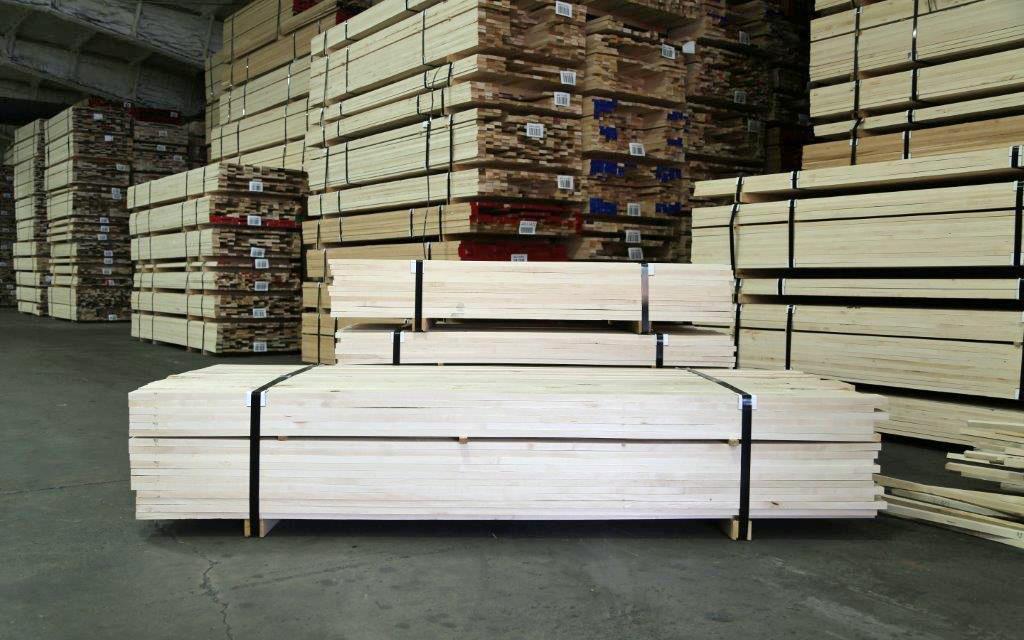
Hardwood lumber is typically sold in random widths and lengths. However, if you are not buying your hardwoods this way, chances are you are purchasing them either width sorted or in exact ripped-to-width bundles. But why would a manufacturer prefer sorted hardwood strips or hardwood rips?
Many manufacturers that purchase hardwood lumber in sorted strips will do so to rip a specific hardwood blank. They already have their own rip saw and the expertise in their production process, and feel they can do this efficiently. These manufacturers usually like the flexibility of slightly different board widths so they can create different, but similar-sized parts from the same sort.
The other consideration for hardwood lumber strips is pricing. At face value, lumber costs for hardwood strips are typically less expensive than SLR2E hardwood lumber. Of course, customers pay a premium over random widths and lengths for sorted strips, but they are still less expensive per thousand board feet than hardwood rips.
However, that could be deceiving. When manufacturers decide to purchase ripped hardwood lumber directly from their supplier, they inherently gain value. Why? Because hardwood rip users save money in freight costs, have less lumber waste costs, gain in lumber usage yields, and usually increase employee productivity. In essence, they are purchasing a moulder-ready blank that is ready for production.
So, when should you consider buying your hardwood lumber width sorted versus ripped? It depends. But a good rule of thumb is to consider a supplier that can help you decipher the benefits of both.
5 reasons hardwood rips make sense
1. To lower operational costs: When working with hardwood lumber one of the most important areas to maximize is lumber yield. Improving yields by 2 or 3 percent can make a big difference in performance. Manufacturers that purchase exact width lumber can capitalize on the precision of their supplier’s equipment as well as benefit from the efficiencies of their supplier’s larger cut bills. It also allows them to reduce their overall lumber waste and waste disposal costs.
2. Shift variable costs to fixed costs: When you rely on random width hardwood lumber you never quite know exactly how the bundles will work in your operation. Purchasing ripped to width blanks takes the guess work out of the hardwood lumber conversion process. It also helps shift variable costs of production to fixed costs.
3. Efficiency improvement: Manufacturers realize efficiency gains when they reduce the amount of unusable inventory created and lessen the amount of re-handling lumber needed in their warehouse. Companies can then reassign employees from the ripping operation to other positions and improve operations in those areas as well.
4. Scalability: When business is good, there is only so much a plant can do to drive increased manufacturing. One way we see customers increase production is to order moulder-ready hardwood blanks and bypass the random width conversion process. Some manufacturers utilize this practice to feed lumber directly into the next phase of their manufacturing process and increase product production since the ripping cell is many times a production bottleneck.
5. Freight savings: Manufacturers that utilize hardwood lumber in their production process require several truckloads of material each year. Depending on one’s specific cutting bill and inventory position, it is not uncommon to experience 15 to 25 percent wood waste. When ordering in exact ripped-to-width lumber that matches your specific production process, instead of traditional random-width lumber, you eliminate paying freight on this type of future waste.
Source: The Baillie Group, Hardwood Ripping Division. For information call 716-649-2850 or visit TheBaillieGroup.com.


Have something to say? Share your thoughts with us in the comments below.