

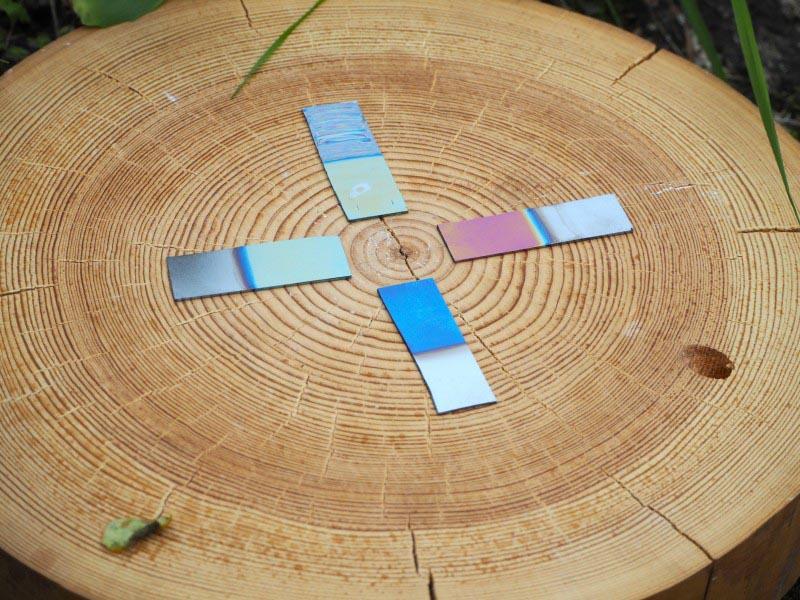
Researchers at Aalto Universityv in Helsinki, Finland, have developed a way to turn a waste material from wood into a bio-based transparent film that can be used for anti-fogging or anti-reflective coatings on glasses or vehicle windows. In addition to offering an alternative to the toxic synthetic materials currently used, this approach transforms a waste product into a valuable carbon sink.
Creating lignin nanoparticles to use for anti-fogging coatings isn’t a new idea, but scientists haven’t yet been able to turn them into transparent films.
"Optical coatings need to be transparent, but so far, even rather thin lignin particle films have been visible.
We knew that small particles appear less turbid, so I wanted to see if I could make invisible particle films
by pushing the particle size to a minimum," said doctoral researcher Alexander Henn, the study’s lead
author.
The team used acetylated lignin and developed an improved way to esterify it in a reaction that
takes just a few minutes and happens at the relatively low temperature of 60 °C.
"The lignin particles I made from the acetylated lignin had rather surprising properties, which made the
rest of this study very interesting. The possibility to make photonic films, for example, came as a total
surprise," said Henn.
In addition to anti-fogging and anti-reflective coatings, the new approach can also make coloured filmsfrom lignin nanoparticles. By controlling the thickness of the coating and using multi-layer films, the teamcreated materials with different structural colors.
"Sahar Babaeipour’s efforts were key to controlling the particles’ photonic properties," said Henn, adding that researchers Paula Nousiainen and Kristoffer Meinander brought expertise in lignin chemistry andphotonic phenomena, respectively, helping the team make sense of their results and use them effectively.
According to the team’s feasibility study, the ease of the reaction and its high yield mean that it could profitably be scaled up to industrial levels.
"Lignin-based products could be commercially valuable andsimultaneously act as carbon sinks, helping relieve the current fossil fuel-dependence and reduce carbondioxide emissions," said Professor Monika Österberg. "High value-added applications like this areimportant to drive lignin valorisation and move us away from using lignin only as a fuel."
Henn notes the study benefited from having perspectives that took it beyond the lab bench. "Teamwork was an important part of making this study impactful. We were able to include the techno-economic analysis with the help of Professor Pekka Oinas and doctoral researcher Susanna Forssell," he said.



Have something to say? Share your thoughts with us in the comments below.