


TEMPE, Ariz. — Economic activity in the manufacturing sector contracted in December for the 10th consecutive month, following a two-month expansion preceded by 26 straight months of contraction, say the nation's supply executives in the latest ISM Manufacturing PMI Report.
Of the 15 industries reporting contraction in December, wood products ranked second in contraction behind only Apparel, Leather & Allied Products. Only two industries tracked reported growth, and they were Electrical Equipment, Appliances & Components; and Computer & Electronic Products. Results for Furniture and Related Products were not released in this most recent report.
The report was issued by Susan Spence, MBA, chair of the Institute for Supply Management (ISM) Manufacturing Business Survey Committee.
"The Manufacturing PMI registered 47.9 percent in December, a 0.3-percentage point decrease compared to the reading of 48.2 percent in November and the lowest reading of 2025. The overall economy continued in expansion for the 68th month after one month of contraction in April 2020. (A Manufacturing PMI above 42.3 percent, over a period of time, generally indicates an expansion of the overall economy.) The New Orders Index contracted for a fourth straight month in December following one month of growth; the figure of 47.7 percent is 0.3 percentage point higher than the 47.4 percent recorded in November. The December reading of the Production Index (51 percent) is 0.4 percentage point lower than November's figure of 51.4 percent. The Prices Index remained in expansion (or 'increasing' territory), registering 58.5 percent, the same as November's reading. The Backlog of Orders Index registered 45.8 percent, up 1.8 percentage points compared to the 44 percent recorded in November. The Employment Index registered 44.9 percent, up 0.9 percentage point from November's figure of 44 percent."
"Morale is very low across manufacturing in general," says a Electrical Equipment, Appliances & Components respondent to the report. "The cost of living is very high, and component costs are increasing with folks citing tariffs and other price increases. Absenteeism is worse around the holidays, and sales were lower than we expected for November. So, things look a bit bleak overall."
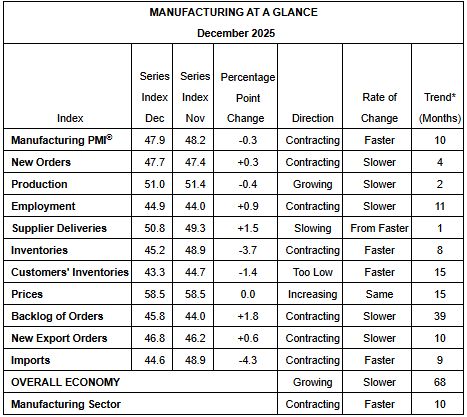
Spence continues, "In December, U.S. manufacturing activity contracted at a faster rate, with pullbacks in the Production and Inventories indexes leading to the 0.3-percentage point decrease of the Manufacturing PMI. Those two subindexes increased in November, so their contraction this month continues the short-term "bubble" of improvement indicative in the last several months of PMI data — and a hallmark of recent economic uncertainty in manufacturing.
"Although the demand indicators are still in contraction, improvement in three indexes (New Orders, Backlog of Orders and New Export Orders) and the Customers' Inventories Index remaining in 'too low' territory (and at an accelerated rate) are positive signs for December, but several consecutive months of gains in these indicators are necessary for a longer-term recovery. A 'too low' status for the Customers' Inventories Index is usually considered positive for future production.
"Regarding output, the Production Index is still in expansion but slipped 0.4 percentage point, likely due to last month's drop in the New Orders and Backlog of Orders indexes. The Employment Index contracted at a slower pace, with 63 percent of panelists indicating that managing head counts is still the norm at their companies, as opposed to hiring.
"Finally, inputs (defined as supplier deliveries, inventories, prices and imports) were mixed, with the Supplier Deliveries Index indicating slower deliveries, the Inventories and Imports indexes contracting strongly, and the Prices Index with the same reading as in November.
"Looking at the manufacturing economy, 85 percent of the sector's gross domestic product (GDP) contracted in December, compared to 58 percent in November, and the percentage of manufacturing GDP in strong contraction (defined as a composite PMI of 45 percent or lower) increased to 43 percent, compared to 39 percent in November. The share of sector GDP with a PMI at or below 45 percent is a good metric to gauge overall manufacturing weakness. Of the six largest manufacturing industries, only Computer & Electronic Products expanded in December," says Spence.
The two manufacturing industries reporting growth in December are: Electrical Equipment, Appliances & Components; and Computer & Electronic Products. The 15 industries reporting contraction in December — in the following order — are: Apparel, Leather & Allied Products; Wood Products; Textile Mills; Paper Products; Chemical Products; Printing & Related Support Activities; Nonmetallic Mineral Products; Petroleum & Coal Products; Primary Metals; Miscellaneous Manufacturing; Plastics & Rubber Products; Fabricated Metal Products; Machinery; Food, Beverage & Tobacco Products; and Transportation Equipment.



Have something to say? Share your thoughts with us in the comments below.