

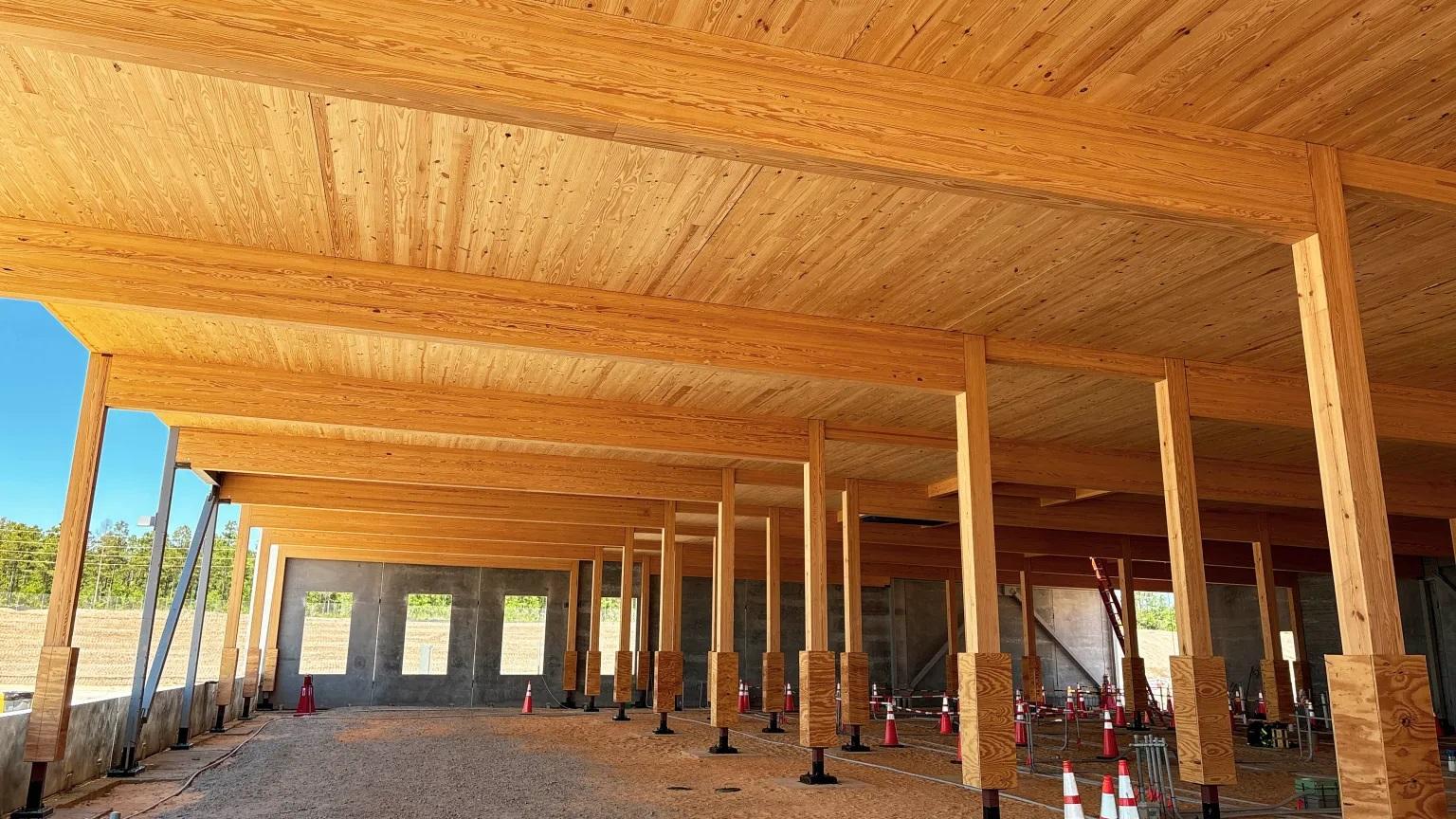
Mass-timber built structures are being constructed at a breakneck pace around the world, in metro area and converted rural locations, from residential buildings to office complexes and in greater numbers to data centers and big tech office spaces.
Vittorio Salvadori, director of design at TimberBLDR, a mass timber integrator partner, said that mass timber demand in the U.S. is strong, with many new projects in the design phase and a growing number of architects and engineers involved across various stages. In a recent LinkedIn post, Salvadori reflected on the recent International Mass Timber Conference in Portland, said that "About 10% of mass timber sold in 2025 went to data center–related projects. Amazon and Meta alone are leading this shift. For a market as big as US, ten percent is crazy. And they are not slowing down.
"Mass timber manufacturers are focusing on manufacturing," he added. "Engineering, fastener procurement, and related services are expected to be handled by others. This is a perfect setup for companies like TimberBLDR that provide design, procurement, and installation services. Everyone is focusing on what they are good at."
Meta, for instance, is utilizing mass timber in its new data centers in an effort to achieve net zero emissions across its value chain in 2030. To reach this goal, they focused on lower carbon alternatives for the materials used in these structures. Most data centers today are constructed of concrete, structural steel and other pre-engineered metal. The company aims to incorporate near-zero-emissions steel in our construction through our membership in RMI’s Sustainable Steel Buyers Platform, and have already piloted a number of approaches to advance low carbon concrete in our data centers.
Meta started piloting mass timber in the construction of buildings on its data center campuses in 2025. Glue-laminated, wooden beams and columns (glulam), mass plywood, and timber wall assemblies are all examples of mass timber. Cross-laminated timber (CLT) is another common mass timber product, used referring to thickly sawn lumber that is glued together with the grain of each layer alternating at a 90º angle.
Its first mass timber administrative building was erected in Aiken, South Carolina. There, it is building a new $800 million data center, set on 300 acres with two massive data halls making up most of its 715,000 square feet of buildings. The data center used mass timber materials provided by SmartLam. The company is also looking to construct additional mass timber buildings at its Cheyenne, Wyoming, site with Fortis Construction and Mercer Mass Timber and at its Montgomery, Alabama, site with Hensel Phelps and Binderholz.
"Looking ahead," the company said in a mass timber analysis, "we will begin incorporating mass timber into additional administrative buildings, warehouses and even the critical data halls that house the servers that connect people to our platforms and bring our technologies to life."
Microsoft adopts CLT in construction
Microsoft has also adopted mass timber technology as part of its goal to be carbon-negative by 2030, and, by 2050, to remove from the atmosphere the equivalent of all the carbon the company it has emitted since its founding in 1975.
In 2021 Microsoft built its new Silicon Valley headquarters out of CLT, the company’s first large-scale use of CLT. In 2024, Microsoft constructed two data centers in Northern Virginia using a hybrid structure of cross-laminated timber (CLT), steel, and concrete to reduce carbon emissions. Designed by Gensler, these facilities use CLT for floors and ceilings, reducing the embodied carbon footprint by 35% compared to steel and 65% compared to concrete. This initiative supports Microsoft's goal to be carbon-negative by 2030.
According to Microsoft, the sustainably harvested CLT Microsoft is using will displace a portion of the thick concrete typically used for flooring and ceilings. To ensure durability and waterproofing, a thin layer of concrete will be applied for reinforcement. Even including that thin protective layer, the result will be a much lighter building requiring far less steel, another factor reducing the embodied carbon of the building.
A benefit of using CLT is that it can be installed more quickly and safely than corrugated steel used in large commercial buildings, notes David Swanson, a structural engineer who works on Microsoft datacenter design. This fast construction method offsets increased material costs.
This kind of cost-benefit analysis has become a big part of the datacenter planning process. “We’re constantly trying to validate the suitability of these novel materials for use in a datacenter environment,” said David Swanson, a structural engineer who works on Microsoft datacenter design. “We want to make sure that they’re going to perform, they’re going to be safe, they’re going to be resilient, and provide all the features that we’ve grown accustomed to all these hundreds of years that we’ve been using those other materials.”
Amazon uses mass timber
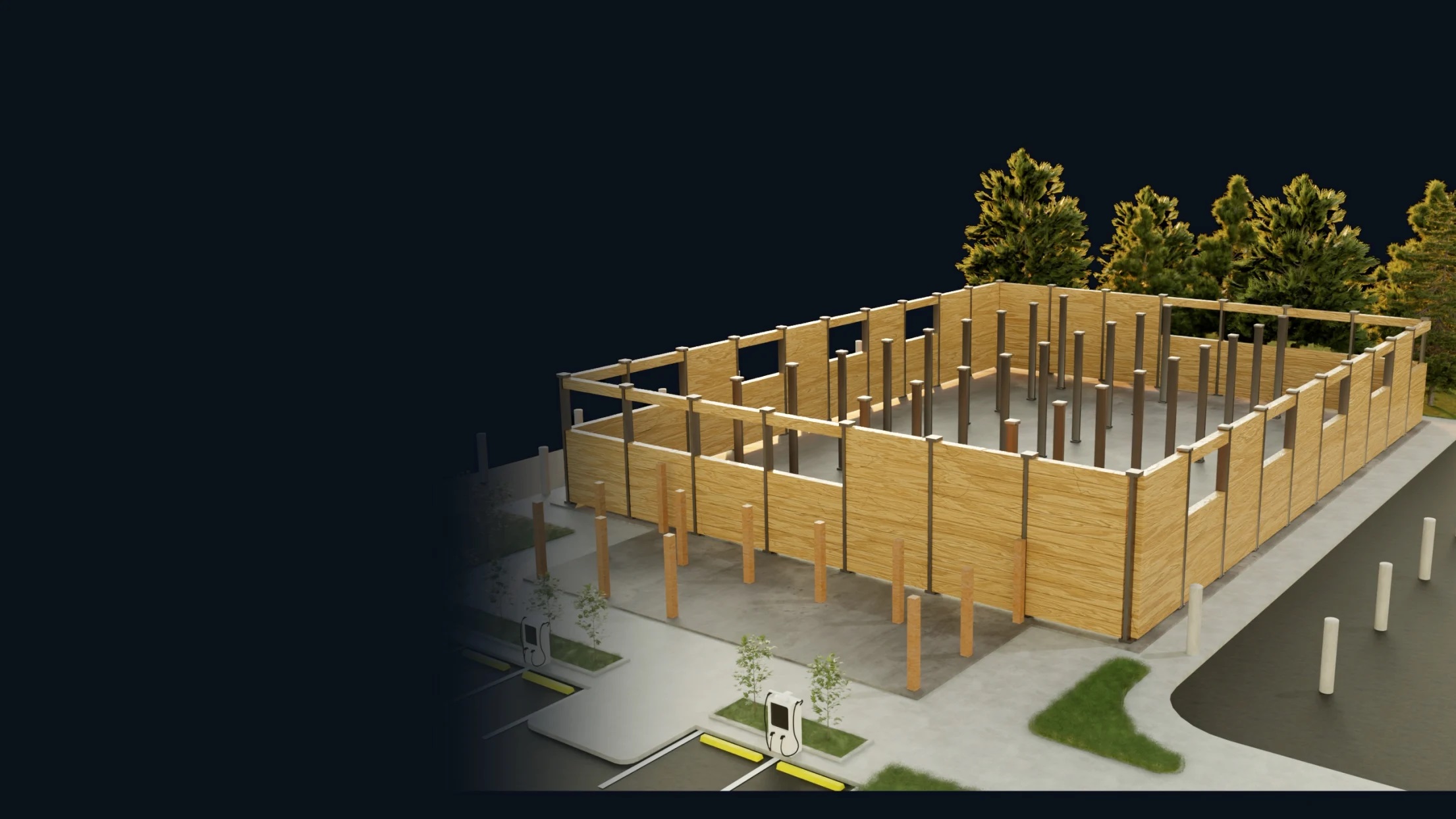
A recently opened Amazon delivery center in Indiana makes heavy use of mass timber. The center, known as DII5, uses mass timber for its walls, sitting atop a foundation of lower-carbon concrete. It’s a material the company has previously used including at its HQ2 in Arlington, Virginia, and a material they plan on implementing at a larger scale.
Mass timber, the company says, holds its own against concrete and steel in terms of structural strength, is less carbon-intensive to produce, and locks in the carbon that the trees sequestered before they were harvested. The net effect is that going with mass timber can put a serious dent in a building’s carbon footprint: A 2022 study found that, on average, the embodied greenhouse gas emissions of buildings made of reinforced concrete are 43% higher than those of mass timber structures.
“Trees absorb carbon from the atmosphere, store it in the cells of their fiber,” said Kristen Dotson, Amazon’s principal for sustainable buildings. “If we can lock up that material in the building for 50 to 100 years, we’re creating a carbon ‘bank’ that keeps that sequestered carbon from being re-released into the atmosphere.”
“The game-changing part around mass timber is that it’s taking a ready commodity and turning it into this structural element that can replace much of the concrete and steel that goes into a building,” Dotson says. “Before mass timber, we didn’t have a market-ready bio-based structural solution that was competitive with concrete and steel.”



Have something to say? Share your thoughts with us in the comments below.