


Editor’s note: This column was originally published in 2021 and was produced before Gene Wengert died in 2025. It is printed here in memoriam.
Q What can you tell me about eliminating machining defects?
A I could answer this question in detail in 30 pages, but I’ll hit only the high points. The NHLA also hosts free webinars on this top at NHLA.com.
There are four main parts to machining quality:
- The wood part of machining
- The tool geometry
- The effects of feed rates & MC
- The planer design features
First, moisture content (MC) is one of the biggest factors affecting machining. If the wood is too wet, the fibers are weak and do not cut cleanly, but tend to flop over, and will pop back up during finishing. If the wood is too dry, it behaves like it is brittle, with all sorts of cracking and splitting.
General definitions: Too wet means above 12% MC for softwoods and higher than 8% MC for hardwoods. Too dry means under 9.5% MC for softwoods and under 6.0% MC for hardwoods. Also, this is the MC right where the knife or saw is working and not the average MC of the piece of wood.
Another huge factor is the hook angle (saws) or rake angle (knives). The correct hook angle is related to the type of sawing machine — band saw, radial arm saw, table saw, etc. In general, for knives, the softer the wood, the larger the rake angle. Many cutters are set up for oak, as this is a popular wood. Some changes may be necessary for softer woods.
Another key is holding the wood securely when machining. This is not only for safety, but also to avoid dip, chatter, snipe and uneven thicknesses. Machines do wear, so inspection from time to time by an expert is advisable.
Then there are several wood issues that affect machining. For example, bacterial infected wood can weaken the wood. Tension wood in hardwoods is also a special problem as the wood is maybe half as strong as “normal” wood, so it machines differently. In eastern white pine, splitting and shelling is common with low MCs and knives that pound the wood too much. Warped wood is also a problem, as the machine expects flat pieces.
Here are a few defects and common reasons for their occurrence:
Chipped grain or tear-out. Low MC. Wood dried too hot in the kiln. Large hook or rake angle. Swirly grain, such as in hard maple. Taking too much off in one pass. Chip breaker mis-set. Knives dull.
Raised grain, shelling, loosened grain. This is quite common in dry softwoods, but even happens in oak. Small hook angle. Knives full, excessive jointing. Excessive pressure from reed rollers, chip breakers, pressure bars, etc. MC out of range.
Roller split, planer split. Low MC. Excessive dip in lumber. Excessive roller pressure. Worn bed plate. Dull knives. High feed rate.
Chip marks. Inadequate dust system. Knives projecting too far.
Fuzzy grain. Tension Wood (weak wood). High MC. Dull knives or saws.
Chatter, thickness variation, washboarding. Bad bearings in spindle or similar. Unbalanced tool. Mis-set or worn chip breaker or pressure bar. Bed plate worn.
Snipe (dip in beginning or end of lumber). Lumber is not properly supported (infeed or outfeed) but gravity forces end into the knife. Chip breaker and pressure bar mis-set. Warped lumber.
Warping right after machining. Stress in the lumber-either drying stress, which can be removed in the kiln or growth stress (no cure).
Checking seen immediately when machining. Preexisting checks that the machine has exposed, but not caused.
Delayed checking. Preexisting checks that reopen with the dry air.
Delayed warping. Wood drying after machining.
Fuzz after sanding. Sandpaper is dull so required more pressure which pushed fibers down.
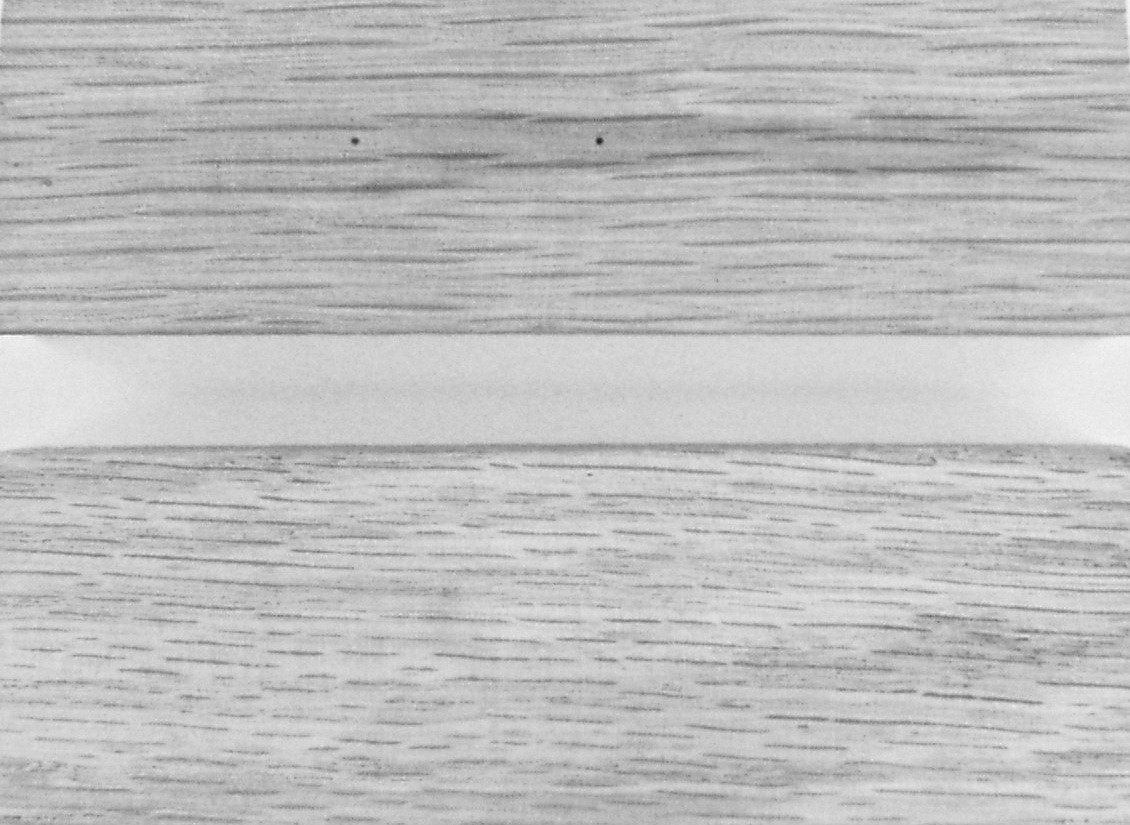
Q What is an easy way to tell red oak from white oak?
A There is a quick test using a 10-percent solution of sodium nitrite; the test has been evaluated by the US Forest Products Lab and is 100 percent. With white oak, the area treated turns very dark.
But, in most cases you can tell visually. In the picture below, one is red and the other I white. How do you know? Look at the dark lines running horizontally. In red oak, these lines, made from wood cells, called rays, are 3/4-inch long at most and usually 1/2-inch or shorter. In white oak, you can find many ray cell lines that are 1-1/2 inches long.
Wives’ tale: Some folks say red oak is porous so you can blow into the end and air will move to the other end. White oak generally is not porous.


Have something to say? Share your thoughts with us in the comments below.