

With that title, you may think, “That’s clickbait.” But I assure you it’s 100% true.
It all started with a call from Au Niveau in Montreal, Canada. This company is run by an amazing couple, Mehdi Oliveira and his wife Kristine. They have been practicing lean for a few years, but just knew there was some untapped potential in their operations.
We are certainly more selective these days about our onsite consulting practice. We knew Mehdi and Kristine were different. Since they were already Kaizenify.app customers, we knew they were measuring their manufacturing operations properly, we could see they were very active in creating SOPs and Kanban cards, and they had attended our seminars at the wood shows. We knew they would take action, so we said, “Yes.”
We arrived ready to dig in and analyze operations. The goal was simple: Open up capacity in the plant. Au Niveau manufactures custom van interiors. They were producing three complete vans per week, and after our initial walk-through, we wondered if there was anything we could do. It was pretty amazing.
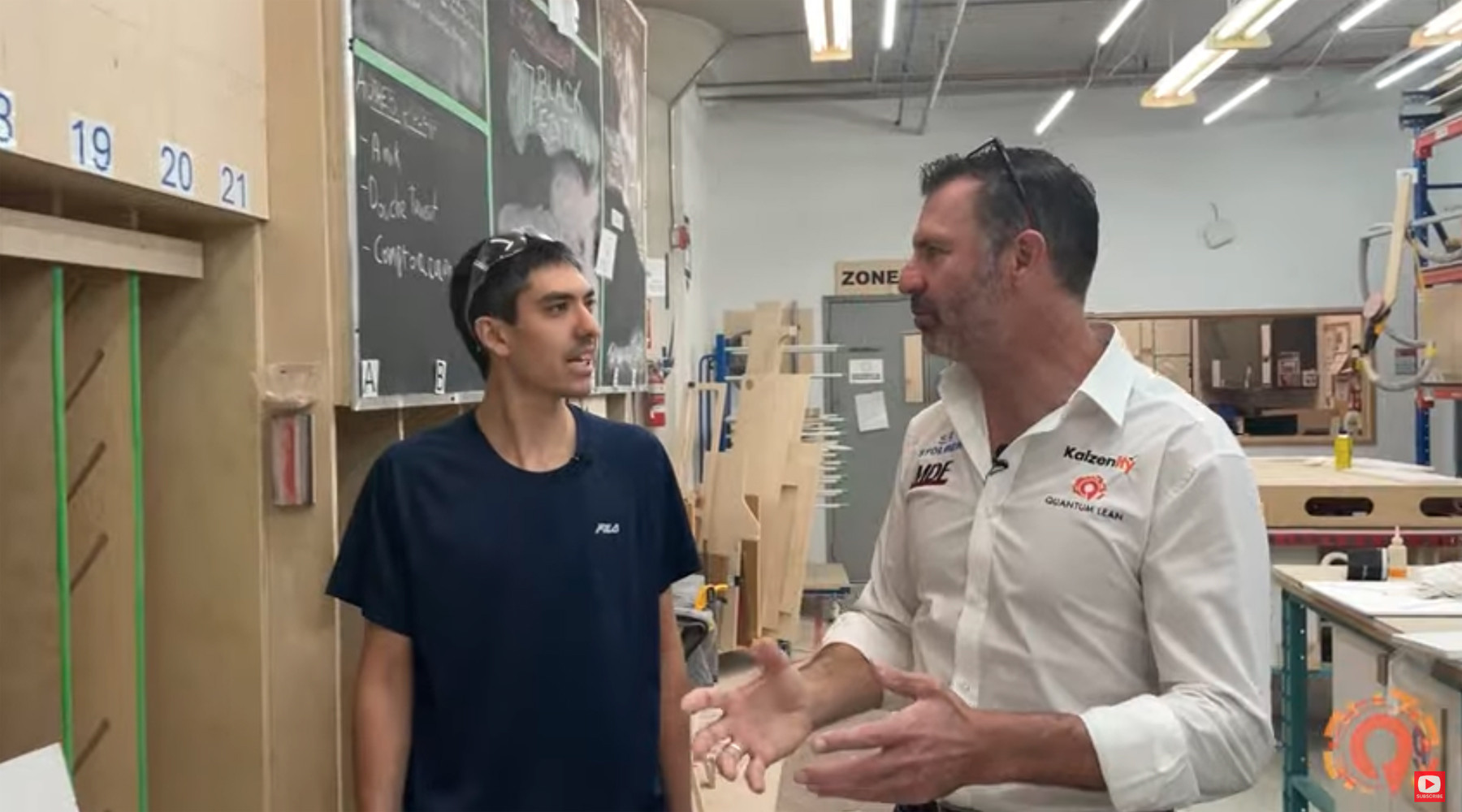
The amount of creative improvements was unreal, we immediately pulled out our cameras and started making videos. Those can be seen below (Plant Tour: youtu.be/dOU743ITs10 and Flow Lessons: youtu.be/3hQgQz7F3K8) One of the coolest parts of seeing all the improvements was how many of them were something they picked up from on our Kaizenify group chat. We are so proud of that community.
Day 1
The first day consisted of studying how parts flow through the shop and looking for hidden opportunities. You don’t have to be in the Gemba (factory floor) very long before things start jumping out. Here is what we found and decided to focus on for the next two days.
- Almost all processes are disconnected; parts are cut at one station, collected until that batch is done and then passed onto the next process. The disconnection between raw parts sanding and finishing was the biggest opportunity to connect.
- Orders were being released in complete batches, yet some parts needed to go through finishing before assembly, and some parts must be staged, waiting for finished parts to show up. We needed to create a trigger system so parts didn’t age on the shelf.
- They were a little too lean with the amount of work in their buffers. Inventory isn’t always bad.
- They were batch producing some of the subcomponents ahead of the cabinet assembly, which might be OK, but in this case, the takt time allowed for both to be done in flow.
- The control point was not where we typically like to see it.
- They were not using the production timer to keep their control point on pace and call for help when needed.
- They were not yet using the defect tracker. The gold is not in increasing your sales, it’s fixing your defects.
We only had two more days left, we thought this was a pretty good list. To say that Mehdi and Kristine took immediate action was an understatement.
Day 2
We started out the second day with a morning meeting and a huge white board. We taught the whole team the difference between connected and disconnected processes. We discussed the control point and why we would like to shift it to assembly. One by one we reviewed what we found, and with the whole team came up with a plan.
They took immediate action! Within hours I saw a second production board going up at the CNC that would allow them to split orders into the parts that needed finishing and hold off cutting parts that didn’t. The CNC department would receive a trigger from finishing to complete cutting a specific order. If you’re a kitchen factory wondering how this can apply to you, think in terms of all your custom work vs. production stuff like cabinet boxes.
Simultaneously, we were busy with the raw sanding and finishing. They were processing all the raw sanding for a complete van in one building, which took about one day. Then those parts would move in a batch to another building for finishing, which took one day. There is a multi factor problem with this situation.
Imagine yourself as the first part being sanded, and all you want to do is get finished. But you have to sit on a cart waiting for all your friends to get sanded before you can get sprayed. There is no good reason why you could not be sprayed immediately. You have to pay the price in wait time for every part getting sanded all the way up to the last one. That doesn’t seem fair does it?
That first raw sanded part is hanging around for almost a full day. This should spark some curiosity, if only we could use that wait time as dry time.
That’s what we did, we connected the booth directly to the raw sanding, so each raw sanded part would immediately flow to the booth for spraying, one at a time. Then by the time you’re sanding the last raw piece, all the others are actually sprayed and dry, ready for sanding again. Dry time problem, non-existent. Also, we took a two-day process down to one day.
The buffer scenario was easier to correct, they were just a bit too lean, we want to protect the control point with at least two days’ worth of work, currently they are running hand to mouth, which is great, right up until a feeding operation has an issue. Increasing the buffer to two days buys your team a little time to fix whatever is going wrong. Remember Murphy’s law.
Batching of sub-components. Memorize this: “Flow where you can, pull where you must.” This simply means all the parts you can make within your takt time you should. Only if you can’t make all your components within takt, they must be made ready by another department ahead of assembly.
The control point was a relatively easy switch, we just set up the production timer in assembly and subordinated all activity to the control point. We fixed the bottleneck situation in finishing that was mainly caused by labor misallocation. It was a bottleneck; we had to elevate that capacity above the control point’s ability to produce.
Last but not least, my Quantum Lean colleague Lynn Thomson took the time to help them set up their defect tracker in Kaizenify.app, and everyone was really excited to expose the issues they knew the system would help them identify.
So, what happened? In short, they were able to go from three vans per week, to one per day. This bought them two additional days of capacity in their factory to take on more work, and we didn’t spend a single penny, it was all done with existing resources.
We are so proud of Mehdi, Kristine and the whole team at Au Niveau. If you are wondering if there is some hidden opportunities in your operations, give us a shout, the help you need may be only a phone call away.
Watch Quantum Lean's videos of the Au Niveau plant tour and flow lessons, below.


Have something to say? Share your thoughts with us in the comments below.