

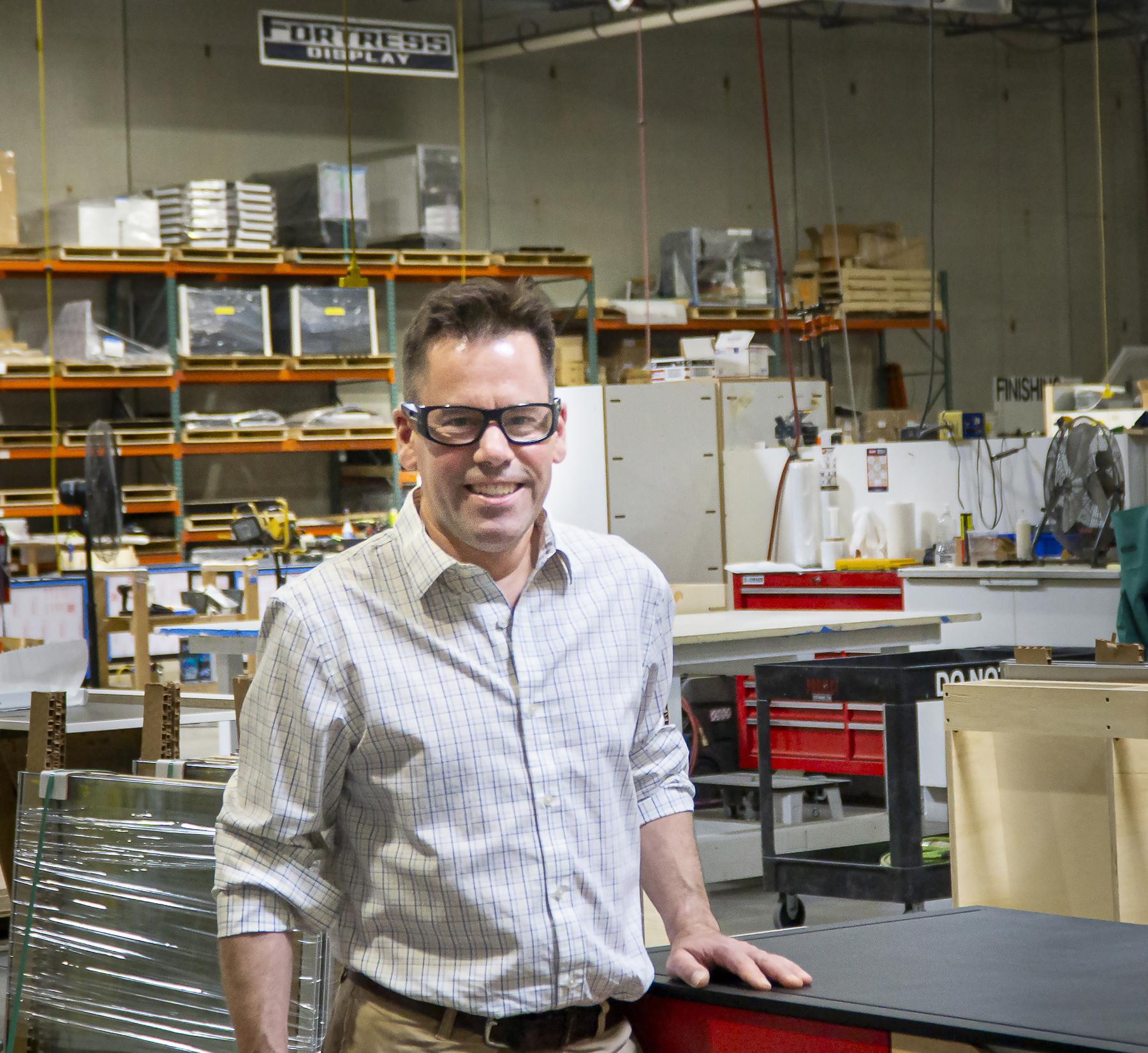
There are builders. There are engineers. There are entrepreneurs. And then there’s Geoff Hoffman — a guy who simply can’t stop solving problems.
The founder of Hoffman Manufacturing in Madison, Wisconsin, has spent nearly 30 years proving that the best businesses aren’t necessarily built on flashy branding or scale, but on curiosity, iteration, and an unwavering commitment to getting things right. Whether designing sledgehammer-proof display cases or mobile kitchens that ship fully assembled and unpack without tools, Hoffman’s approach remains consistent: engineer for ease, build for the long haul, and never stop improving.
“We’re always looking for the simpler, smarter way to do something,” he said. “That’s not just for us — it’s for the people using the thing when we’re not there to explain it.”
That last part — being mindful of the user — is one of the things that separates Hoffman from the average fabricator. He doesn’t just think about how to make something, but how it’ll be received, installed, used, and maintained — often years later, by someone who’s never heard of Hoffman Manufacturing.
School wiring to cabinet engineering
Hoffman’s journey began as a curious high schooler in a Racine, Wisconsin, welding shop, where he found himself modifying machines rather than just operating them.
“I was wiring up contactors and programming duct-sizing calculators in DOS,” he said. “They let me experiment, and that shaped how I’ve looked at everything since.”
He pursued engineering at UW–Madison but quickly realized his learning style didn’t align with theoretical classrooms. “I didn’t want to just prove a concept,” he said. “I wanted to build it, test it, make it better.”
That hands-on mindset carried him into a job at a cabinet shop, where he developed a framework that later became a core principle of his company: parts should be standardized, modular, and designed for efficiency.
“I was there for a few years. I think in a way, it was my college education. This wasn’t a small shop; it was 50 to 75 guys. But the way we were doing stuff, we were cutting rectangles, building a box, and then machining the parts on a built cabinet — which seems really backwards, doesn’t it? But that’s how an old-school cabinet shop did things.”
This predated CNC manufacturing. “It was all about a panel saw and an edgebander,” he said. “Let’s build a box and then do all of our cabinet work — the machining — after it’s built, which I thought was ridiculous.
“Toward the end of my employment there, I actually wrote what I considered my ‘thesis.’ I called it Parts Is Parts, and I delivered it to the owner of the company,” he said. “They actually used it. The concept was: we should make all of our cabinet parts fully — make the part first — before we build the cabinet.”
Repeatable precision
By the late 1990s, Hoffman had opened his own shop, starting with rugged metal-framed furniture for student housing that incorporated replaceable TFL panels with PVC edgebanding. It was built to last, with panels that could be swapped out if damaged. Student housing managers loved it.
“Why toss out the whole piece when you can just replace the part that gets worn or dated?” he said. “Even then, we were thinking about lifecycle.”
Student furniture is a seasonal business. To keep things going year-round, he began branching out. “We tried to get into the retail fixtures world,” he said. “I even did some local contractor work. I had a panel saw, an edgebander, some spray finishing, and a welder. I couldn’t do a ton, but I could do enough to have some value.”
He started taking on whole store interiors for small local retailers. Hoffman had a dual focus on wood and metal fabrication, something that still defines his company’s capabilities. “A lot of shops will do one or the other and then outsource the rest,” he noted. “But from the beginning, because of that initial concept of steel frame furniture with replacement wood panels, we always had wood and metal both in-house.”
Design software crucial
One of the most important decisions Hoffman made was to invest in SolidWorks, a 3D CAD software that completely changed how he designed, built, and thought about fabrication.
“It’s still my go-to,” he said. “I use SolidWorks probably every day, hours on end. It’s a fantastic tool. Honestly, I don’t know how I would have done what I’ve done without it.”
The software shaped his approach to product development. “It goes right along with the Parts is Parts thesis,” he said. “You’re not drawing a whole big cabinet. You’re drawing a part at a time and putting them into an assembly.”
He built a vast internal library of reusable components. That allows Hoffman Manufacturing to respond quickly and intelligently to custom opportunities. “It’s faster for us to adapt something that works than to start from scratch,” he explained. “We can quote complex projects quickly, model potential changes, and anticipate problems before they hit the floor.”
The platform also supports the company’s hands-on engineering culture. “We’ve built our own clamp racks, nesting fixtures, mobile workstations,” Hoffman said. “They may not be pretty, but they make our lives easier.”
Material handling by design
One of Hoffman’s core beliefs is that material handling isn’t “nice-to-have,” it’s an engineering challenge to be solved.
“We’ve created glide systems that allow heavy subassemblies to be moved by one person,” he said. “We have magnetic tagging systems that sync with our production software. Nothing is an afterthought.” By controlling how every part is stored, moved, and assembled, Hoffman reduces labor time and damage, and ensures that even a new employee can pick up a part and know where it’s headed.
Sledgehammer tests
Hoffman has worked behind the scenes for major national clients, including Trek Bicycle and Gander Mountain. His team built everything from mobile demo units and store displays to ultra-secure gun showcases.
“We were doing Trek events where the client would call on Monday and need a finished display by Thursday,” Hoffman said. “We were sleeping at the shop, running CNC through the night.”
Gander Mountain wanted a display case that could stand up to an actual sledgehammer. “Gander Mountain was headquartered in St. Paul, so it’s only four hours away,” Hoffman recalled. “We got lucky, because one of their other fixture providers was falling down a lot, and we happened to be there at the right time when they were doing some expansion.”
Gander Mountain needed a high-security firearm display case. “That’s where they would show their firearms and high-dollar items,” Hoffman said. “The idea is, you can’t just run in the store and smash-and-grab and steal, whether they’re open or they’re closing.”
The retailer had a simple but brutal standard: “It’s got to prevent us from getting in within three minutes.”
It didn’t go smoothly at first. “I didn’t get it the first time or the second time,” he admitted. “There’s a lot of really elaborate engineering. It’s not just about using the right materials. It’s about how these parts fit together while still keeping it efficient and usable. It’s got to work well in the retail environment.”
Eventually, Hoffman nailed the design. “They gave up after 15 minutes of trying to break into it,” he said. “That’s also when they confessed that my competitor didn’t make three minutes either. We had built the better mousetrap.”
That success opened the floodgates. “They launched a big expansion, and we were doing a lot of work for them, to the point that we needed to open some temporary locations for final assembly. It was crazy; sales were incredible.”
The product’s performance and market potential led Hoffman to launch a new brand and product line: Fortress Display. Fortress has opened even more doors for Hoffman. “We have a unique product that maybe not a lot of other places sell, and so we can get in that way. And then, well, we can build your fishing rod racks too, right?”
The parts of the Fortress displays that aren’t metal or polycarbonate are Uniboard TFL in Slate Gray.
Charlie Cart Project
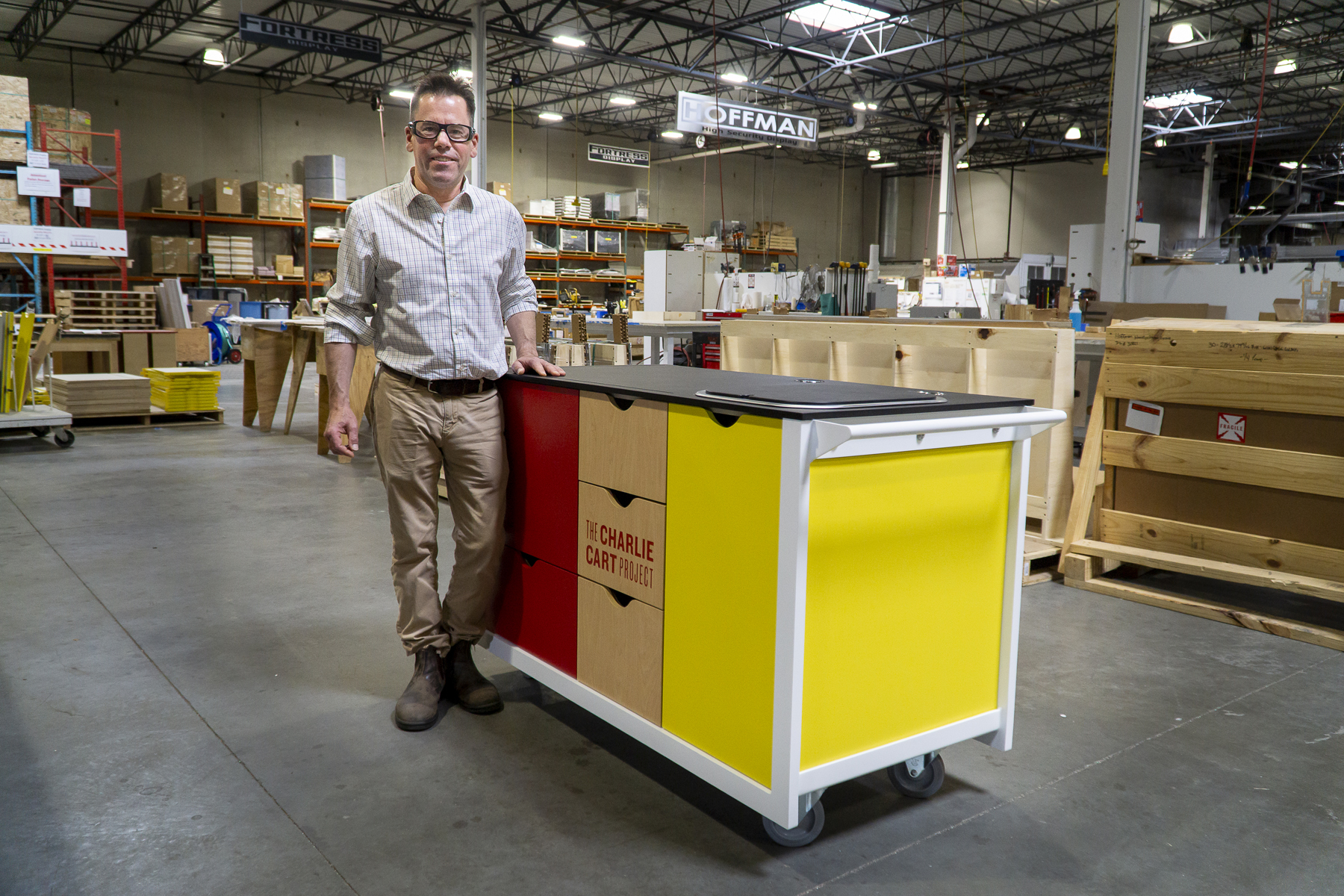
Another breakthrough came with the Charlie Cart Project, a nonprofit initiative that brings fully equipped mobile kitchens into classrooms, libraries, and community spaces across the country.
Using a 5-foot by 3-foot cart on wheels, like a mobile kitchen, the goal is to give kids hands-on access to real cooking tools in an educational setting — YMCAs, schools, libraries.
“It’s a whole kitchen on wheels,” explained Hoffman. “There’s no fridge, but there’s an oven, there’s a hot plate, and a blender, mixing bowls, and measuring cups, and all that stuff. There’s even a sink and fresh and gray water tanks.”
The carts are manufactured with a durable metal frame that’s welded and powder-coated in-house. “There’s a wood cabinet that drops into this metal frame, and it’s got all these wood doors and drawers and all this stuff,” he said. “So it uses about every department in our shop. Personally, I’d rather build Charlie Carts than stuff for cell phone stores. It’s a good thing to be a part of.”
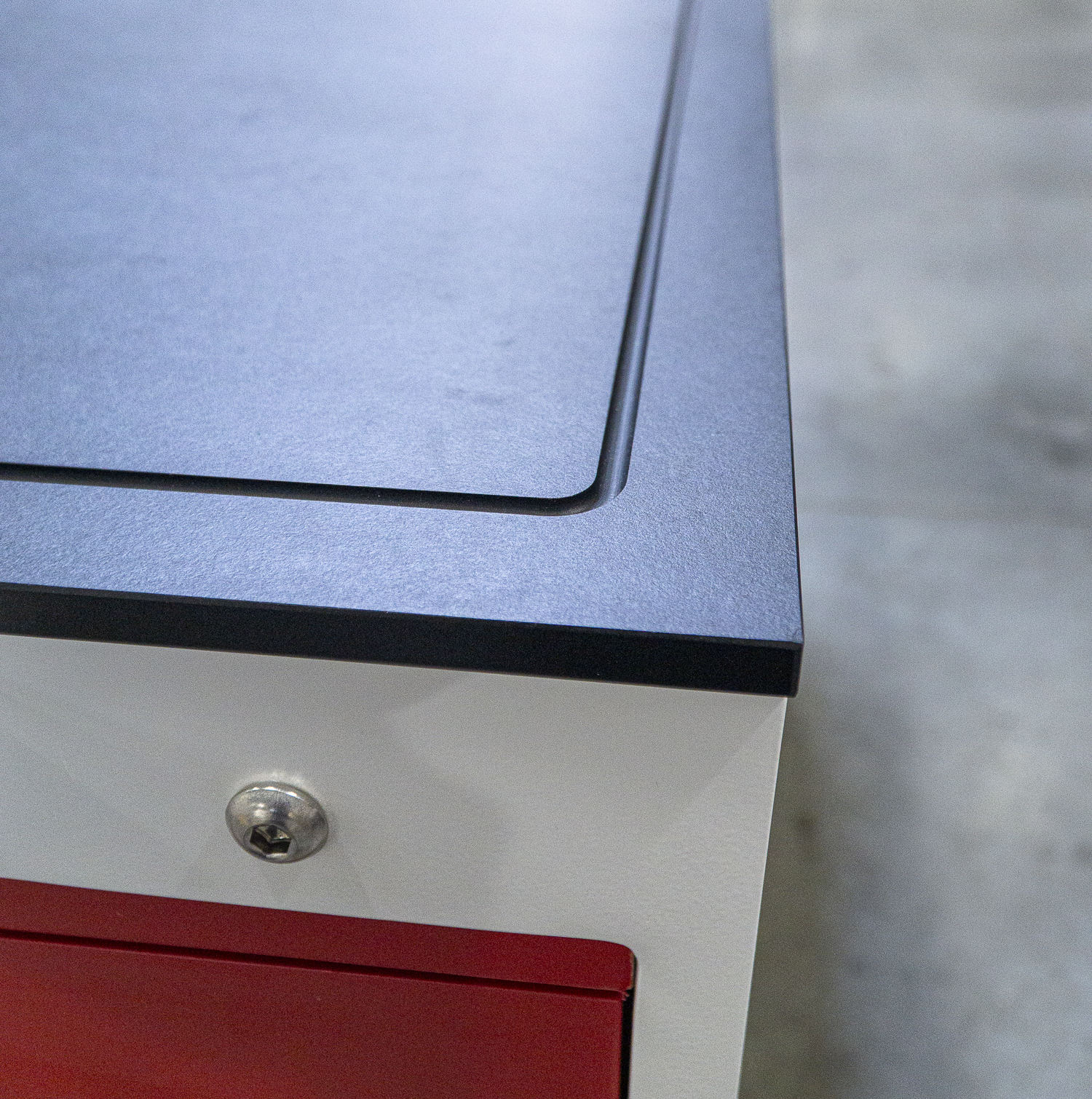
One of the cart’s signature components is its Richlite countertop. Richlite is a durable, sustainable surface material made from layers of FSC-certified paper infused with phenolic resin and compressed under heat and pressure, similar to what’s known as “compact laminate” or “solid phenolic.” (Richlite prefers the term “paper composite.”)
The result is a dense, non-porous paper-fiber panel that performs like hardwood but resists moisture, heat, and impact. Originally developed for industrial and aerospace applications, Richlite is now widely used in architectural millwork, foodservice surfaces, and outdoor furniture. It machines cleanly like wood and is valued for its warm, organic appearance and low environmental impact. Richlite is also NSF-certified for food contact and contains up to 65 percent recycled or rapidly renewable content.
Hoffman uses 12mm black Richlite on the Charlie Cart. The sink and drip edge are cut on the company’s two CNC routers. “Richlite machines wonderfully. It’s really great. It’s not as brittle, so it’s not going to chip,” said Hoffman.
The rest of the colorful panels on the Charlie Cart are Navajo Red and Primary Yellow from Pionite and Amber Maple from Formica, all HPL over plywood from the Pacific Northwest.
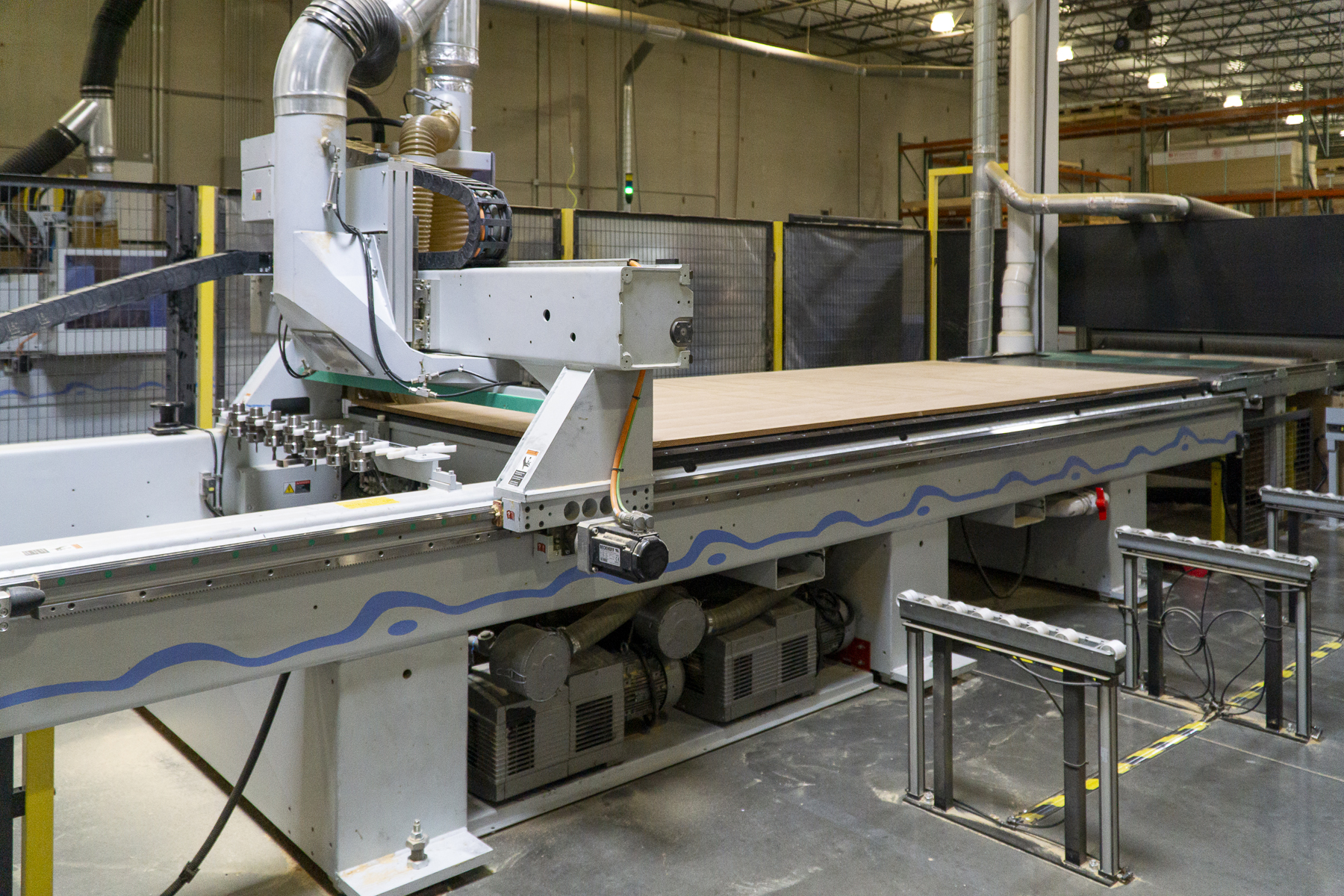
Key woodworking machines in Hoffman’s 58,000-square-foot facility include a 5x12 Weeke CNC nested router, a 4x8 Homag CNC nested router, a Biesse edgebander, a Homag edge bore and dowel inserter, a Homag case clamp and a Brandt contour edgebander. Hoffman uses Blum hardware almost exclusively, for its quality, selection and availability.
And of course, his plant houses a full metal powder-coating line and several stations for metal fabrication.
Engineered to be user friendly
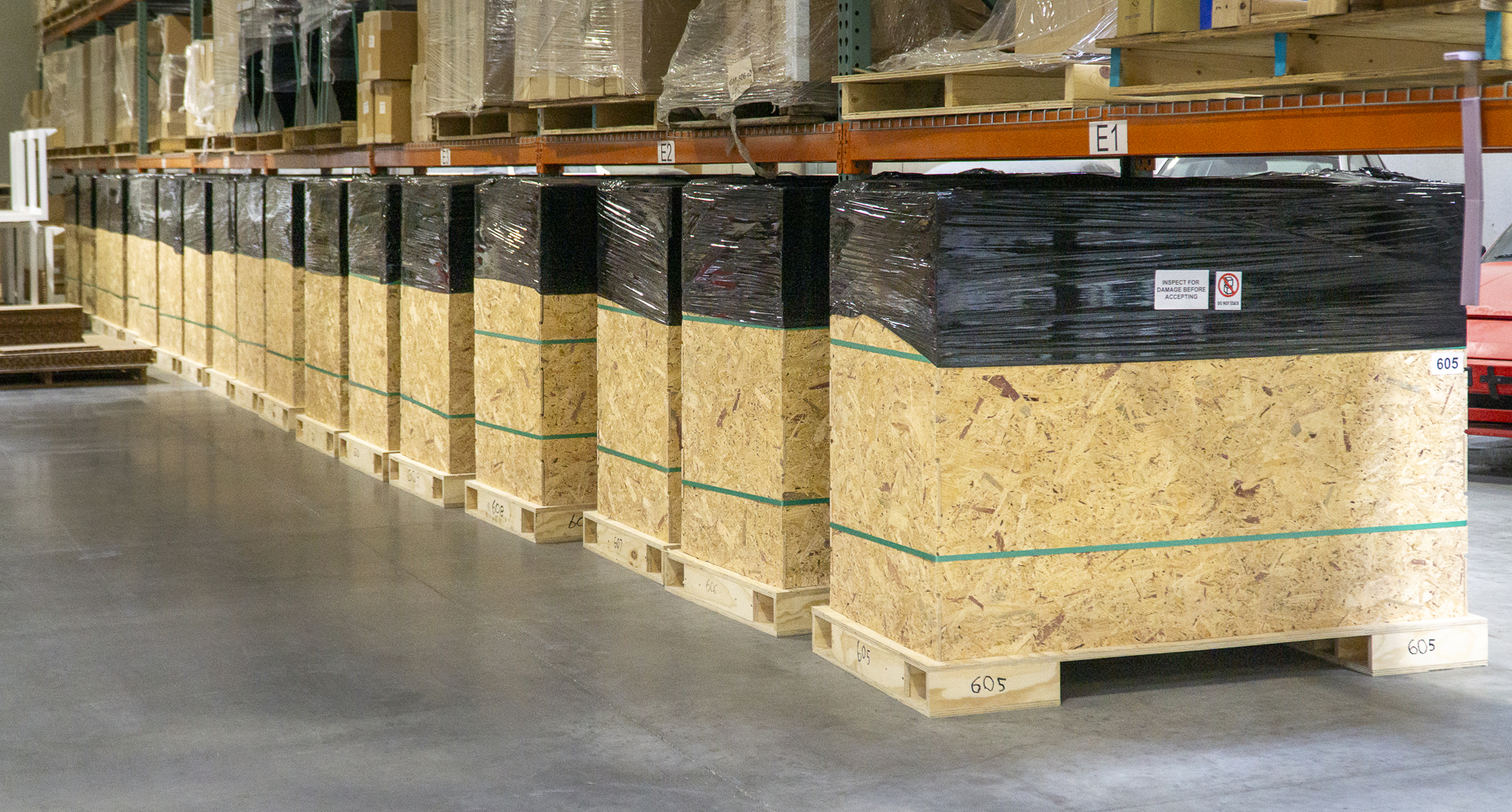
Hoffman’s commitment to user experience extends to how the carts are delivered. “We had to design the crate so it could be moved around with a fork truck, of course,” said Hoffman. “A single person can unpack the Charlie Cart in a facility that may not have crowbars, cordless drills, screwdrivers, or someone to do heavy lifting.”
Everything is designed for intuitive use: drawers close softly, parts can be removed and washed, and laminated diagrams guide teachers through setup.
Each unit is tested end to end. “We test the power system, water system, drawer alignment, doors, everything. If something rattles, it doesn’t ship.”
After producing more than 500 Charlie Carts, the project remains one of Hoffman’s proudest ongoing collaborations. “It’s a good project for us,” he said. “It’s nice work, and a good thing to be a part of.”
Culture of curiosity
Hoffman Manufacturing employs about 30 people, many of whom started with no formal training but plenty of curiosity.
“We look for careful thinkers,” Hoffman said. “We don’t care if you have a résumé full of credentials. Show us how you solve a problem.”
Cross training is standard, and SOPs are updated constantly. “If someone finds a better way to do something, we write it down. The whole team gets better.”
It’s that blend of engineering, humility, and endless refinement that makes the company unique. “We’re not trying to be big,” Hoffman said. “We’re trying to be useful. And when something breaks, we’re the team you want on the other end of the line.”



Have something to say? Share your thoughts with us in the comments below.