

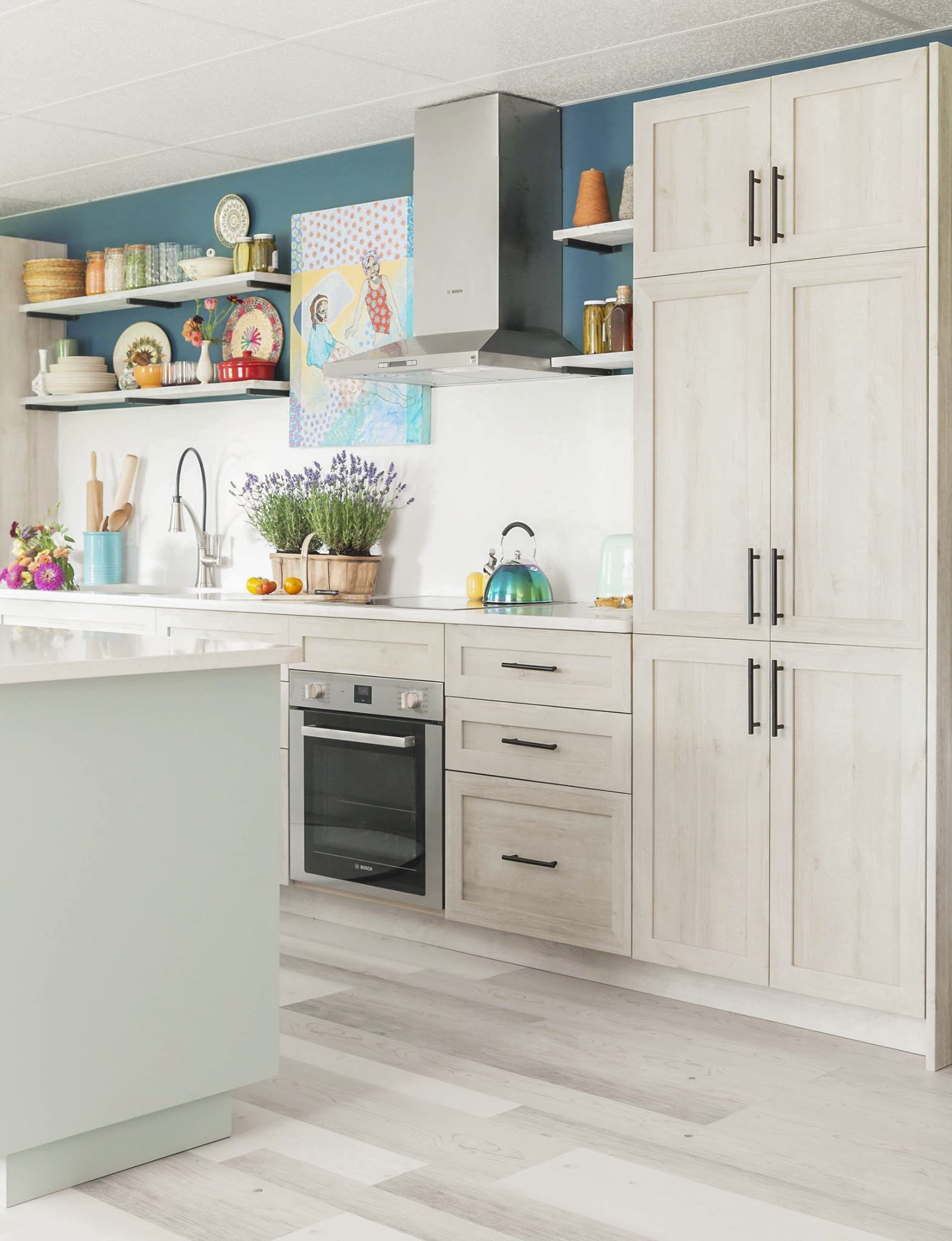
In closets, cabinetry, furniture, and interiors, sustainability and material choices are interconnected on several levels, and with the rise of 2D laminates, companies now have more options.
Speaking specifically about decorative components for closets and cabinetry, sustainability and health-and-wellness impacts depend on:
What the overlay is made of: A sustainably harvested and sourced material like forest fiber (paper), which includes HPL and TFL, compact laminate, and lightweight papers.
A recycled or recyclable material like PP (polypropylene), PET (polyethylene terephthalate), or PVC (polyvinyl chloride) that includes recycled content.
- Whether the overlay can be recycled after being laminated to a substrate is a difficult challenge our industry is working to address.
- Whether the overlay design is an effective substitute for other, less sustainable materials.
- Durability.
- How much effort and energy is involved in cleaning the surface?
- What substrates are required?
- How much energy do these components require to produce?
Let’s be honest. When it comes to resource use and carbon footprint, the heavy lifting of a component like a shelf or a cabinet door is done by the substrate, which makes up 95 percent or more of the volume and weight of the component. In North America, these cores are almost always particleboard or MDF, sourced from managed forests and manufactured in modern plants. They’re fully cured before shipping to distributors and manufacturers, and meeting the world’s most stringent indoor air quality standards.
As we’ve explored in other articles, any time the conversation is carbon, wood always wins. Trees absorb C02 from the atmosphere as they grow, storing the carbon and releasing the oxygen; that carbon remains sequestered from the atmosphere until that wood burns or rots, potentially for centuries. Life cycle assessment (LCA) studies show that composite wood panels like particleboard and MDF store far more carbon than is released in their production and use, offsetting the carbon footprint of other materials used in a project; this is why we call these materials “carbon negative,” or “climate positive.” All wood-based materials can tell the same story; composite wood panels are the only category with research we can share.
In addition to the climate-positive carbon advantage of forest fiber, we can also say that the wood products industry in North America does an exceptional job of managing forests for long-term productivity, biodiversity, and ecosystem health. Forest management techniques are based on nature’s own rhythms of renewal, and on the wisdom of indigenous people who long ago learned the difference between living on the land, and living with the land.
2DL: The new ‘it’ material
“What’s exciting about 2DL is how far it’s come,” said Missy Sjerven, vice president of Marketing at Northern Contours, a leading residential and commercial components manufacturer.
“The tactile realism is unbelievable — textures, woodgrain ticking, the depth of color. Combine that with EIR (embossed in register) technology and you get materials that look and feel remarkably like real wood, but with performance that blows traditional finishes out of the water.”
While 3DL (membrane-pressed thermofoil) components have long been a mainstay for Northern Contours, Sjerven said demand for 2DL solutions is exploding.
One reason for this, she said, is 2DL’s realism in wood-look doors.
“Designers often prefer the look of ‘true grain orientation’ in five-piece doors. With 2DL stiles and rails, we’re able to deliver that classic Shaker style with a warmth and authenticity that today’s consumers love.” 3DLs are beautiful, she said, but the unidirectional woodgrain effect isn’t as realistic as 2DL five-piece doors.
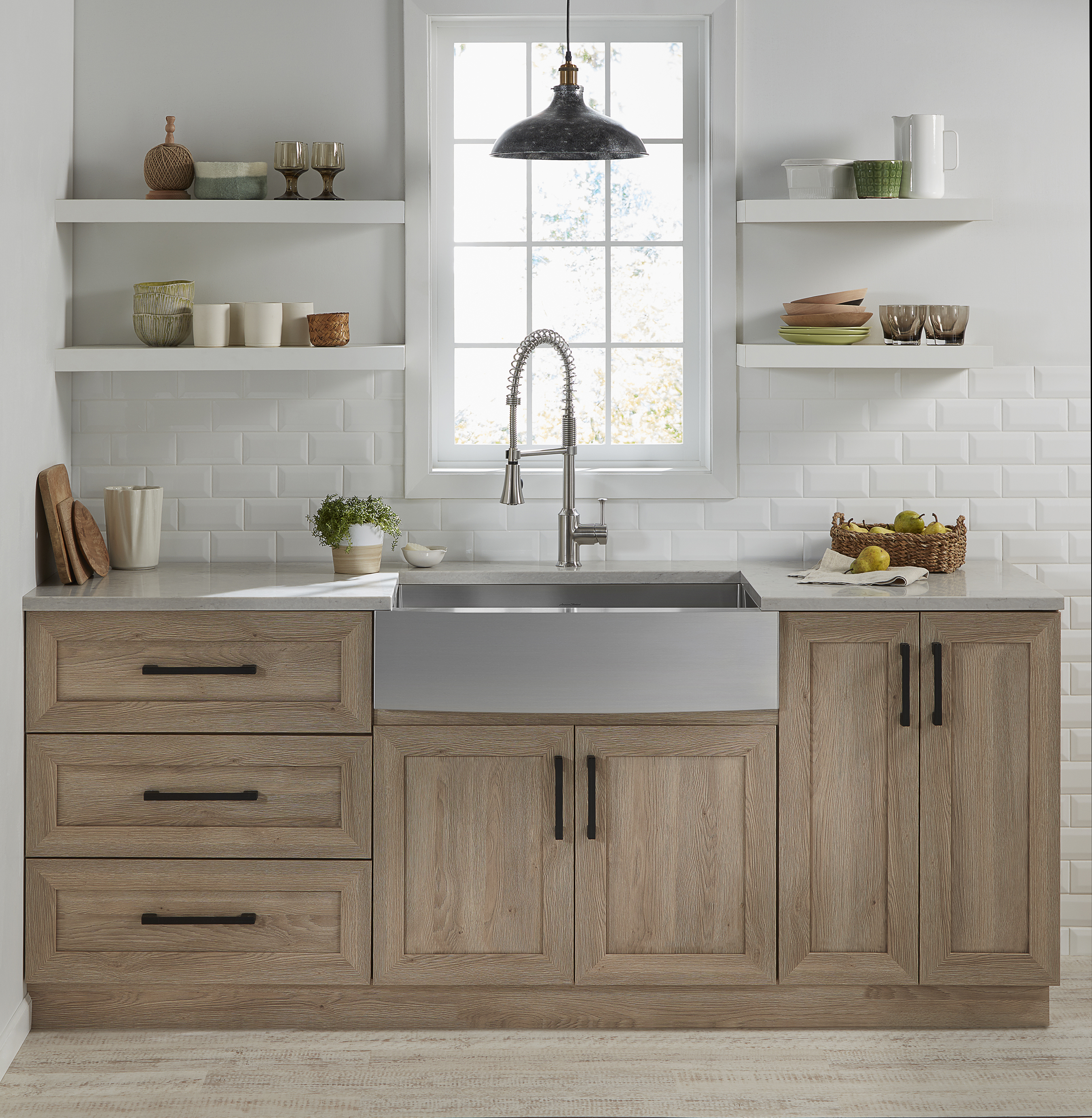
“Textures are playing an increasingly important role in the realism of 2DLs,” said Lana Cella, product manager, American Renolit, one of Northern’s top 2DL suppliers. “The deep embossing we see in PP and PET have really been a game changer, because these textures also play a role in the visual impact of these materials.”
While manufacturers often still adhere to traditional solid wood practices, the closet industry is blazing a more progressive path.
“Closet designers are extremely knowledgeable about materials. They want precise color and texture matches. And with 2DL, we can deliver that — especially when it’s paired with complementary TFL panels,” said Sjerven.
The ability to mix and match — wrapping profiles, pairing with flat-pressed panels, or integrating five-piece door constructions — gives closet systems a level of material sophistication that’s only now catching on in adjacent industries. And as woodgrains surge back into popularity, 2DL brings them to life with unmatched realism.
Greg O’Connell, Sales manager at SSI, another of Northern’s top 2DL suppliers, agreed.
“The closet industry has been a driver for the need for 100% matches,” said O’Connell. “They are constantly pushing and making this industry better because they demand such strict matches between three to five different materials: edgebanding, TFL, 3DL, 2DL, HPL…if you talk to any material supplier, they will tell you that the main push for perfect matches is the closets market.”
Superior aesthetics aside, 2DL also offers process advantages that boost both performance and sustainability.
“We’re doing a lot of miter folding now,” Sjerven said. “Our 2DL drawer boxes fold up in seconds with no visible seams. They ship flat, so we’re not wasting space or energy in transit, and install in less than a minute. It’s a perfect example of how efficiency can drive sustainability.”
One of the most compelling reasons to embrace 2DL? The sustainability story.
“There’s a growing shift from PVC to recycled PET,” Sjerven said. “And not just virgin PET; we’re talking recycled water bottles, soda bottles, and consumers understand that. It makes the conversation easier and more authentic.”
Sjerven is quick to acknowledge the challenges of green messaging. “There are so many acronyms, so much jargon, it can be overwhelming. We have to make sustainability tangible. When we say ‘this door is made from recycled plastic bottles,’ that resonates more than throwing out a bunch of polymer names.”
Northern Contours is actively working to simplify its climate positive message, while backing it up with credible data. “People are nervous about greenwashing, and rightfully so. But we believe in constant improvement — just keep doing better tomorrow than you did today.”
Summing up, Sjerven said, “Designers want materials that are beautiful, durable, and cost-effective — but also smart and sustainable.
“2DL checks all the boxes, and it’s only getting better.”
What is ‘2DL’?
2DL is any material that can be applied to the top and two sides of a component using profile wrapping technology, vs. 3DL, which can be laminated to five of six panel sides.
Common 2DL materials:
Polypropylene (PP): Thin and affordable, PP films are used widely in North America in kitchen cabinetry (5-piece doors), RV cabinetry, furniture and closets. In Europe it’s also heavily used for indoor passage doors. Other applications include ceilings and wall panels. PP is free of formaldehyde and plasticizers and provides a barrier against moisture.
Polyethylene Terephthalate (PET): Also sometimes referred to as polyester, PET has high scratch and fingerprint resistance and can be made from recycled content, perfect for firms choosing to be PVC-free. It has excellent deep-draw characteristics for unusually thick parts (e.g. 4-inch depth) and is sometimes preferred for high-gloss designs. The material is popular for use in healthcare, furniture, kitchens, RV and retail applications.
Polyvinyl Chloride (PVC): PVC is one of the most versatile and the third most widely used polymer, found in a range of items including IV bags, water pipes, and resilient flooring (LVT). PVC for furniture and interiors typically contains 10-15 percent recycled content. Unlike other thermoplastics that are entirely derived from oil or gas, PVC is 57 percent chlorine, derived from sodium chloride (table salt), and 43 percent derived from hydrocarbon feedstock, predominantly oil or gas via ethylene. The chlorine content is what gives PVC its excellent fire resistance.
Paper: Still widely used in lower-cost laminate and TFL applications, paper-based overlays are less durable and have more limited embossing options. However, they can be cost-effective for non-contact or vertical surfaces.
Substrates:
Most 2DL materials are laminated to MDF or particleboard cores, although they can be applied to many other substrates.
2DL materials deliver design-forward surfaces with surprising durability and sustainability benefits — offering the look and feel of high-end finishes at a fraction of the weight, cost, and environmental impact.
For a much deeper dive into 2DL materials, visit materialintelligence.com/all-material-guides.



Have something to say? Share your thoughts with us in the comments below.