

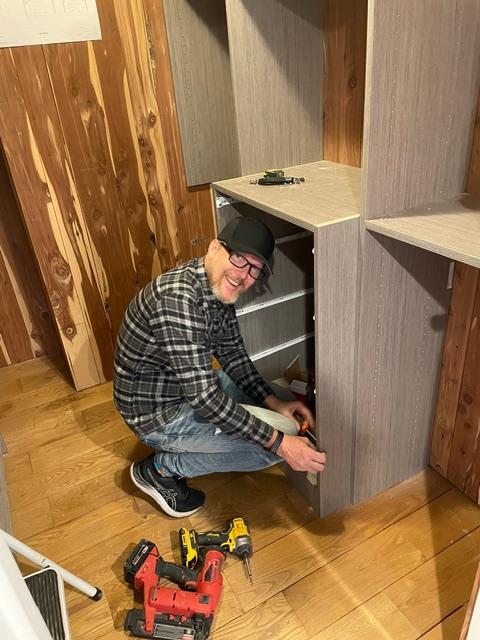
Welcome back, everybody. Hopefully, you survived January and February, as January is normally the biggest sales month of the year for storage companies. You should be receiving installation paperwork for the next three months for jobs that were sold in January and February. That should keep you busy installing into the Spring, but that’s a tale for another time, as you’re not gonna get a break till summer. In the last issue of Closets, we discussed the 5T’s of installation, and I covered Tools and Timing. This issue, we’re covering Technology and Transportation and we will save Training for a future issue.
Technology is actually my favorite, and today there’s even more technology than ever. I mean, seriously, if you’re installing for a forward-thinking closet company, you’re probably getting tracked because you’re using an app on your phone for client info to get to your job, and your boss wants to know when you’re done with the job or that you arrived on time. That app is part of the technology used today to help companies grow through good service, which creates repeat and referral business.
You can also use the apps to help yourself, and you should be using them. And if you’re not using one, here is a short explanation: Client relationship management (CRM) apps have a somewhat wider focus on client-facing processes. Like storing contact information, tracking interactions, analyzing client data, and streamlining communication. Most CRMs have space for notes and pictures. These tools are a place to store advances and obstructions on job sites. For instance, does your company count the flights of stairs or floors in a building, and if an elevator exists that you must use to deliver your tools and materials? This will affect the timing we discussed in the last issue.
If not, you can start a space on the app for this info, as it takes up extra time and energy to make extra steps like that. We might be able to talk with your company’s technology expert to see if there’s a way to build this idea. Remember, “steps cost dollars.” Or if the material is mis-manufactured, you could upload pictures to your production manager or shop foreman faster than explaining what you need. I remember back in the early 90s when the closet company I was working for hired a shop foreman from outside the closet industry. He knew nothing about the 32mm system, and it took forever to explain to him what was wrong (if I only had an iPhone or an app) to get the correct parts. Batman needs Robin, and boy, did they have technology to make their crime-fighting life easier.
Transportation
Getting tools, personnel, and materials to the job site takes on a whole different look, whether you live in the desert or the jungle. Man, do I love my truck, but it’s not a good vehicle for Seattle. I believe, regionally, installation vehicles are starting to develop a feel of their own. In Seattle, you’re gonna get rain nearly 150 days a year. Whereas in Phoenix, you only get about 30 days a year. That means with all the holidays and weekends, you probably run into a problem with rain about 20 times a year. Rarely should you need to cover up your material, and one of the biggest closet companies in Phoenix uses only open-bed trailers connected to pick-up trucks as its installation vehicle. Whereas, in Seattle, an enclosed van tall enough to stand up in is very important for dealing with rain more than 1/3 of the year.
And just hooking up and disconnecting a trailer takes extra time, so the choice of vehicle has a lot to do with installation timing. Back in the day, when we first started installing in New York City, we had to get somebody just to stay with the elevator so we could get materials back and forth without losing the use of the elevator.
When talking about vehicles, there are many important subjects to consider.
- What is the weight capacity? Engineered wood is quite heavy.
- How many installers can you safely fit in it, as we know larger crews are more productive, and average job sales have hit the high five and maybe six digits, taking multiple days.
- Does your vehicle choice have ample space for lettering like your address, phone number, and possibly a QR code to connect? I mean, if you’re in installation vehicles on the road twice a day and in front of a lot of other vehicles on the highway, isn’t that a great place to advertise? So, let’s look at our vehicle with as much seriousness as the material we choose to keep our clients out of callbacks.
And for a last word on vehicles, don’t forget about maintenance. Do you have a maintenance schedule? Can you add it to your CRM? Do you have someone in charge of this other than the installer? I remember when I was 17, I owed my boss a new transmission because I had a leaky transmission. He told me to check the fluid. I mean, how is that really my fault? Until the next issue, this is Eric telling you, don’t forget the nails, and if you did, make a list.




Have something to say? Share your thoughts with us in the comments below.