


For many in the design industry, the process begins with a mood board, a color swatch, or a Pinterest search. For Li McGi, owner of The Organizing Genius, it starts with a simple count.
“I go and assist. I touch everything you have in your closet, and I count it, I measure it, and then I design the closet around what your needs are,” McGi said. “So, we know that you have a truly custom closet, not just custom to the space… but custom to you and your style as a person.”
This organizer-first approach is the foundation of a design business that McGi, a former IT professional, built from scratch in March 2019. What started as a necessity, her children’s father had fallen ill and could no longer work, quickly morphed into a high-end design business catering to clients with “hefty wardrobes.”
“I was having a conversation with my cousin about what I can do to make some extra money,” McGi recalled. “And she said, ‘Well, you can help people clean out their closets.’ I’m like, ‘Ain’t nobody gonna pay me to help clean out the closet.’”
Her cousin and best friend insisted, referencing a “Marie Condy” (Marie Kondo) lady. McGi, who had never heard of Kondo or the term “professional organizer,” went to Barnes & Noble, bought some books, and realized her innate talent had a name.
“I was like, all this seems like I know already,” she said. That Monday, she registered her DBA. That Friday, she opened a bank account. Within two days, she had built her own website. Her first client, a business coach with 90,000 social media followers, hired her before she was even officially open.
“I didn’t know what I was doing,” McGi admitted. “All I had was some Ziploc bags and some rubber bands.”
But the client posted her work on Instagram, and the “calls started flooding.” McGi was juggling a full-time software job and a rapidly growing side business, but the leap into full-scale custom closets was yet to come.
The “secret weapon”
McGi’s transition from organizer to closet designer was sparked by a key partnership. She met a carpenter in July 2019 through a Home Advisor lead, and by January 2020, they were installing their first project together.
“He’s done every single closet since that day,” McGi said, though she protects his identity. “He’s my secret weapon.”
The carpenter, she explained, taught her the business and the technical side of fabrication. “He said, ‘You can make money from this. I can give you a discount, and you can mark it up and make money.’… He taught me a lot. I didn’t know where your rod height is supposed to be… I didn’t know about blind corners.”
In return, McGi’s vision elevated his work from “basic, simple, and easy” to the complex, high-end installations she is now known for. “My vision is what makes the closet what they are,” she states.
Their relationship, built on a “gentleman’s agreement” with no contracts, has been tested. McGi recounts a “come to Jesus” meeting after discovering the carpenter had been working with one of her clients behind her back for a year. But the partnership has endured because it’s symbiotic. McGi’s design-build process relies on his craftsmanship, and his portfolio has grown from her ambitious designs.
Designing from within
When asked about her inspiration, McGi is direct. “I am the inspiration,” she said.
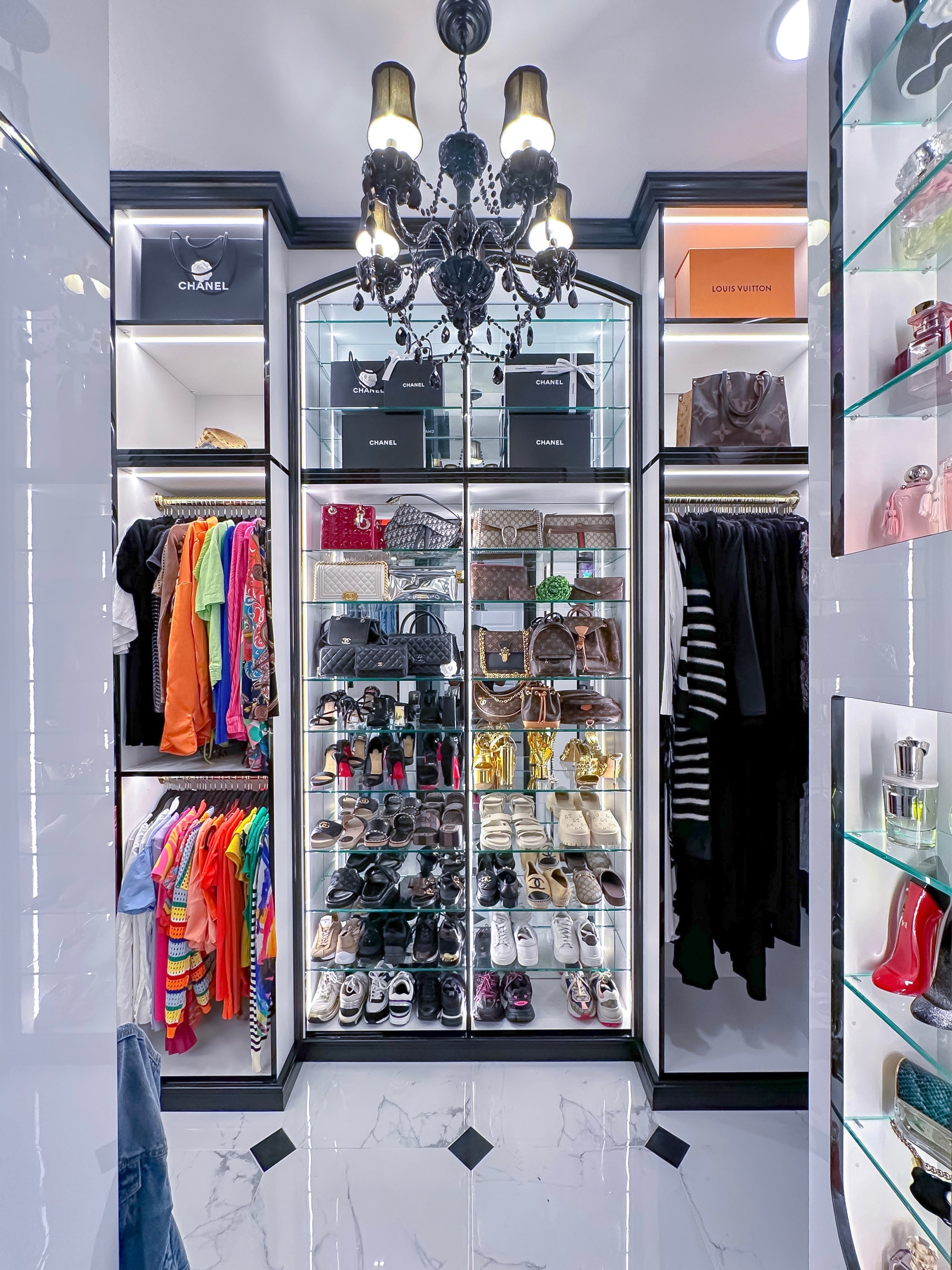
“The inspiration doesn’t come from Pinterest. It doesn’t come from Instagram... My closets are inspired by luxurious boutiques. I go to Gucci, I go to Prada, I go to Louis Vuitton… I’m going to look to spas, restaurants, boutiques.”
This philosophy was put to the test on what she calls a “blind design” for a high-profile Instagram influencer in Atlanta. She designed the closet conversion without ever seeing the client’s wardrobe, a massive collection of high-end women’s wear, shoes, and bags.
“It was an overwhelming amount of clothes,” she recalled. “I was like, ‘Oh my God, what… how the hell am I gonna get through this?’”
Working on the fly, she began sorting by color and brand, creating an “all pink section, an all earth-tone section,” and, in a moment of inspiration, a “Chanel column.” The final result, which she dubbed “The Glam-azon,” was a viral success that “catapulted me into the next level of being a well-known designer.”
McGi’s rapid growth has not been without challenges. She shared the story of a project that spanned 10 months, from September 2024 to August 2025, and provided a costly lesson in scaling.
“My day-one carpenter… was very busy,” McGi explained. She hired a new carpenter, but communication barriers, and a lack of quality control led to disaster. “The work was... not as clean as I needed it to be for this to be a very expensive closet.”
McGi had to fire him and go back to her primary carpenter, who was “a little salty.” The fix required a complete tear-out and rebuild, costing an additional $14,000 and severely straining the client relationship.
“The client was very upset. She blocked me on social media. We were arguing through text,” McGi recalled.
The lessons were clear. First, make sure you can communicate fluently with the contractor. Second, “don’t start a new person off with something complex.”
But the most critical takeaway was the distinction between a laborer and an artist. “A carpenter [is] a dime a dozen, but a true craftsman, a true genius who care[s] about matching corners and sealing nail holes properly and doing things precisely… That’s what people fail to realize.”
McGi operates with a level of creative control that many designers envy, and she is clear with clients about her role.
“I’m learning to give more options,” she conceded, “but I used to not even tell them what kind of knobs they were getting.” Her motto is “one and done.” She refuses to design the same closet twice.
“People call all the time, ‘Hey, I saw the art you did in the closet… Can you do that?’ No, ma’am. You have to pick a different color… I can’t design two identical closets.”
Texture, tech, and innovation
After her first visit to the 2025 Closets Conference & Expo in West Palm Beach, Florida, McGi is newly energized about materials.
“I’m excited to go into the wood, the different textures,” she said. “I’m doing my first Kronospan wooden closet. I’ve never done a wooden closet. They’ve all been white or black… I want to start working with more textures, more leather, more painted glass.”
She sees the future of luxury closets not just in technology, but in custom-engineered solutions. Her upcoming projects reflect this ambition, including a 1,500-square-foot closet with a 100-plus-square-foot arsenal and a request from another client for a gun chandelier.
“He wants to be able to use them... I was like, ‘What do you want it to spin?’ He was like, ‘That’ll be cool.’ So, it’s stuff like that,” McGi said. “Everything I do requires a lot of innovation and thought process, and it’s like a blueprint that will be used one time.”
Learn more at theorganizinggenuis.com.



Have something to say? Share your thoughts with us in the comments below.