

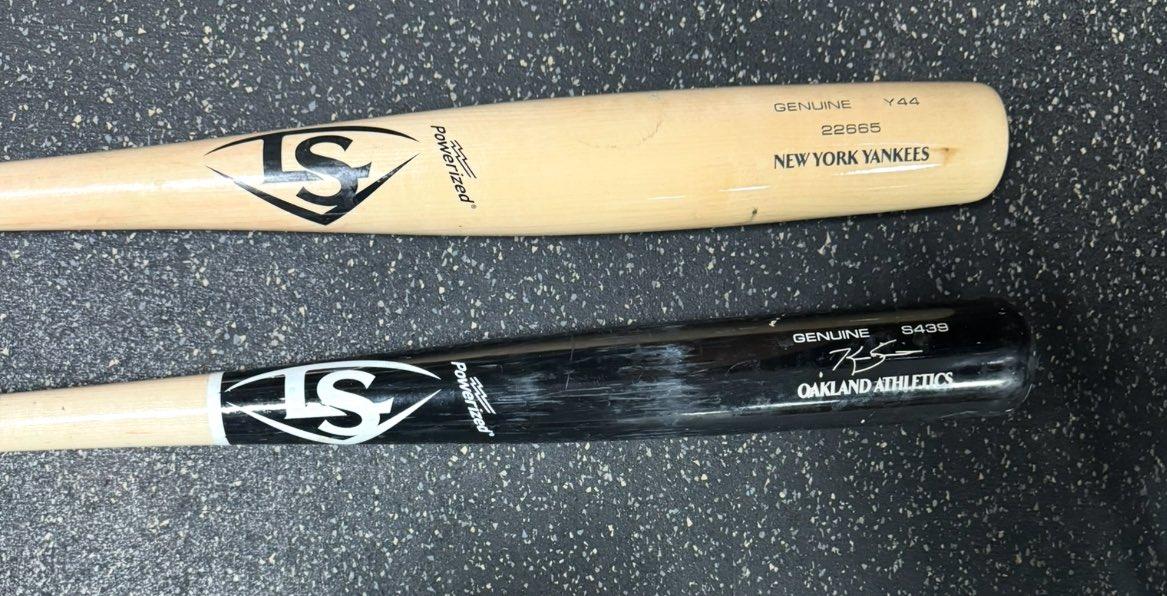
The New York Yankees set a franchise record with nine home runs in a single game Saturday, March 28, as they pounded the Milwaukee Brewers 20-9 at Yankee Stadium. In fact, the Bronx Bombers hit 15 home runs in the three-game sweep of the Brewers.
How did the Yankees come up with so many long balls to start the season? Beyond talent, the team had a little weapon on their side. A specially designed bat dubbed the torpedo bat because of its shape that resembles a torpedo. It is a way of redistributing the weight of a bat to give the hitter a better chance to hit the ball on the "sweet spot."
Each player has a sweet spot, the area of the bat that the player is more prone to hit the ball. The Yankees analytics department looked at every player’s hitting data so that the widest part of the bat – or the barrel – could be placed where they most often hit the ball.
According to MLB.com, for shortstop Anthony Volpe that meant moving the barrel closer to the label on his bat, according to YES Network commentator Michael Kay. Volpe’s teammates Jazz Chisholm Jr., Cody Bellinger, Paul Goldschmidt and Austin Wells were also swinging torpedo bats this weekend.
Developed by MIT physicist Aaron “Lenny” Leanhardt when he was an analyst in the Yankees organization, “It’s just about making the bat as heavy and as fat as possible in the area where you’re trying to do damage on the baseball,” Leanhardt told the Athletic.
“It’s just through those conversations where you think to yourself, ‘Why don’t we exchange how much wood we’re putting on the tip versus how much we’re putting in the sweet spot?’


Have something to say? Share your thoughts with us in the comments below.