

DUBLIN — The "Wood and Timber Products Market Global Report by Application, Country & Company Analysis | Forecasts 2025-2033" has been added to ResearchAndMarkets.com's offering.
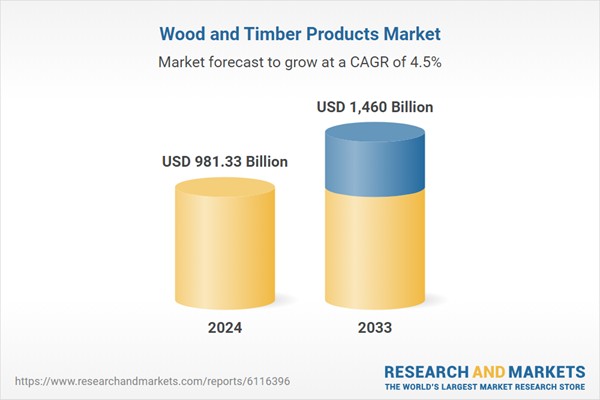
The Wood and Timber Products Market is expected to reach $ 1.46 trillion by 2033 from $ 981.33 billion in 2024, with a CAGR of 4.54% from 2025 to 2033. The market for wood and timber products is anticipated to expand gradually due to rising demand from the furniture, packaging, and construction industries as well as growing awareness of renewable and sustainable building materials.
Ket factors driving the market include:
- Growing demain the construction industry.
Construction projects involving homes, businesses, and industries all depend on wood and timber supplies. Global infrastructure investment and urbanization are driving up demand for structural timber, plywood, and engineered wood. Wood is used by builders because of its easy installation, visual attractiveness, and thermal insulation qualities. Furthermore, the use of wood in mid-rise and high-rise buildings is growing due to contemporary construction techniques like cross-laminated timber (CLT) and modular building systems. Timber is also favored by sustainability movements in design as a low-carbon substitute for steel and concrete. One of the main drivers of growth is the building industry's high demand, particularly in areas with a growing population and housing crisis.
- Technology advances in wood processing.
The performance and usefulness of timber products have been greatly increased by advancements in wood processing. Cross-laminated timber (CLT), oriented strand board (OSB), and laminated veneer lumber (LVL) are examples of engineered wood that provides improved strength, stability, and moisture resistance. Timber may now be used for more intricate structural applications, such as commercial structures and industrial installations, thanks to these advancements. Digital production equipment, precise cutting, and automated sawmilling are also increasing product quality and decreasing waste. The lifespan of products is also being extended by new treatments for weather endurance, insect management, and fire resistance. Wood products are becoming more competitive as a result of these technological advancements, increasing their market share in production, design, and building.
Growing priority in eco-friendly and sustainable matierials.
Wood is becoming more and more popular as a sustainable material as environmental responsibility and climate change awareness grow. Timber is renewable, biodegradable, and, when harvested sustainably, has a lower carbon footprint than metal and plastic. Green construction standards, which frequently encourage the use of certified wood products, are being adopted by governments, businesses, and consumers more frequently. Eco-labels and forest stewardship certificates increase market credibility by guaranteeing ethical sources. To achieve sustainability goals, companies are substituting wood for synthetic materials in industries like interior design, furniture, and packaging. The market for wood products is still being driven by the global trend toward eco-friendly materials in a variety of industries.
Challenges in the market include:
- Regulations concerning deforestation.
Deforestation and the ensuing environmental issues are among the main issues confronting the market for wood and timber products. Because unsustainable logging techniques can result in soil erosion, biodiversity loss, and climate change effects, governments and non-governmental organizations are enforcing stronger forestry rules. Adherence to environmental regulations necessitates meticulous monitoring of timber origins, frequently entailing expensive and time-consuming certification and auditing procedures. Grey-market imports and illegal deforestation further skew market pricing and jeopardize sustainability initiatives. Businesses need to make investments in legally compliant, traceable, and ecologically conscious supply chains as regulatory constraints increase. Not meeting these requirements can harm a brand's reputation and restrict its access to markets, particularly in areas where environmental concerns are prevalent.
- Price and raw material supply.
A number of variables, such as weather patterns, shifts in forest policies, labor shortages, and geopolitical tensions, affect the cost and availability of raw timber. Supply chains can be significantly impacted by natural disasters like wildfires, floods, and pest outbreaks, which can result in shortages and price increases. Disruptions can result in delays and increased production costs because the processing of wood is highly dependent on a steady supply of raw materials. Additionally, price fluctuation makes it challenging for businesses to acquire reliable contracts and plan long-term investments. Businesses need to diversify their sourcing strategy, create buffer inventories, and implement more adaptable procurement procedures in order to reduce these risks. However, industry stakeholders continue to face difficulties in controlling supply chain volatility.
To learn more, visit researchandmarkets.com/reports/6116396.





Have something to say? Share your thoughts with us in the comments below.