

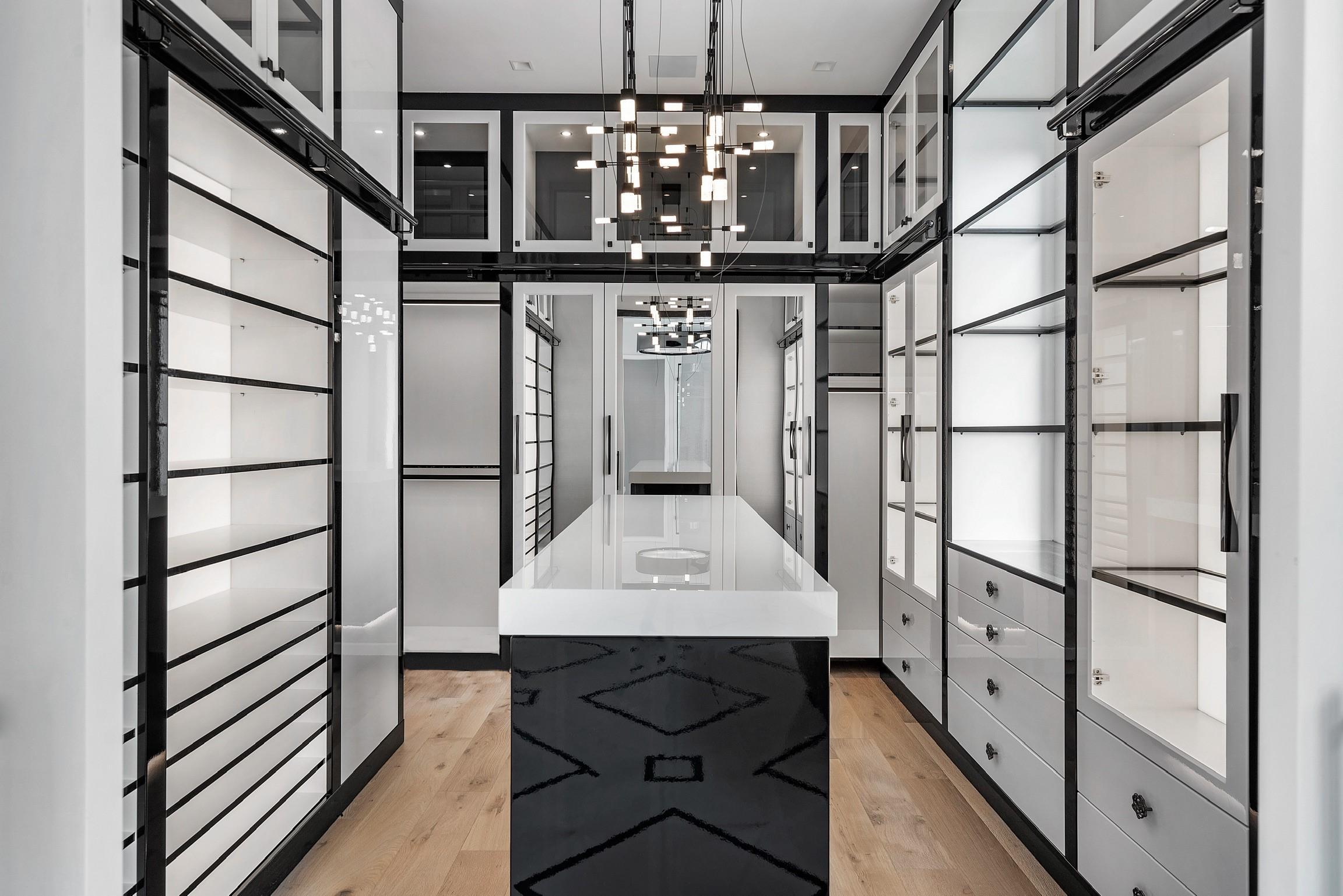
While alternative materials like laminate surfaces have long been the standard in closet design, a significant opportunity exists to elevate these spaces with stone’s timeless beauty and durability. As clients increasingly seek high-end, custom looks throughout their homes, incorporating natural stone countertops and surfaces in closets offers a way to elevate and differentiate projects and deliver that coveted “wow factor.”
Denise Butchko, Trade Account Manager at Precision Stone Design and NKBA President for the Chicago Midwest Chapter, sees immense potential here. “What I think the opportunity is to really amp up a closet is by figuring out a way to bring in stone, ideally a natural stone,” she suggests. She emphasizes “the idea that you can take a closet and elevate it up five or 10 notches by using stone instead of … Formica, or a white melamine shelf”. This move enhances the aesthetic and can lead to better project photos, prestigious awards, and ultimately, bigger jobs down the line. “When you see that it’s actual stone, it just changes the whole look.”
Navigating the stone landscape
A common point of confusion for designers and clients alike is the difference between quartz and quartzite. Understanding the distinction is crucial: “quartz is a manufactured product made by man, and quartzite is a natural stone that comes from the earth, Mother Nature,” explains Butchko. Quartz, while popular, “is a manufactured stone... It has resins in it that can yellow”. Butchko elaborates, stating quartz “will yellow from heat. If you have an air fryer sitting on it, it can yellow it”. Also, health concerns surrounding silica dust generated during fabrication have led to bans or restrictions in some regions.
Quartzite, on the other hand, is a natural metamorphic rock. “Quartzites are actually some of the most durable, indoor, outdoor, hard, gorgeous stones,” says Butchko. She adds, “For durability and beauty, quartzite, to me, that’s the only stone I would ever use if I had to only pick one.”
Beyond quartzite, other natural stones offer compelling options. Marble brings elegance, and while potentially more porous than other stones, it’s viable in a closet setting, especially as a remnant. Granite remains a durable choice. Porcelain, though extremely durable, often carries a higher price tag due to complex fabrication.
Sustainability and trends
Sustainability is becoming increasingly important for many manufacturers and within the architecture and design community, and natural stones hold an advantage. While acknowledging she isn’t “bad mouthing quartz,” Butchko points out a practical issue: “if somebody tears out 30 floors of quartz, it goes in a landfill. There’s not a way to recycle it”. In contrast, natural stones like “quartzite, marble, granite, can all be re-purposed... They can be turned into different products... So, there’s recyclability with the natural stone,” which resonates with environmentally conscious clients.
While quartz remains prevalent, interest in natural materials is growing. Another trend is creating seamless indoor-outdoor transitions using matching stones specifically rated for each environment.
Cost and collaboration
The perception of stone as costly can be a barrier. However, closets often require smaller surfaces. Butchko advises, “With space in closets, it’s not as though we have to have slab after slab after slab, so you can get a gorgeous remnant.” Using remnants significantly reduces costs.
Another strategy is finding the right fabricator. Butchko suggests finding “a local fabricator who will sell on square foot pricing” for materials in stock. “So instead of you having to buy a whole slab of material... you can go in with the drawings, and we’ll sell you what you need based on your job, because we have the material in stock,” she explains. Building relationships is crucial. “Find reputable fabricators, you know, go tour their factory, their showrooms, get that experience,” Butchko urges. These professionals handle the specialized installation. “It’s going to be installed by the fabricator... it’s absolutely the fabricator,” she confirms. Be aware that some fabricators might deem small jobs unprofitable, but many value designer relationships and may work with remnants or stocked materials.
Butchko encourages designers to take the leap, even if profits on the stone itself aren’t immediate. “Don’t be so concerned that you make money on the stone, particularly the first or second time that you’re doing it,” she advises. She contrasts the potential minimal profit lost on a melamine top with gaining a “gorgeous, amped up space.” The long-term benefits – “this gorgeous closet, the homeowner is going to talk about it more. You’re going to get photos” – often “way outweigh” the initial cost considerations. By understanding materials, leveraging cost-effective sourcing, and collaborating with skilled fabricators, designers can successfully integrate the luxury and lasting appeal of stone into their closet projects.
More at precisionstonedesignil.com.





Have something to say? Share your thoughts with us in the comments below.