


VANCOUVER, B.C. — West Fraser Timber Co. Ltd. reported a loss of more than three-quarters of a billion dollars in its 2025 fourth quarter results released Feb. 11. The company notes elevated softwood lumber duties and tariffs, southern yellow pine lumber and OSB oversupply, and tempered demand for many wood-based building products as a reflection of these results.
Q4 highlights:
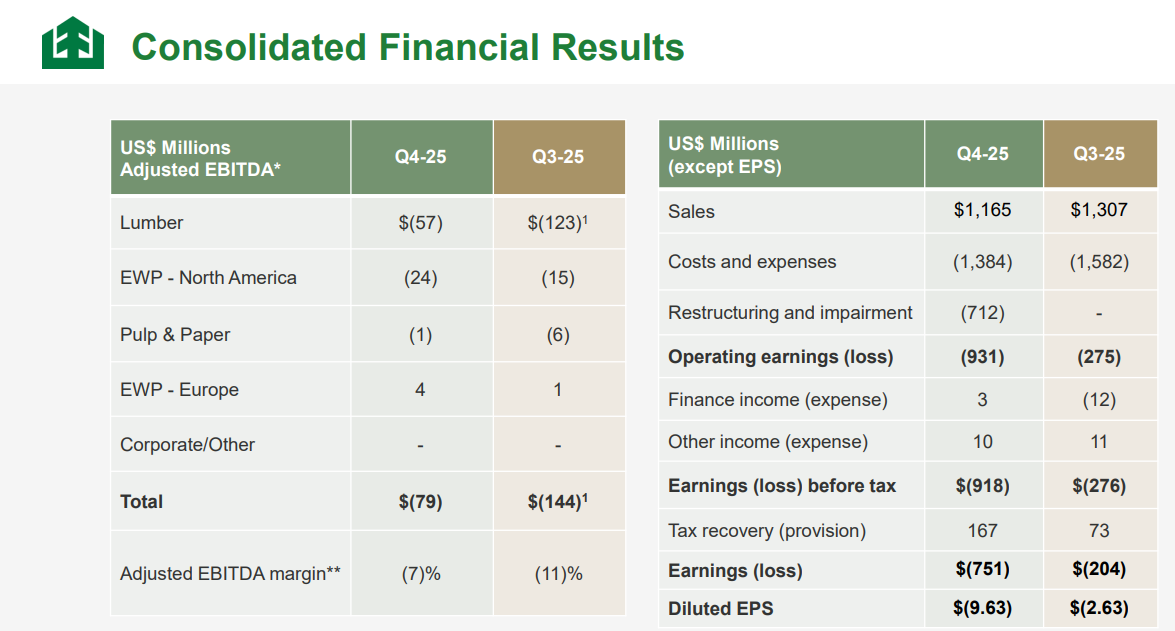
- Sales of $1.165 billion, but an earnings loss of $751 million (USD), or $9.63 per diluted share.
- Pre-tax earnings included $712 million of restructuring and impairment charges.
- Adjusted EBITDA of $(79) million, representing (7%) of sales.
- Lumber segment Adjusted EBITDA of $(57) million, excluding $473 million of restructuring and impairment charges.
- North America Engineered Wood Products ("NA EWP") segment Adjusted EBITDA of $(24) million, excluding $239 million of restructuring and impairment charges.
- Pulp & Paper segment Adjusted EBITDA of $(1) million.
- Europe Engineered Wood Products ("Europe EWP") segment Adjusted EBITDA of $4 million.
- Repurchased 108,079 shares for aggregate consideration of $7 million.
Annual highlights:
- Sales of $5.462 billion and earnings of $(937) million, or $(12.08) per diluted share.
- Pre-tax earnings included $712 million of restructuring and impairment charges.
- Adjusted EBITDA of $56 million, representing 1% of sales.
- Lumber segment Adjusted EBITDA of $(100) million, including $67 million of export duty expense attributable to the finalization of AR6 but excluding $473 million of restructuring and impairment charges.
- North America Engineered Wood Products ("NA EWP") segment Adjusted EBITDA of $153 million, excluding $239 million of restructuring and impairment charges.
- Pulp & Paper segment Adjusted EBITDA of $(2) million.
- Europe Engineered Wood Products ("Europe EWP") segment Adjusted EBITDA of $5 million.
- Repurchased 1,639,207 shares for aggregate consideration of $124 million.
"The fourth quarter of 2025 was another challenging period for West Fraser, marked by elevated softwood lumber duties and tariffs, southern yellow pine lumber and OSB oversupply, and tempered demand for many of our wood-based building products, much of which can be attributed to housing affordability constraints that have continued into early 2026. Notwithstanding this environment, we made great advances with some of our major capital investments that will improve both our cost profile and our operating flexibility, completing construction and starting-up our modernized lumber mill in Henderson, Texas, and effectively completing the ramp-up of our large-scale OSB mill in Allendale, South Carolina. We did have to make some difficult decisions late in the year with announced closures or curtailments of uneconomic lumber and OSB mills, but these decisions were made to size our portfolio to our customers' demand and with a view to make the Company stronger and better positioned for the future," said Sean McLaren, West Fraser's president and CEO. "We are steadfast in our strategy and will continue to take the necessary steps to ensure our operations remain safe places to work, flexible, and able to effectively serve our customers while controlling costs. We will continue to evaluate strategic investments and follow a balanced capital allocation strategy that allows us to grow while maintaining robust liquidity, increasing through-cycle resilience and creating long-term shareholder value."
Results summary:
Fourth quarter sales were $1.165 billion, compared to $1.307 billion in the third quarter of 2025. Fourth quarter earnings were $(751) million, or $(9.63) per diluted share, compared to earnings of $(204) million, or $(2.63) per diluted share in the third quarter of 2025. Fourth quarter Adjusted EBITDA was $(79) million compared to $(144) million in the third quarter of 2025.
Full year sales were $5.462 billion, compared to $6.174 billion in 2024. Full year earnings were $(937) million, or $(12.08) per diluted share, compared to earnings of $(5) million, or $(0.07) per diluted share in 2024. Full year Adjusted EBITDA was $56 million compared to $673 million in 2024.
Outlook
Markets
Several key trends that have served as positive drivers in recent years are expected to continue to support medium and longer-term demand for new home construction in North America.
The most significant uses for North American lumber, OSB and engineered wood panel products are residential construction, repair and remodeling and industrial applications. Over the medium term, improved housing affordability from the stabilization of inflation and interest rates, a large cohort of the population approaching the typical home buying stage, and an aging U.S. housing stock are expected to drive new home construction and repair and renovation spending that supports lumber, plywood and OSB demand. Over the longer term, growing market penetration of mass timber in industrial and commercial applications is also expected to become a more significant source of demand growth for wood building products in North America.
Operations
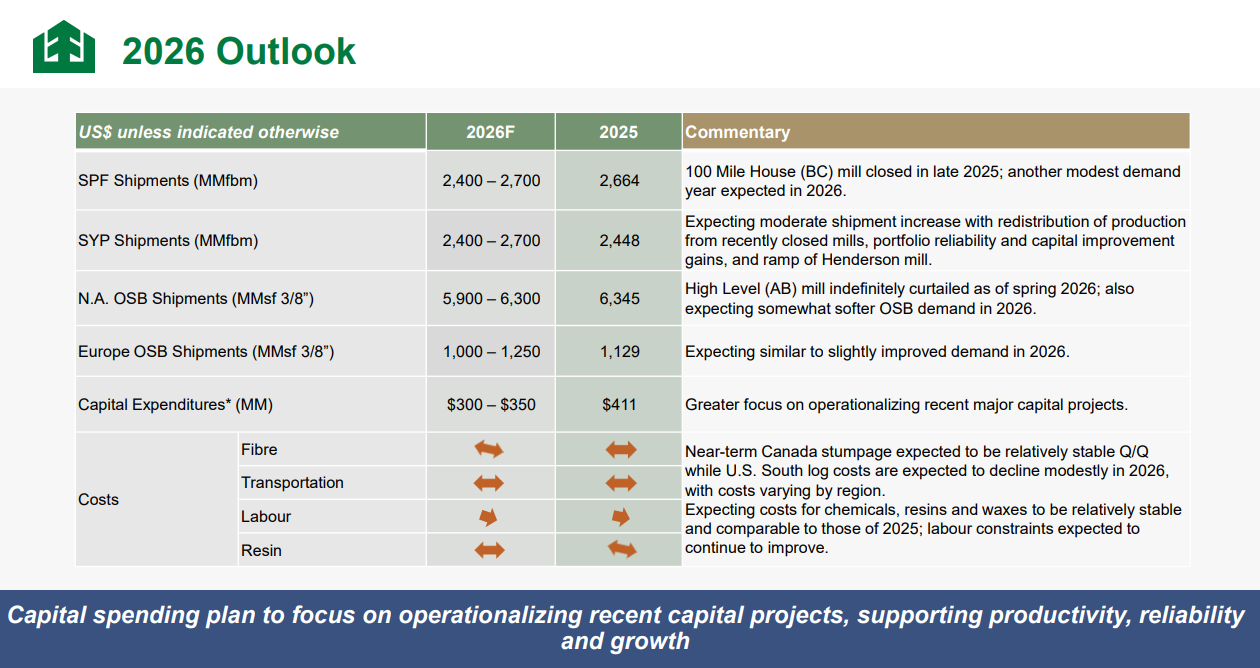
The Lumber segment is expected to experience another year of modest demand in 2026, as unknowns persist related to the potential demand impacts from new tariffs imposed by the U.S. administration late in 2025 as well as persistent housing affordability challenges. Based on the current environment, the sawmill closures announced in 2025, plus offsets from ongoing reliability and capital improvement gains across lumber mill portfolios and the ramp up of the modernized Henderson mill, the company is reiterating each of our SPF and SYP shipments targets to be 2.4 to 2.7 billion board feet in 2026.
To read the full report, visit westfraser.com.



Have something to say? Share your thoughts with us in the comments below.