

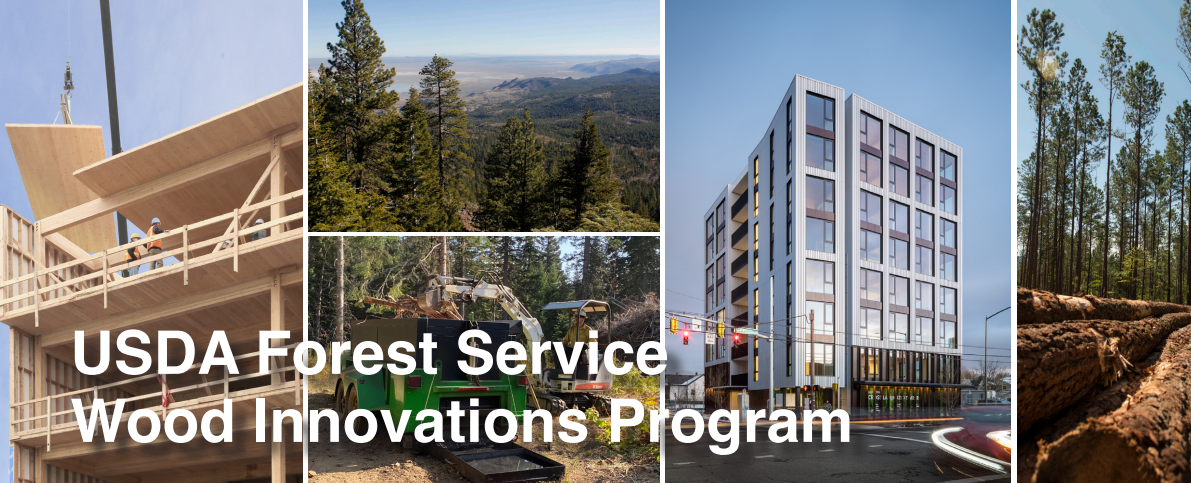
WASHINGTON — The U.S. Department of Agriculture’s Forest Service is making up to $34 million in funding available to support innovation and jobs in the forestry sector while supporting healthy forest landscapes.
Funded by the Bipartisan Infrastructure Law and Inflation Reduction Act, the Forest Service offers three grant programs to support the forest products economy: Wood Innovations Grant, Community Wood Grant, and Wood Products Infrastructure Assistance Grant Programs.
“Sustainably sourcing wood to manufacture products makes our forests healthier and our communities more vibrant,” said Agriculture Secretary Tom Vilsack. “Thanks to the Biden-Harris Administration’s Investing in America agenda, we’re making even greater investments in the wood products economy and supporting sustainable forest management, which in turn creates jobs in rural areas.”
The $34 million comes on the heels of the distribution in May of nearly $74 million to fund 171 project proposals across 41 States and American Samoa that were determined to support forest health and the wood products economy. The Forest Service has provided nearly $190 million to 482 projects across the country since 2021. Over $618 million was matched or leveraged from applicants for a total investment of $808 million. These projects also help address the nationwide challenge of reducing the risk of catastrophic wildfires, disease, and infestations by retaining or expanding markets for sustainably sourced wood.

The agency is seeking proposals that support innovative uses of sustainably sourced wood in construction, as a renewable energy source, and in manufactured and processed products. These programs also provide direct support to expand and retrofit wood energy systems and wood products manufacturing facilities nationwide.
The three programs are the Wood Innovations Grant (WIG), Community Wood and the Wood Products Infrastructure Assistance Grant programs. The first two are authorized by the Farm Bill, while the latter was enacted as part of the Infrastructure Investment and Jobs Act (IIJA).
The Wood Innovation Grants Program, launched in 2015, stimulates, expands, and supports U.S. wood products markets and wood energy markets to support the long-term management of National Forest System and other forest lands. National focus areas include mass timber, renewable wood energy, and technological development that supports hazardous fuel reduction and sustainable forest management. The deadline to apply for financial assistance is 5:00 p.m. local time on December 11, 2024. For an application, click here. Contact Collin Buntrock at [email protected] for more information.
The Community Wood Grant Program, launched in 2020, provides funding for grants to install thermally led community wood energy systems or to build innovative wood product manufacturing facilities. The deadline to apply for financial assistance is 5:00 p.m. local time on December 18, 2024. For an application, click here. Contact Sabina Dhungana at [email protected] for more information.
The Wood Products Infrastructure Assistance provides funding may be used to provide support for facilities that purchase and process byproducts of ecosystem restoration projects. This includes applications to establish, reopen, retrofit, expand, or improve a sawmill or other wood-processing facility in close proximity to federal or Indian lands that need ecosystem restoration and will generate byproducts. The deadline to apply for financial assistance is 5:00 p.m. local time on December 18, 2024. Contact Adam Smith [email protected] for more information. For an application, click here.
The Forest Service is requesting proposals from eligible entities in the private, non-profit, and government sectors including tribes, local and state governments, businesses and for-profit entities, institutions of higher education, as well as public utility, fire, conservation, and school districts, among others.
These investments in the sustainable wood products industry will support forest management projects to improve forest health and reduce wildfire risk. Byproducts from forest management, like small-diameter timber and woody biomass, have historically had little market value. Thanks in part to these Forest Service grant programs, funding is available to support and explore the use of these materials in many types of existing and future commercially viable wood products.
Businesses that are engaged in or support the forest products economy are eligible to apply for funding to expand manufacturing capacity to process wood materials with zero or no commercial value. These businesses are vital employers in local communities, especially in tribal or rural communities.
The investments will also support the Forest Service’s 10-year strategy to address the wildfire crisis in the places where it poses the most immediate threats to communities. The agency is investing in projects that source wood from activities that reduce risks to communities, like prescribed fire and mechanical thinning to reduce the vegetation that fuels wildfires.


Have something to say? Share your thoughts with us in the comments below.